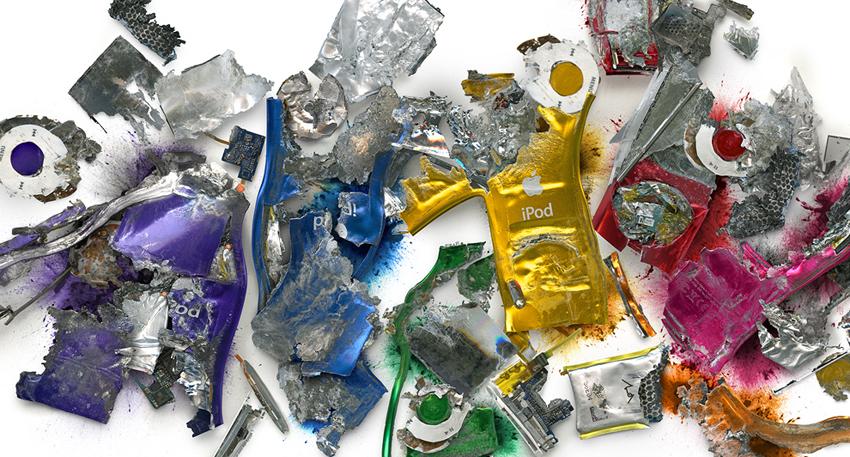
“Why does everyone pick on Apple products?”
This was an implied question I got from @Scionwest on Twitter recently. In light of last week’s column on the new iPad overheating, I thought it was a fair observation: We clearly have had laptops that seemed to get hotter than the iPad 3, and we sure didn’t pound on them as hard.
Part of that is likely because you don’t typically hold a laptop. But there are other examples of Apple catching an especially hard break, like Antenna Gate. The same issue existed in other products at the time, yet generally didn’t get much ink. Why?
It’s a downside to Apple’s homogenous product line.
It’s ironic when you look back at Apple’s iconic 1984 ad that the company has stopped being the rebel and is now even more consistent than IBM, the company it was making fun of in the original ad. It also showcases that the one-time IBM model, now Apple model, works.
Every strategy has advantages and disadvantages, but often we look at one or the other and don’t contrast them. The disadvantages can range from opportunity costs (what was not done in order to do what was done), to outright problems with the strategy. For instance, the advantage of speeding is you get where you are going quicker; the disadvantages include higher chances of a ticket, accident, fatality, and insurance cost risks. But I’ll bet none of us, including me, think through those when we put the pedal to the metal.
So let’s talk about the advantages and disadvantages to Apple’s simplified line model.
The simplified lineup
When compared to other computer and consumer-electronics companies, Apple is more successful, but its product lines look downright anemic. At the start of Apple’s recovery, there was just one iPod. Then different capacities came out. Then different sizes and colors.
The iPod line was more of an exception, because with the iPhone you can only choose capacity, and with the iPad, capacity and connectivity. Both just come in black and white. The core components, processor, screen, case, battery and other essential parts don’t change. The same goes for Macs: Apple basically offers two laptop designs and three desktop designs.
The advantages of keeping it simple
Operating this way allows Apple to focus. It can put more into design, more into marketing, and maintain a higher level of connection with its brand and hardware ID. In addition, its repair, stocking, returns, and sales incentives are simpler and cheaper. Finally, there is less customer confusion. Nobody is confused between buying an iPhone against an iPad. Within Apple, only the iPod line presents any opportunity for product confusion, and even there it is likely minimal.
Go to buy an Android phone and you have plenty of choices, but which one is the right one? Sometimes Apple is simply the easier decision to make.
The pitfalls of no choice
When something goes wrong with this approach, problems are magnified.
If Dell or HP has a problem with one of its PCs, it might affect a few thousand people. If the something goes wrong with a laptop, they can simply push buyers to another model. If Samsung has an issue with one of its phones, it can simply just push you to another phone. In any case, because the lines are so diverse, one problem seldom touches a company’s entire customer base.
When an Apple product has a problem, it touches all buyers of the line in most cases. You might opt to buy the older model (for instance, given the new iPad’s problems, I’m recommending the iPad 2), but for Apple, pushing the older product would look like a failure. It can’t support that strategy publically. The iPhone 3G truly sucked, but did Apple push folks to the older model? No. Apple always has to ride through or cover up the problem, because it doesn’t have the option of pushing people to another product – it doesn’t have another viable product to push them to.
 Image courtesy of Consumer Reports
That’s why Apple is generally slow to admit problems, and you get what looks like a company in denial while engineers frantically work on the issue. Recall that Apple never publicly fessed up to the problems with MobileMe, but fired the team that created it and replaced it with iCloud. Steve Jobs downplayed Antenna Gate as much as possible, but Papermaster got fired for it, Apple had to go to IBM for a fix, and the subsequent iPhone 4S featured a complete (hardware) redesign, suggesting there were likely other problems with the iPhone 4 we didn’t catch.
Skip the iPad 3
From Apple’s standpoint, the simplified product lineup is working — just look at the company’s bottom line. But once you understand the shortcomings (the company has to cover up problems while it fixes them) consumers might want to adopt a different strategy for buying Apple products: Don’t be the first to buy, and skip products that appear to have a critical or unusual number of problems.
Look at the iPad 3. Like the iPhone 3G, iPhone 4, chubby iPod, and tiny iPod Shuffle, it has some critical issues. It runs hot (Consumer Reports has now been corroborated by other reviewers, which means we should anticipate early battery fatigue and other internal problems over time), takes twice as long to charge, is heavier than the last model, LTE isn’t available in many places (Australia just forced a refund, and parts of Europe appear to be ramping up to do the same), and in a constrained data market it consumes a ton of it (folks are burning through their monthly data plans in days). This last point is like bringing out a Hummer during a gas shortage. If you think about it, had anyone else brought out a product with this many issues, it wouldn’t have sold. That either speaks to the power of Apple marketing, or our own gullibility. Maybe both.
I expect the fourth-generation iPad to run cooler, be lighter, still have the same display, use data compression and upscaling to get around the data problem, arrive in a world with more LTE, and likely have Gorilla Glass (I’m throwing that in because products without it are breaking a lot, and Apple helped invent it). Engineers might also try to get the battery to charge more quickly, but that’s a tough problem.
When Apple has a bad product, it typically fixes the problems in the following product, which is the one to buy. It reminds me of the “buy the third generation” rule we used to use with Microsoft.
Game the system
Apple has clearly selected a selling strategy that works best for its bottom line. Once you learn it, you can adopt a buying strategy that works best for your bottom line. By waiting to jump on the latest products, you can buy smarter, navigate through the problems with Apple’s strategy, and more reliably pick the best products over a period of time. The iPad 2 was the high point in the iPad line, as is the iPhone 4S, and both are still on the market.
Just like, as an adult, you don’t have to eat everything on your plate, you don’t have to buy every Apple product. You really don’t.
Guest contributor Rob Enderle is the founder and principal analyst for the Enderle Group, and one of the most frequently quoted tech pundits in the world. Opinion pieces denote the opinions of the author, and do not necessarily represent the views of Digital Trends.
Editors' Recommendations
- The best productivity apps for Android and iOS
- Apple’s manufacturing is back on track, but will there be demand for iPhones?
- AirPods, iPhones, and Apple Watches could jump in price due to the trade war