  1. Home
  2. Emerging Tech
  3. Legacy Archives

Honda’s newest Asimo robot can walk faster, hear you better, and knows sign language

Add as a preferred source on Google

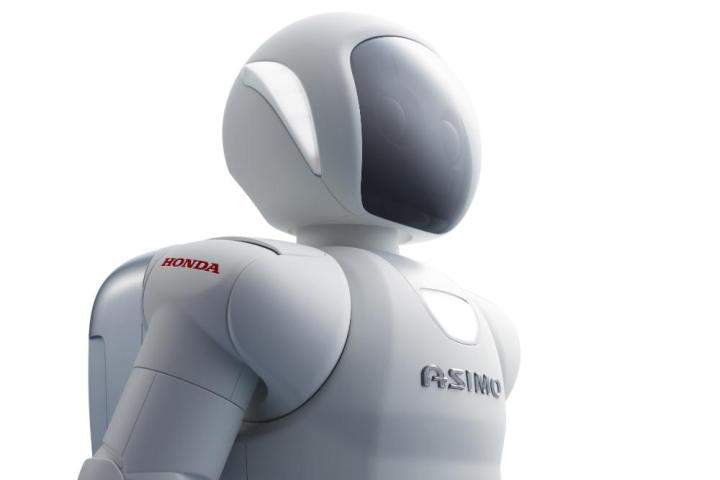
The latest version of Asimo turned up in Belgium on Wednesday, giving European robot enthusiasts their first up-close look at Honda’s advanced life-like bot.

Watching Asimo walk and run with such effortless grace and ease, it’s hard not to imagine the Honda chairman himself inside, pulling all the moves. It’s certainly a far cry from its hopeless but hilarious attempt at climbing stairs back in 2007.

Recommended Videos

Apparently, though, Asimo’s for real, a marvel of Japanese engineering that’s been improving markedly with every iteration over its 14-year lifespan.asimo robot

The 4.2-foot-tall humanoid was last taken into the engineers’ tool shed for a major makeover a couple of years ago when it was given a speed boost (to 5.6 mph from 3.7 mph) as well as a more graceful running style. The bot was also fitted with technology to recognize different voices speaking at the same time and respond to different instructions given by each person.

The further-refined, all-new Asimo can also cope better with rough terrain, while enhanced dexterity allows it to communicate via sign language and perform tasks such as taking the lid off a bottle and pouring a drink (without spilling it all over the place, thankfully).

“Previous generations of Asimo have demonstrated incredible fluidity and speed of movements,” Satoshi Shigemi, chief engineer of the Asimo project, said during a demonstration this week in Brussels, Belgium. “The all-new Asimo takes this mobility, task performing ability and interaction with people to the next level and moves Honda one step closer to its ultimate goal of developing a robot that can be a helper to people in need.”

In other words, Asimo, which stands for Advanced Step in Innovative Mobility, could one day find itself carrying out duties in places like homes for the elderly, or assisting the disabled with various tasks.

While it might seem like a cool idea to also have Asimo pottering around your home — answering the door to visitors, relaying alerts and notifications, and unblocking the toilet — such a reality could be many years away. For something close to that, you’re best off laying down $500 for Jibo.

[Source: HondaYahoo]

Trevor Mogg
Contributing Editor
Not so many moons ago, Trevor moved from one tea-loving island nation that drives on the left (Britain) to another (Japan)…
Students who use AI every day may be falling behind, while moderate users pull ahead
New global testing data suggests more AI in the classroom isn't automatically better.
Logo, Text

I assumed more AI access might help students learn faster. However, a new OECD study dispels that misconception for me and everyone else who gave their children a paid version of AI chatbots, thinking it would help them through their educational journey. 

According to PISA 2025 data from 760,000 students in 91 countries, students who use AI daily score meaningfully worse on standardized tests than their peers. The full picture is more complicated than a simple ban would fix.

Read more
XPENG just put its humanoid robot on the production line, and it walked itself out
IRON clocks in for its first shift
XPENG Iron

XPENG’s humanoid robot has officially joined the workforce, and it even got an employee badge. The Chinese automaker announced on September 8 that its next-generation IRON had completed assembly and autonomously walked off its newly commissioned humanoid robot production line in Guangzhou.

CEO He Xiaopeng then pinned a staff badge onto the robot, symbolically welcoming it to the XPENG team. It is a charming little ceremony for a machine that the company hopes will eventually become a regular part of everyday life. XPENG is moving IRON beyond R&D prototypes toward production-line manufacturing, applying the quality-control systems and manufacturing experience it has developed through its electric vehicle business.

Read more
An AI-designed drug might help slow aging, but we’re not there yet
The results hint at a possible anti-aging effect, but there’s still a long way to go before we know what it means.
medical test tubes

Rentosertib, a drug Insilico Medicine designed almost entirely using AI, was created to treat idiopathic pulmonary fibrosis, a disease that scars and stiffens the lungs over time. But fighting lung disease was only half the plan from the start.

According to a new study published in Nature Biotechnology, the drug's target was chosen specifically because it overlaps heavily with the biology of aging, and the whole trial was designed to test whether treating the lungs could also mean turning back the body's biological clock.

Read more