
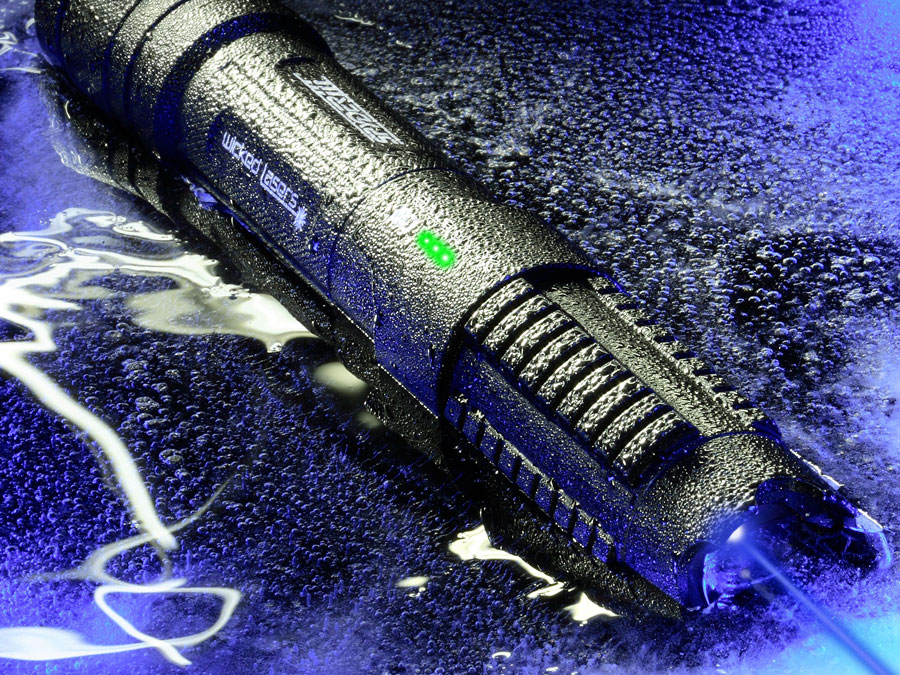
Sometimes life is bewildering enough that fiction just gets in the way. A while back, we reported on a hand-held laser (not just any laser) which is the most powerful portable laser that the average user can buy. Assuming there is an “average” user for an overpowered laser capable of burning things. It was a laser for home use that could actually burn clothing, might give you cancer, and could possibly make your retinas explode. Basically it was a very early prototype death ray, and it just happened to look almost exactly like a lightsaber.
Well, apparently George Lucas, best known for creating the cult hit Star Wars (you may have heard of it) did not take too kindly to the company Wicked Lasers producing a beam that the military would balk at using because it might actually violate the Geneva Convention (the blinding people part), and then having either the gall (or the marketing savvy depending on your point of view) to make it look like a lightsaber.
Lucasfilms Ltd., which has never been known for its sense of humor when it comes to its properties (see Lucasfilms versus Digg.com over similarities to the game titled “The Dig, Lucasfilms versus Dr. Dre over a note that sounded like the THX sound test, Lucasfilms versus Reagan’s missile defense system “Star Wars”, etc., etc.), sent a cease-and-desist letter to Wicked Lasers, claiming that the public was led to believe that Wicked Lasers was selling a product that had more than a passing similarity to their copyrighted lightsabers, at least in terms of looks, if not function. While the laser might be the most powerful portable laser ever made, it is unlikely to be able to deflect bullets, or cut metal frames in two (yet).
The true problem was not even with Wicked Lasers, who were happy to simply promote their laser that is capable of producing a beam 1000 times more powerful than sunlight while looking around with a puzzled “wha’ happened” attitude towards the legal action, but rather with the way the media portrayed the S3 Spyder Arctic. The letter to Wicked Lasers, which was obtained by CNN, cited several news headlines, including one from Gizmodo that read “a real life lightsaber”. Another from Daily Tech article said that the S3 Sypder Arctic “looks, unsurprisingly like a lightsaber”. Digital Trends was not mentioned. Not that we care, or anything. No big deal. We didn’t want to be mentioned by Lucasfilms anyway…
In response, Wicked Lasers, a company with less than 3,000 friends on Facebook, decided not to test the legendary creator of Jar Jar Binks, and sent a series of mea culpa letters claiming they had never intended the laser to be marketed as such, and that the laser was not a toy. Even though it does kind of looks like a toy. But hey, it ships with a pair of safety goggles, and they added a new safety switch which should totally stop any potential misuse of the laser, just like when laser pointers came out and everyone everywhere respectfully declined from taking them into movie theaters, class rooms, and making animals nearly die from exhaustion as they sadly chased the red dot in the futile hopes of catching something awesome.
After a healthy dose of groveling in the press, Lucasfilms magnanimously declared that it was pleased with Wicked Lasers, and will withdraw the imperial lawyers.
“We are aware that, during this time you have made several statements to the media insisting that your product is not intended to resemble a lightsaber and is not marketed by your company as either a lightsaber or as having any connection with ‘Star Wars’ or Lucasfilm,” the Lucasfilm lawyers said in a letter to Wicked Lasers that was obtained by CNN.
So peace has now been restored to the galaxy- or at least to Wicked Lasers, who celebrated by raising the price of the laser from $199 to $299, because they could. The totally non-Star Wars-ish looking laser that legally no longer resembles a lightsaber in anyway (that could cause a lawsuit) has mostly been selling to researchers and industrial customers, according to Wicked Lasers, but the company did admit to a spike in “hobbyists”. It was unclear if by “hobbyists”, they meant idiots that want to own a ridiculously powerful laser capable of blinding people and giving them skin cancer.
The lasers themselves are simply tools like many others. Dangerous tools perhaps, but no more so than most power tools. But how many practical, home-based applications can there be for a laser that warns people to under no circumstances point it at the cockpit of a commercial jetliner because you could end up on the news in a very bad way.
So rejoice, laser fans, you can now purchase a wildly over powered laser for your home so you can run physics experiments and stuff, or whatever. After all, despite the humor of the hyperbole in this article, the laser isn’t really powerful enough to actually burn you unless you tried really hard, and it could only catch clothing on fire after several seconds. The cancer thing is kind of hard to justify, but as long as you don’t look directly into the beam, or see a direct reflection, or get too close to it, you probably won’t go blind. So have fun!


