  1. Home
  2. Emerging Tech
  3. Legacy Archives

Wi-Fi enabled tooth sensor tracks your eating and smoking habits

Add as a preferred source on Google
tooth-sensor
Image used with permission by copyright holder

Published within a study conducted by researchers at the National Taiwan University, the team created a sensor designed to be embedded in your mouth in order to track and hopefully curtail bad habits like smoking or overeating. With an accuracy of nearly 94 percent in the current prototype, the sensor can differentiate between eating, speaking, coughing, smoking, drinking and breathing. All of this data is collected and can be sent to your medical professional in order to provide a more accurate history of your daily habits, both negative and positive.
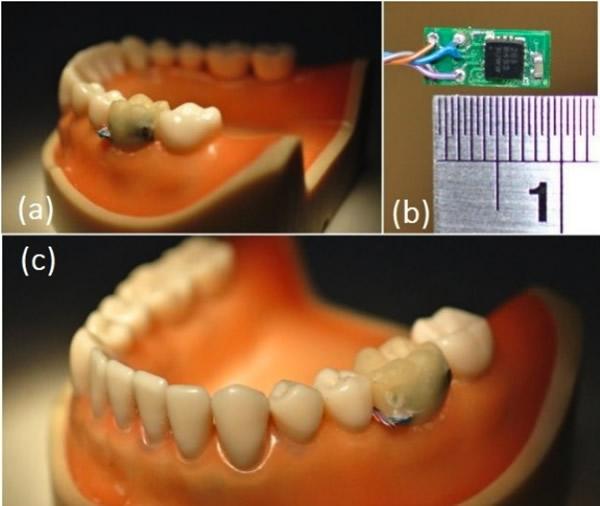
tooth-sensor-sizeWhile the current prototype currently uses an external wire for power, the team is looking into creating a version that uses an internal battery. At this point, the tiny circuit can be fitted between two teeth or mounted on oral hardware like dentures or braces.

Recommended Videos

However, the mount would have to be extremely secure in order to avoid the possibility of it becoming loose and potentially swallowed. In addition, the team has to make the device completely waterproof in order to avoid damage to the electronics.

In addition to pursing battery power, the team is also looking into the possibility of adding Bluetooth to the device. This could allow a doctor to download recent data to a smartphone or tablet when you arrive at the office rather than uploading the data to a server over Wi-Fi. However, the researchers want to test the safety of that type of technology being used within the mouth.

Beyond keeping tack of eating and smoking habits, the team believes that dentists could find this technology useful as well. In an interview with the New Scientist, Faculty of General Dental Practice vice-chair Trevor Johnson said “This could have a number of uses in dentistry, for example as a research tool, for monitoring patients who clench or grind their teeth, and for assessing the impact of various dental interventions.”

Mike Flacy
By day, I'm the content and social media manager for High-Def Digest, Steve's Digicams and The CheckOut on Ben's Bargains…
A new AI model wants self-driving cars to think before they swerve
Forget guessing games, this self-driving AI actually shows its work.
Self driving car

Self-driving cars have gotten pretty good at driving. The harder problem is teaching them to drive safely in situations nobody planned for. We have heard horror stories of self-driving cars, behaving erratically in emergency situations, often times delaying first responders from reaching the scene.

A team at Seoul National University, led by professor Jun Won Choi from the Department of Electrical and Computer Engineering, thinks they have cracked part of that puzzle with a new AI model called SafeDrive. The research was recently selected as a highlight paper at CVPR 2026, a distinction that goes only to roughly 3% of all submissions.

Read more
An AirPods-sized mini lab could help catch disease markers in minutes
Meet VPodDuo, an AirPods-sized molecular testing gadget
VPodDuo Mini Medical Device

Home testing could eventually become a lot more convenient. Researchs at the at the University of Illinois Urbana-Champaign has developed the VPodDuo, a pocket-sized fluorescence reader designed to measure sensitive molecular tests outside a conventional laboratory.

Its housing is roughly comparable in size and shape to an AirPods charging case, while Bluetooth connectivity sends results directly to a smartphone. Meaning, you might not have to wait in line anymore.

Read more
Your future AR glasses might finally stop making the real world look weird
Researchers have developed a new display technique that keeps virtual objects realistic without dimming the real world.
Samsung AR Glasses

One of the biggest promises of augmented reality is blending digital objects seamlessly into the real world. Ironically, today's AR glasses often make the real world harder to see. Researchers at the Shibaura Institute of Technology (SIT) in Japan, led by Assistant Professor Xiaodan Hu in collaboration with Dr. Yan Zhang and Professor Xubo Yang from Shanghai Jiao Tong University in China, and Professor Kiyoshi Kiyokawa from Japan's Nara Institute of Science and Technology, have developed a new AR display technique that aims to make virtual objects look realistic without reducing visibility of the real world. The study was published in IEEE Transactions on Visualization and Computer Graphics.

The biggest AR problem isn't virtual objects; it's everything around them

Read more