Shopping for a speaker system? Then you’re no doubt wondering which features are worth the money, and which are pure marketing hype. We put the question to Dennis Erskine of The Erskine Group, an expert in audio and architectural acoustics to get the scoop. Here is his advice:
Q: Lots of features are promoted by speaker companies as important items to consider making your purchase – which ones are valuable, and which should be discounted entirely?
A: In general there is not a lot of worthwhile information being provided by speaker manufacturers within the consumer marketplace. While physical dimensions and weight have some value, the real information that matters is not or will not be provided. A perusal of speaker websites will find such terms as “unprecedented accuracy,” “pristine reproduction of the most complex musical passages,” and similar glittering generalities. Among the specifications, I find that most consumers are confused by statements such as “capable of 500 watts.” While I doubt the veracity in some cases, the consumer is often mislead (not intentionally) into thinking the speaker requires 500 watts. In the speaker world, the two biggest BS statements to watch out for are:
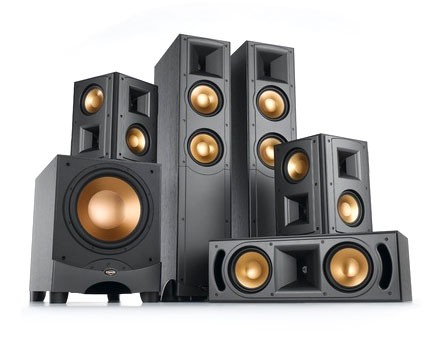
• That you can mix and match any speaker from within a broad product group and they will blend perfectly.
• The horizontally oriented center channel speaker will exactly timbre match with vertically oriented left and right speakers.
In both cases, there are a few laws of physics that would need to be set aside for this to be true.
Another problem I have is with the term “Reference Quality” or “Reference Speakers.” What does it mean? Referenced to what? Whose reference? Is Brand X’s “reference” the same as Brand Y’s “reference?” What’s the minimum performance level required to achieve “reference?” The only outfit I know of measuring speakers to determine if they really meet some level of performance is THX.
Q: Two subwoofers are better than one: True or False?
A: True. Two subs are always better than one and, in many cases, four are preferred. The use of multiple subwoofers is not to ramp up the boom of low-frequency effects, but rather to provide a consistent bass response in the seating area.
Q: We’ve heard that there are certain frequencies that the human ear can’t hear, and thus it doesn’t matter if all the various “highs and lows” are represented. What’s your expert opinion?
A: This becomes a trick question… almost. On the one hand, if the frequency range is not audible to you, it does beg the question about whether or not reproducing that frequency is a priority. On the other hand, the job of a speaker is to accurately reproduce the audio signal provided to it. If certain frequencies cannot be reproduced, the speaker is not accurate. If the speaker is not accurate you have to ask why? And why are you spending money on something that does not meet the basic established criteria for sound reproduction? The generally acceptable audible range for humans is from 20Hz to 20kHz. While I admit that very few people can hear 20kHz, it is not an excuse for a speaker manufacturer to cut corners. Do note, though, that certain speakers are designed specifically to not reproduce low bass and, in general, the manufacturers identify those speakers as requiring a low frequency speaker (aka a subwoofer).
Q: Is it true that you can’t mix and match speakers if you want good sound?
A: By and large, this is true specifically for the front three channels. I would go so far as to suggest all of the surround or ambience speakers should also be matched. In an ideal situation, the front main speakers would be identical to the surround speakers. But from my perspective there is generally so much going on (identical speakers mounted differently are no longer “matched”) that taking the pragmatic approach of using equivalent-quality surround speakers is perfectly acceptable and can provide stunning results.
Q: Is there really a difference in sound quality between a 5.1 and 7.1 surround sound system?
A: The use of two additional surround speakers has a dependency on the size and design of the room. Where the addition of surround channels comes into play is with sound panning around the room. These additional channels eliminate holes in the sound field or in the accurate recreation of the ambiance of the recording venue (i.e. a concert hall). When a sound starts at the front of the room, disappears and then reappears somewhere behind or beside you, that distraction will pull you out of the film and back into the room. Clearly, there is a loss of realism to the mix when a 7.1 soundtrack is played back in a 5.1 environment.
Q: How much better are high-res soundtracks than plain old Dolby Digital or DTS soundtracks: Is there a huge difference as marketed?
A: I hesitate to put a factor on this, be it five times, ten times or 100 times. A very good Dolby Digital or DTS soundtrack will sound better than a poorly-mastered high-resolution soundtrack. To the vast majority of listeners, it is likely they will not discern any difference between high-resolution and DD/DTS perceptually encoded material. However, once you do point out the differences to a listener, they will hear those differences every time. It’s rather like showing someone dot crawl on a CRT. They’ll hate you for it because all they’ll see in the future is dot crawl.
Editors' Recommendations
- Save $200 on this Epson 4K home theater projector at Best Buy
- Home theater receiver sale: Save on Yamaha, Sony, and more
- Best Bluetooth speaker deals: Save on Bose, Sonos, JBL, and more
- You Asked: home theater setup challenges, in-home TV calibration, and is Sony abandoning OLED
- Save $90 when you buy two Sonos Era 100 wireless speakers