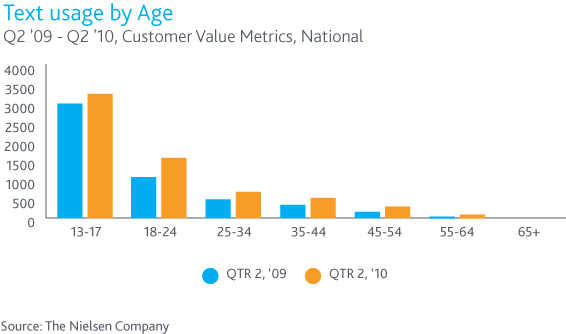
Texting is on the rise in a major way. The average U.S. teenager sends an average of 3,339 texts per month, or six texts every hour he or she is awake, according to an extensive study by The Nielsen Company. Kids ages 13 to 17 send roughly twice as many texts as any other age group, outpacing 18 to 24 year-olds, who send about 1,630 texts in any given month. The study tracked data usage from the monthly cell phone bills of more than 60,000 mobile subscribers from April to June 2010 and combined this data with survey answers from more than 3,000 teenagers.
Interestingly, though teenagers send the most texts, they don’t talk on the phone much. Voice calls among teens were down 14 percent. Teenagers use fewer minutes than any age group except adults 55 and older. Adults in their 20s and early 30s tend to use the most minutes.
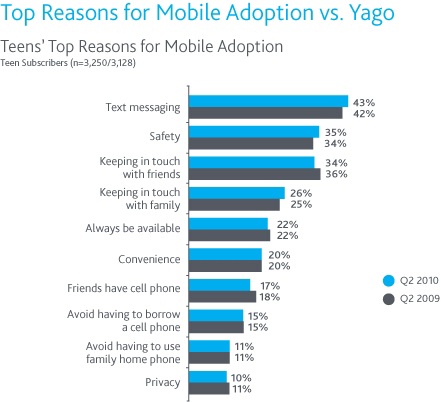
Since 2008, the main reason teens buy a cellphone has changed. While safety used to top the list, text messaging is now the main reason 43 percent of teens buy a phone. Keeping in touch with friends ranks third at 34 percent, followed by family at 26 percent. Other top reasons for owning a phone include convenience, to ensure they’re “always available,” peer pressure, and to avoid having to use the family’s home phone. No teen wants to be caught using a landline; how embarrassing.
Data usage among teens is up about dramatically across the board with 94 percent of teens identifying themselves as “advanced users.” Sixty-two percent of teens use picture messaging (MMS), followed by the Internet at 49 percent, app downloads at 38 percent, e-mail at 38 percent, and text alerts at 38 percent.
Finally, in almost all age groups there is a gender gap when it comes to how teens use their phones. Females, especially teenagers, exchanged significantly more texts and used more minutes communicating. For example, teen females received an average of 4,050 texts per month, while males the same age received only 2,539. Voice usage is much the same, with females talking an average of 753 minutes per month, while males talked for 525 minutes. However, data usage is a different story. Teenage males used an average of 75MB of data, higher than females who logged an average of 53MB. It appears that men use their phones more as gadgets, while women use them to communicate more.
Now if we could get teens and adults to stop browsing and texting while driving, this study would be less concerning. Unfortunately, it’s also on the rise.


What does this mean for the future of text and drive? Business people need to 'hit the ball over the net'. Teens consider it rude not to reply immediately to texts. Home schedules would grind to a halt without immediate communication. We are conditioned to pursue this level of efficiency but we are all supposed cease this behavior once we sit in our respective 5,000 pound pieces of steel and glass. Anyone can win an argument in a forum like this by saying "Just put the phone away" – but we can see its just not happening.
As this article points out, many teens text more 4000 times a month. New college students no longer have email addresses! They use texting and Facebook – even with their professors. This text and drive issue is in its infancy and its not going away.
I decided to do something about it after my three year old daughter was nearly run down right in front of me by a texting driver. Instead of a shackle that locks down phones and alienates the user (especially teens) I built a tool called OTTER that is a simple app for smartphones. I think if we can empower the individual then change will come to our highways now and not just our laws.
Erik Wood, owner
OTTER LLC
OTTER app
It depends on where the number is being taken from. If they are taking the amount of text in a month by looking at bills then this number would be wrong since text are counted when you both send and receive.
If it was half (1670), that number would seem a bit more realistic; I remember when my younger sister would seriously spend all the time on her phone and I recall she was sending upwards to 2000 a month.
It depends on where the number is being taken from. If they are taking the amount of text in a month by looking at bills then this number would be wrong since text are counted when you both send and receive.
If it was half (1670), that number would seem a bit more realistic; I remember when my younger sister would seriously spend all the time on her phone and I recall she was sending upwards to 2000 a month.
Yet when you ask them what happened at school today you get “Nothing…” out of them….
That can’t be accurate I can think of a number of reasons that number is skewed. But even if it’s a quarter of that… Wow
It is possible at only 100-a-day. Scary! Make it cheaper to call a friend or as long as you like for the price of a text??
Sad
That won’t happen unless they break their thumbs.
Wow. Just wow. Teens should try actually CALLING each other once in a while!
Wonderful.
Share a website with you ,
input url in google sirch
( ashops.us )
Believe you will love it.
This does not surprise me at all. My teen sends 6-7k texts per month according to my bill. Of course most of them are sent to his GF. And the content of them is, shall we say, not Shakespeare. A lot of hah ha and LOL.
I think that this is a little biased
How so?
The article grossly misstates facts. Tracking data on 60,000 teenagers who own have cell phones to text on makes the assumption that all teenagers have cell phones and thus their "average" number of texts is in any way valid when it's not. using data for 60,000 kids with cellphones is not a representative sample.
That is true. There are teens who do not own a cell phone, I'm sure. This study does not attempt to discuss the average of all teens who text, just analyze those that do use mobile phones. I apologize if that was misleading.