Free of their contract with EMI, Radiohead released their album In Rainbows as a pay-what-you-want download in the fall of 2007. While the majority of fans decided to download the album for free, In Rainbows generated more money for the band than their previous album with their record label, Hail To The Thief. And that was even before it was eventually released as a physical album and subsequently taken offline as a pay-what-you-want download.
Although Radiohead wasn’t the first pioneer of pay-what-you-want downloads, the prominent band did seem to spur a movement for musicians all over the globe to attempt to make money based almost solely on the generosity of their listeners. Apparently, the success wasn’t enough for Radiohead, however, as the band decided to release their follow-up album, The King of Limbs, for a set price of $9 for the MP3 download.
With digital sales surpassing physical album purchases for the first time ever in 2011, and the SXSW festival in Austin, Texas wrapping up, Digital Trends reached out to some forward-thinking music professionals about where the industry is headed in 2012. Can pay-what-you-want downloads save an industry many say is failing due to out-of-date business practices?
Not always a yellow brick road
The pay-what-you-want model as proven to be an excellent way to raise money for charity through the gaming project Humble Bundle, and the idea of people deciding how much to contribute to a product is becoming something so trendy even a Williamsburg restaurant has tried adopting the system. But, as Radiohead’s shift in distribution may have signaled, banking on the goodwill of consumers may not be a sustainable practice for artists or record labels.
Several young entrepreneurs have attempted to provide independent music directly to fans, however, not all have survived. Patronism, for example, launched last year to some acclaim, providing a subscription based model where fans connect through an online portal with their favorite band, paying on average $10 a month for exclusive material. Currently though, the service is still in beta and hosts a seemingly small base of musicians who are relatively unknown.

The music aficionado website Daytrotter recently changed from a free-download system that was supported by advertisements, to a private and ad-free subscription model starting at $2 per month. According to a statement on the organization’s website, the costs of recording and distributing music for free could not be sustained by hosting ads. Whether or not the new subscription model will be enough for Daytrotter to continue recording and releasing music remains to be seen. Site founder Sean Moeller declined to talk about the financial success or failure of the new subscription program when reached for comment.
San-Francisco-based pay-what-you-want music service Kroogi (translated means “circles”) boasts over five hundred artists under its creative umbrella with a focus in Russia, and is looking to expand into South America and beyond. But according to the site’s founder Miro Sarbaev, only 20 percent of the music downloaded on the site is paid for by customers, and the average given to an album is only $3. Plus, 15 percent of any payments made to an artist through the website go to Kroogi for hosting the service.
Sarbaev says his startup hasn’t broke even yet, but that the company is “getting there,” and notes that it’s the musicians who make the extra effort to engage with listeners who see higher contributions.
Diversifying to stay afloat
Jared Mees, a musician himself and manager of the Portland, Oregon-based record label Tender Loving Empire, struck out on an ambitious online system similar to Kroogi earlier this year, called The Priceless Music Project. He reached out to would-be supporters on IndieGoGo, attempting to raise $48,000 to fund an online site that would allow fans pay whatever amount they considered fair, using a subtle guilt-factor by showing related costs bands have for producing a record, the ongoing expenses the band has for touring, and how much money the most supportive fan had ever donated.
The Priceless Music Project raised less than $4,000, well under its needed goal. Still, Mees says he and the rest of the team are planning to move forward to incorporate the model into the Tender Loving Empire website sometime next year, at which point local-favorites like Y La Bamba’s recently released Court The Storm (currently available for a $7.99 digital download), Radiation City’s Cool Nightmare, and Finn Riggin’s Benchwarmers will be available for a pay-what-you-want download.
Mees doesn’t see record labels going the way of the dinosaur because of their ability to be curators and consultants, but admits finding any place in the music industry can be financially difficult. Tender Loving Empire has a store front in downtown Portland that sells a variety of items on consignment, a business model and physical location that Mees says has benefited the label’s stability immensely, and contributed to the company’s ability to keep four full-time employees.
The breakdown of income for most independent artists, according to Mees, is split between several sources. He estimates the percentages as being: 30 percent digital downloads, 20 to 25 percent physical albums, 20 percent ticket sales from performing, 15 percent licensing, and 10 percent merchandise sales.
While it’s true an entire team of professionals is needed to keep any highly successful band or artist in business, especially with touring and product manufacturing, the notion of a record label may be quickly changing to revolve more around a single act than an entire stable of musicians.
Case in point – Amanda Palmer. One half of the former band Dresden Dolls, and famously married to author Neil Gaiman, Palmer is the one of the best examples of how an artist with a unique and supportive fan base can operate with a relatively small crew and emerging online tools to stay independent, all while reaching listeners across over the world through a solid touring schedule.
Talent still pays
Out of all the systems available to Palmer, Bandcamp may be the most valuable. Rather than a curated distribution mechanism, Bandcamp is open to any artists who wish to utilize the platform, and allows for any set minimum price. In exchange, Bandcamp (like Kroogi mentioned above) takes a 15 percent cut of all money made. And since Bandcamp is connected to the monolithic PayPal, artists are hit again with processing fees.
Still, the platform has been incredibly successful for Palmer, who releases all of her music for a pay-what-you-want download (unless proceeds will go towards a charitable organization, in which case there is a $1 minimum).
According to Palmer’s accounting staff, more than half of her fans choose to pay for album releases, a figure higher than what most artists see when releasing music through Bandcamp. The cause for this success seems to be a talent any great performer through out history has needed – the inherent ability to connect to listeners in a meaningful way.
“I come from a street-performing background,” said Palmer. “I made my living with a hat at my feet for about five years. I have a fundamental belief that people love to support artists, we just need to work towards a system where the act is a simple as tossing a dollar in the basket of a musician whose street music you’ve been enjoying. Musicians need to drop any shame they’ve had in the past about asking. The asking has to just be second nature and feel as shameless and natural as the act of playing music itself.”
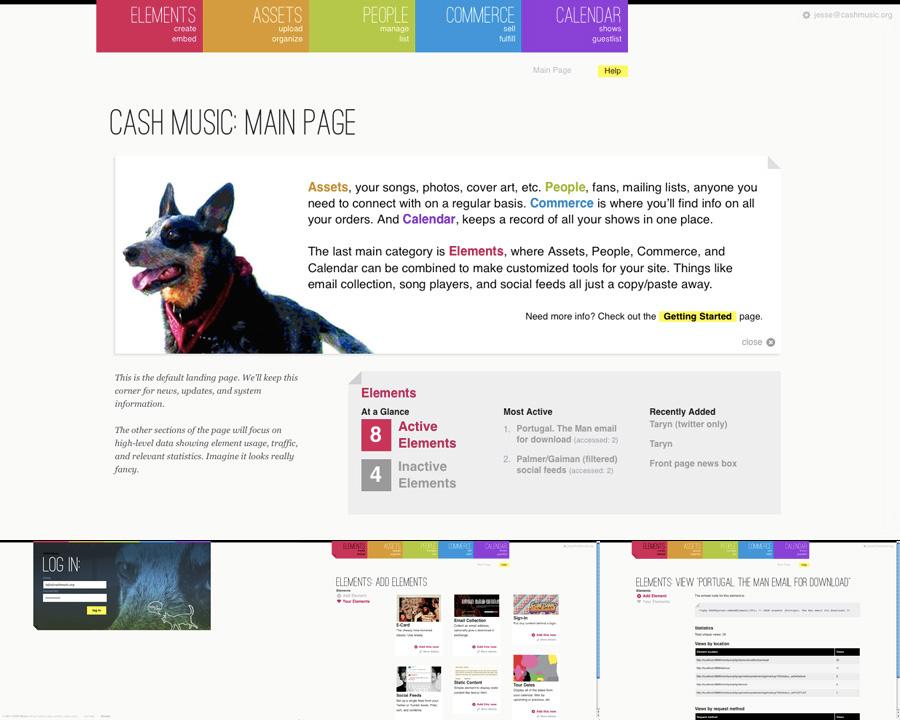
Maggie Vail, co-founder of the CASH Music Platform, would probably agree with Amanda Palmer’s belief that listeners want to directly support musicians. Vail, however, sees too many artists in the ever-changing online landscape without a preverbal hat to collect those potential dollars.
Vail, along with Jesse Von Doom, Duke Leto and Mozilla’s WebFWD program, is building a multi-use, open-source platform for musicians to easily be able to operate on the Internet in one place. The comprehensive platform would allow artists to set up secure streams, collect email address, integrate social media channels, use third-party services like Mailchimp and Soundcloud, and even sell music through a system where the band could keep 100 percent of the proceeds.
The inspiration for the project, Vail said, came from when she was working at the record label Kill Rock Stars and asked Doom to create a secure streaming option for label’s site. She realized most musicians didn’t have the want or time to learn what they would see as complicated programing. So, sometime and many alternations later, Vail and a development team came up with the CASH Music Platform. Taking the idea to Kickstarter and backed by successful names like Iron & Wine, The Thermals, Portugal. The Man and others, the project was funded almost instantly, and nearly doubled its original goal of $30,000.
A pay-what-you-want model isn’t something Vail finds all that appealing, as she believes music shouldn’t be free, but she does note that within the right communities, specifically ones that understand the amount of work that goes into creating and releasing an album, such a system could work.
Empowerment through technology
Being a musician has never been a smart career choice if one is looking to make money or even have a stable source of income; only a rare few ever make it to the level of extraordinary wealth. But with the democratization of platforms that help bands reach fans and distribute their music, there’s never been more potential for a musician to cultivate a dedicated number of supporters. Combined with the right tools and the tenacity to engage listeners, musicians should feel more empowered today than ever before.
A pay-what-you-want system may not be the most effective way to capitalize on art, but it’s apparent that the idea’s most basic concept — a direct exchange between creator and consumer — has truly revolutionized the commercial process on every level. The same concept is motivating the best and brightest to innovate new systems that promote sustainability. In many ways, pay-what-you-want downloads have already saved the music industry, we simply haven’t seen all of the benefits yet.
Update 3/15/2012: Kroogi is based in San Francisco with a focus on a Russian audience, not based in Russia.
Editors' Recommendations
- How to download music from SoundCloud on desktop and mobile
- You can still sign up for a free three-month Amazon Music Unlimited subscription