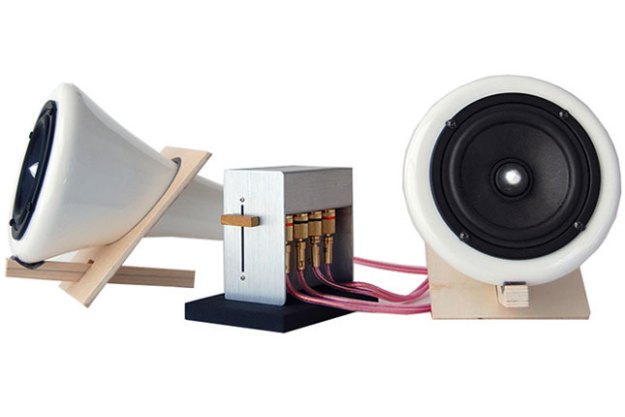

“Joey Roth’s imaginative Ceramic Speakers use the same material you probably eat dinner off of to produce stunning sound from a compact package.”
- Detailed, quality sound
- Premium components
- Uber-hip aesthetic
- Very little bass
- Delicate support stands
- Expensive
Introduction
Since the ‘60’s, high-end speaker makers have been striving to transcend technology and art, or at least multi-function furniture, out of the otherwise very scientific loudspeaker. Some of these designs have been astounding to behold but few, if any, were very likely to make an appearance anywhere near your home or office. On the opposite side of the audio/art spectrum are the poorly designed, cheaply built “multimedia” or “computer” speakers that sound and look horrible but are at least small, easy to use and more likely to be sitting next to your computer or iPod.
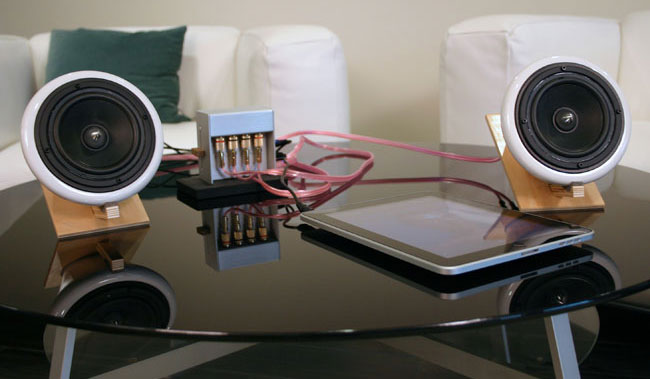
With his Ceramic Speakers, designer and artist Joey Roth has managed to bridge a gap between art and technology and produce a product that is as much a blank canvas for other artists as it is a practical piece of audio equipment. The system’s design is modern and minimalist not only in its aesthetic, but in its function as well. Here, we take a listen to the ceramic speakers to determine if they sound as good as they look.
Out of the Box
Since you won’t be finding the Ceramic Speakers by Joey Roth in any typical retail store, you’ll have to have them shipped to you. This makes product packaging pretty important since they’ll be shipped to you by one of a handful of shippers, none of which are known for being particularly gentle with their packages. We’re pleased to see that Mr. Roth’s packaging choice includes no EPS or EPE foam. Almost everything in the box is bio-degradable. Even the setup instructions are printed on recycled paper. The reinforced corrugated cardboard is rigid enough to protect the ceramic speakers against most abuse and the speakers center placement in the box helps ensure that you won’t receive a box full of broken porcelain.
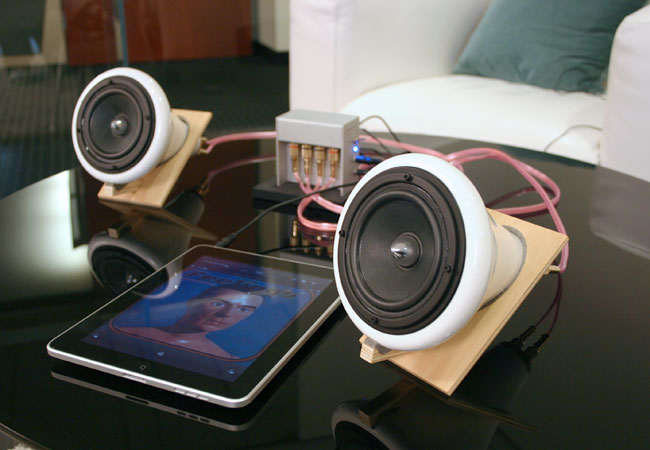 Inside the box we found two glossy white ceramic speakers, an amplifier module, a power supply, 16 AWG speaker cables terminated with banana plugs on both ends, a 1/8” mini to 1/8” mini cable, a 1/8” mini to stereo RCA cable, two birch speaker pedestals and a simple instruction sheet.
At first sight, the ceramic speakers might look a little strange just sitting in the box. If we hadn’t seen them before, we may have thought we’d been shipped some sort of lighting kit. The ceramic speaker enclosures look a lot like a ceramic lighting fixture. Dig a little further, though, and it is clear this is a clever set of speakers that makes use of unconventional materials to add style to its function.
Features and Design
As San Francisco based industrial designer Joey Roth explains in our recent video interview, the inspiration for these speakers came from a lack of space for conventional floor-standing speakers. Through his research for small, desktop speakers, Joey quickly learned that as speakers got smaller, materials were compromised and, therefore, so was the resulting sound. Injection molded plastic enclosures weren’t going to do the trick for Mr. Roth, so he set out to create a speaker design that conveyed the warmth and personality of the music he enjoyed.
Joey then consulted with audio enthusiasts on a number of public forums to get input on what the technical side of the design should involve. The result of his careful consideration and testing is what you see here: two gloss white ceramic speaker enclosures fitted with full-range 4” drivers, a custom made Class-T amplifier, Baltic Birch speaker supports and all the cables and pre-terminated speaker wire necessary for the system to function.
From a technological standpoint, the system is extremely simple. As many audiophiles will quickly point out, though: the simpler, the better. Anything that can be done to remove junk from the signal path will usually result in superior sound.
The speakers themselves are a 4” single driver design. Not only does this allow for a simple, single enclosure, it eliminates the need for a crossover and, with it, the potential for sound coloration.. The notion of full-range driver design has been popular with a handful of audiophiles for decades because, in theory, it reproduces a pure sound that more accurately reflects the artist’s intentions than a conventional loudspeaker is capable of. This approach is not without its challenges however. In order to pull of a full-range driver design, the driver itself must be top quality and the speaker enclosure must be precisely configured to match the specifications of the driver.
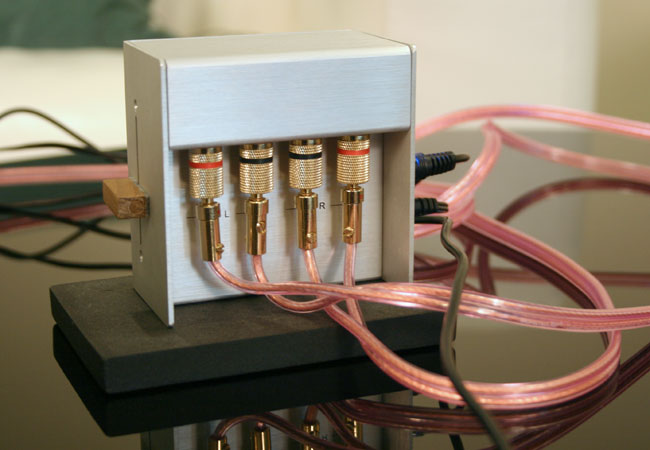 Also popular with audiophiles is the choice of amplification that is paired with the ceramic speakers. The Tripath 2040 chip (a.k.a. T-Amp or Class-T) is a digital amplifier that uses electrical feedback from the speaker to improve its efficiency. In layman’s terms, it makes more sound with less power (15 watts). Not only that, the quality of sound is superb. The T-Amp never really achieved mainstream popularity, likely because it was never introduced in well-built products; but when Sonic Impact came out with a small, battery operated amplifier that used the T-2040, it caught a lot of attention as being an audiophile grade digital amplifier.
We appreciate the inclusion of quality, pre-terminated speaker wire and connection cables in the kit. It would have been easy to leave these accessories out as so many manufacturers do, but it speaks volumes of the designer’s intent to produce a stylish, great sounding system that is easy to use right out of the box
 Performance
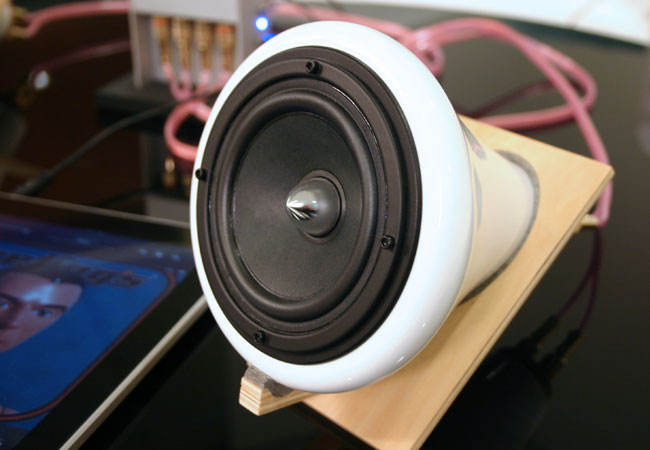
We tested the ceramic speaker with several sources that included an iPhone, iPod Touch, laptop computer, desktop computer, HeadRoom DAC and turntable with phono pre-amp. We also tested the speakers in various room sizes and shapes.
Considering the full-range driver design, we were interested to see how the ceramic speakers performed with both very high and low frequencies. We’re used to seeing 4” drivers handle mostly mid-range responsibilities and occasionally mid-bass if placed in a ported cabinet. The lack of a tweeter had us concerned about its high-frequency prowess, however, we are happy to say our concerns were misplaced.
The ceramic speakers exhibit an airy, detailed treble that we simply did not anticipate. With all of the tracks that we used for testing, we felt the ceramic speakers did a good job of reproducing sparkling, zesty highs without being too aggressive. Such forward high frequencies tend to expose a lot of detail in the recording and this was certainly the case with the ceramic speakers. As we switched to compressed tracks, we noted how compromised the high frequencies were and found ourselves longing for better sounding material. We didn’t return to any 128k MP3 files after a quick 3 minutes of testing.
The midrange performance was on par with many small audiophile satellite speakers we’ve tested in the past. We felt that the midrange had a quickness and synchronization that is usually missing in most speakers – probably a benefit of the crossover lacking design; there was only the slightest hint of coloration to be heard. When listening closely to vocals and other midrange intensive instruments, we noticed a 1Kz resonance (we’re guessing at the frequency as we do not have the necessary graphing equipment handy but we think we’re pretty close here) that seemed to be a result of the speaker enclosure. Though the speakers are well dampened inside, the size of the enclosure probably makes this midrange bump unavoidable. Thankfully, it’s a pretty minor coloration and we don’t think most listeners will be sensitive to it.
Bass performance is difficult to rate because, frankly, there is no bass performance. In fact, there seems to be a conspicuous lack of mid-bass performance as well. Even in small spaces, the sound lacked the body that even a small amount of bass can provide. Again, we think this is probably due to the size of the enclosure and an unavoidable byproduct of a smart design. Any larger, and the speakers would not be at home sitting on a desktop. For fun, we put an 8” subwoofer in line between the T-Amp and the speakers. Adding a subwoofer filled out the low end very nicely and, suddenly, the speakers really started sounding like audiophile grade satellites.
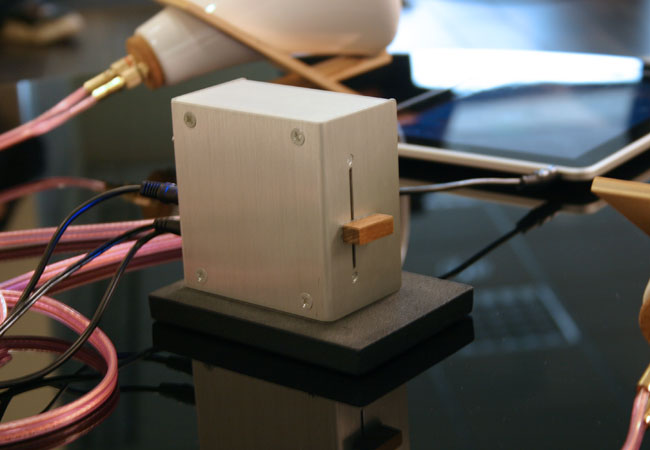 We had just small quibbles with a couple of the kit’s aspects: The T-Amp’s volume control on our review sample was a bit heavy and noisy. We heard a bit of scratching as we adjusted it up and down. This could be due to some dirty contacts but we were unable to clean them successfully and stop the (barely audible) noise. Also, the Baltic Birch speaker supports are a bit “light” and don’t have anything to increase stability on smooth surfaces. We would suggest adding some felt or rubber pads to the bottom to keep them from sliding around because one false move and the supports may very well snap apart.
Conclusion
Joey Roth’s Ceramic Speakers are a revelation in stylish audio technology. Their premium sound, hip, modern look and thoughtful overall product design is a rare culmination of audiophile performance and art. Though a bit expensive, we believe that music lovers and artists everywhere will appreciate what they bring to their work and living spaces.
Highs:
- Detailed, quality sound
- Premium components
- Uber-hip aesthetic
Lows:
- Very little bass
- Delicate support stands
- Expensive
Editors' Recommendations
- Edifier MP230 Hands-on Review: The pint-sized, retro Bluetooth speaker brings a vintage vibe
- The best computer speakers