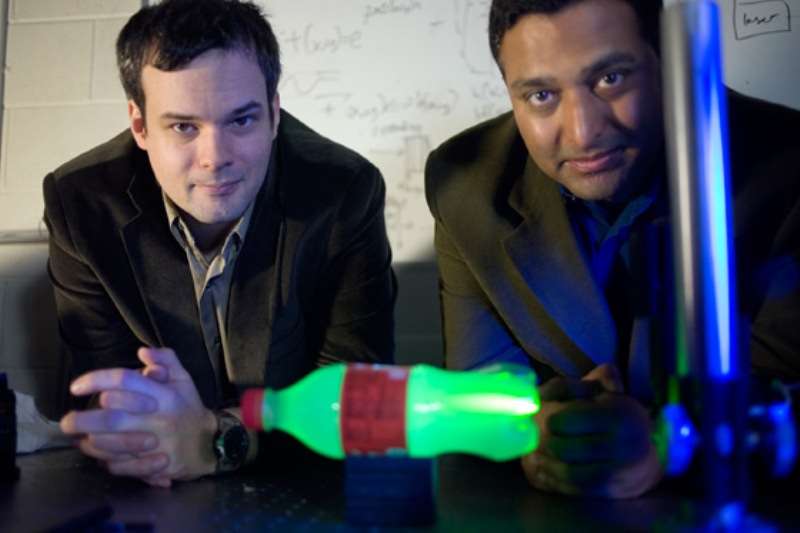
 If you were excited about the speed of the Canon 1D X, expect to be blown out of the water. The MIT Media Lab’s Camera Culture Group have created a faster-than-fast imaging system—which actually is being coined “the world’s slowest fastest camera.”
The camera can capture images at a rate of one trillion frames per second, which is how the team was able to capture the motion of light. “There’s nothing in the universe that looks fast to this camera,” Media Lab postdoc Andreas Velten says. According to the study, MIT was able to record this movement by using extremely short exposure times (two trillionths of a second) and a narrow field view, capturing the video “over several minutes by repeated and period sampling.”
To accomplish all this, researchers used a streak camera. A streak camera is typically used to measure the pulse of extremely sophisticated (read: fast) laser system. In this case, it would split a scene into a one dimensional frame. The team would reposition the stream camera repeatedly until they were able to combine and create a two-dimensional image. Which is where the slow part comes in: taking the time to set up the camera and the light beam and repeat the process in order to create the final product was painstaking. The team used a light source directed by mirrors into a soda bottle to conduct the experiment. The new technique has been labeled “Femto Photography.”
But in addition to producing a mind-blowing video, can this work be applied to anything? Velten says the technology could be seen as progress for the medical imaging field. Researchers could “learn more about the material properties of the objects,” he says, “about what is under their surface and about the layout of the scene.”