Mainstream automakers are pouring billions of dollars into the development of electric cars, but the segment remains well within the reach of ambitious startups. EVelozcity, a two-year-old automaker based in California, has changed its name to Canoo in a bid to be taken more seriously as it attempts to compete against the world’s biggest car brands. It also outlined how it plans to become a household name.
Canoo, like most startups, claims to exist “to disrupt tradition.” The company doesn’t want to sell you a V6-powered Ford Explorer. It wants to build electric cars and distribute them through a subscription service rather than sell them to consumers. While the company is a newcomer to the automotive industry, it was founded by former Faraday Future employees Stefan Krause and Ulrich Kranz, so it knows what it’s getting itself into. As of March 2019, 300 employees are working around the clock to make its vision of the future a reality.
Canoo posted a mission statement of its official website that outlines a lineup initially consisting of four models. One will be a lifestyle-oriented model, another will be aimed at commuters, while ride-sharing and delivery vehicles will round out the quartet. The company will save money by building all of its vehicles on the same basic skateboard-like architecture, and it will outsource production to a third party rather than build cars itself. There’s no word yet on who will handle manufacturing.
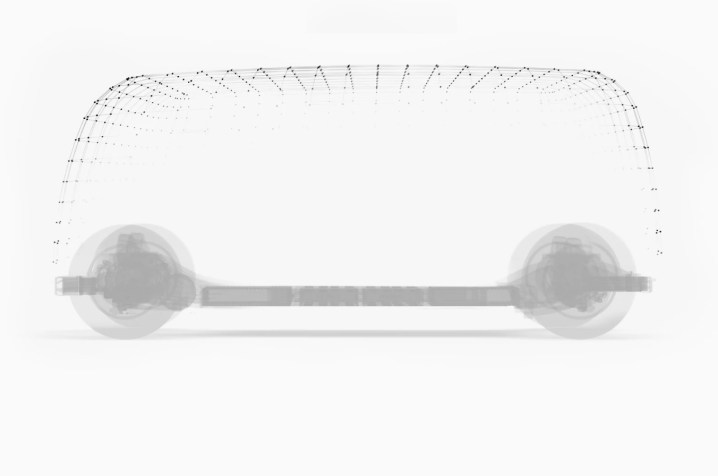
Its intent to disrupt tradition also applies to design. Canoo wants to leverage the packaging benefits of electrification to challenge the conventional three-box design that has been used by many passenger cars over the past decades. The firm hasn’t revealed what it has in mind, though a diagram shown on its website (pictured above) shows a mono-box, toaster-like design that looks like a modern version of the rear-engined Volkswagen Bus. That’s hardly revolutionary or disruptive; keep in mind the Bus was released in 1949, and Volkswagen has already announced plans to bring it back as an electric car in the early 2020s. To its designer’s credit, the van is about the size of a compact car yet it comfortably seats seven passengers. We’ll need to wait until Canoo releases more information to get a better idea of what its models will look like.
Canoo intends to launch the first car in its model offensive in 2021. It will start by selling vehicles in what it calls the most cutting-edge cities in the world, a term which likely describes major metropolitan centers like Los Angeles, New York City, Beijing, and Paris.
Editors' Recommendations
- Don’t let the gimmicks fool you. The Ioniq 5 N is a serious track car
- Genesis Neolun concept is an electric SUV inspired by tradition
- Tesla faces new rival as a tech giant launches its first EV
- 2024 Dodge Charger Daytona reinvents the muscle car for the EV era
- Here’s how Ford will give EV customers Tesla Supercharger access