  1. Home
  2. Cars
  3. Virtual Reality
  4. News

Can VR improve experience of buying a car? Jaguar Land Rover thinks so

Add as a preferred source on Google

Shopping for a car can be an exhausting experience, but Jaguar Land Rover (JLR) thinks a little virtual reality can make it less of an ordeal.

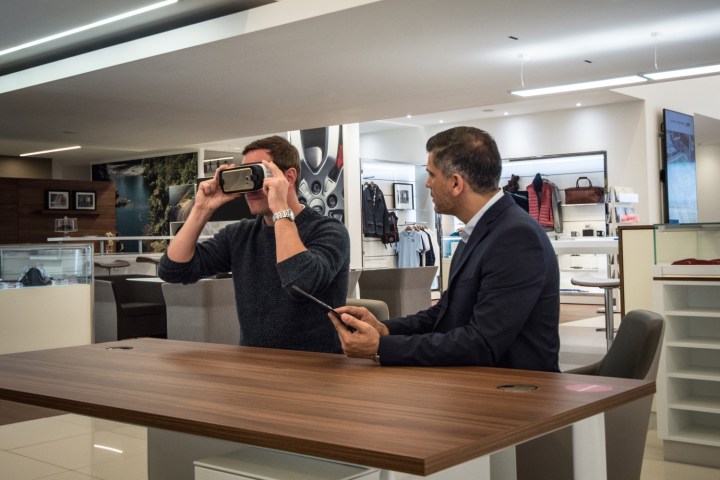
The British automaker is experimenting with virtual reality as a way to let customers “see” new cars without having to physically open the door and plop down behind the wheel. Before the end of the month, JLR plans to ship “Virtual Reality Experience” kits to its U.S. dealers, who will use them to show customers the company’s new models.

Recommended Videos

Customers will be able to strap on a VR headset and take a virtual tour of a car, even before it goes on sale, JLR says. The program will render a life-size model of any JLR vehicle, including 360-degree views of the interior. It will also include “animations” to showcase specific technical highlights of the vehicle.

“The VR Experience will … help retailers to break the ice with customers and inject even more fun into the process of buying our vehicles,” said Andy Goss, JLR’s sales operations director. Jaguar Land Rover is putting a lot of faith in VR to make what many people consider an arduous task more enjoyable. Consumers routinely criticize the carbuying experience in surveys.

JLR will offer the VR Experience at more than 1,500 retailers in 85 markets, encompassing 20 different languages. It tested the system during the U.K. launch of the Jaguar F-Pace, the brand’s first SUV. JLR plans to implement VR with each new vehicle launch, beginning with the 2018 Land Rover Discovery.

JLR isn’t the first carmaker to try to connect to customers via VR. Volvo has experimented with using VR at dealerships, and Cadillac is reportedly considering something similar. Ford, which uses VR for vehicle-development purposes, launched a VR app last year as a promotional tool for things like its Le Mans race program.

Stephen Edelstein
Stephen is a freelance automotive journalist covering all things cars. He likes anything with four wheels, from classic cars…
Your next car’s software update could become its biggest security risk
Your next car could receive updates like your smartphone. That's also becoming a cybersecurity nightmare.
OTA technology allows manufacturers to remotely deliver software updates.

Modern cars are no longer machines that stay the same after they leave the showroom. Increasingly, they're becoming software-defined vehicles that receive new features, bug fixes, and security patches wirelessly, much like smartphones. But while over-the-air (OTA) updates have made vehicle maintenance easier and cheaper, cybersecurity experts are warning that the same technology could also become one of the automotive industry's biggest security challenges.

Researchers and policymakers are now calling for stronger oversight as connected vehicles become increasingly dependent on remote software updates. Their concern isn't just about hackers stealing personal data. It's about someone potentially interfering with the operation of a moving vehicle.

Read more
This sleek Chinese EV pairs supercar styling with three AI brains
The Xpeng L03 is an AI supercomputer disguised as a stylish family SUV
Xpeng L03

Xpeng’s latest electric vehicle carries enough processing power to make the term "smart car" actually sound more realistic than it actually is. The new Xpeng L03 debuted simultaneously in Europe and China on July 16, with the company presenting it across 65 markets. Available as a fully electric vehicle and an L03 Power X range-extender, the coupe-SUV is Xpeng’s most internationally focused model so far. Market-specific prices and sales dates remain unannounced.

Three AI chips and Google Maps built right in

Read more
A new sodium battery posts wild four-minute charging numbers, but don’t expect it in an EV yet
The breakthrough could improve fast charging and battery life, but the study hasn’t demonstrated those results in a production-sized pack
EV Charger

A new sodium-metal battery has posted a charging number that makes today’s EVs look painfully slow. In laboratory testing, the cell operated at a 15C rate, equivalent to completing a charge or discharge in roughly four minutes.

That doesn’t mean researchers plugged in an electric car and watched it fill up before the driver finished buying coffee. The result came from a small experimental cell using a new quasi-solid electrolyte, while the larger pouch-cell prototype delivered far less dramatic performance.

Read more