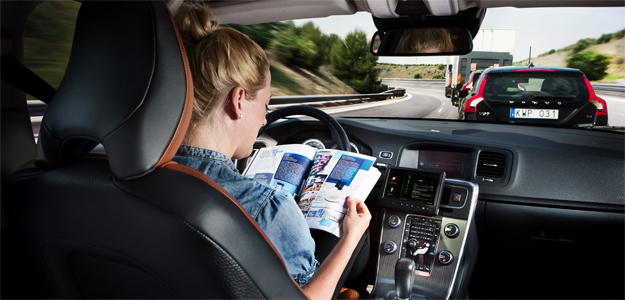
Google and several carmakers are hard at work developing autonomous cars, but do consumers actually want them?
Apparently not. A new survey says most consumers would not buy a self-driving car.
On behalf of the Chubb Group of Insurance Companies, ORC International surveyed 1,000 adults and found that only 18 percent of participants would buy an autonomous car, Forbes reports.
It seems that, despite the technological zeitgeist, average drivers are hesitant to trust their lives to a machine. Two-thirds of the survey respondents said they didn’t feel comfortable riding in a self-driving car, and only 22 percent would feel confident allowing their loved ones to ride in one.
This may be a question people have to deal with in the near future, because the technology to make cars autonomous already exists.
The 2014 Infiniti Q50 has a steer-by-wire system, with no physical link between the steering wheel and the road. That is, until the steer-by-wire ECUs fail. Then an electromagnetic clutch slams together, physically linking the steering wheel to the steering gear. With the optional Active Lane Control, the Infiniti Q50 can actually keep itself centered in a lane without any input from the driver.
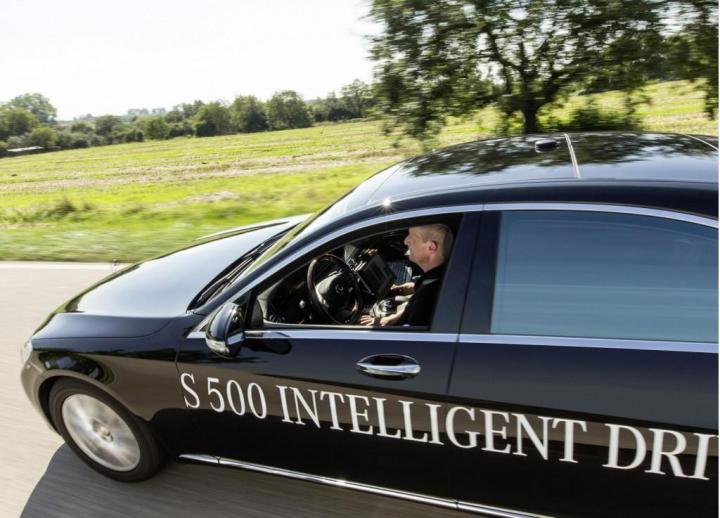
The 2014 Mercedes-Benz S-Class already has enough cameras and sensors – about 25 in all – to become self-aware. A point proven by the prototype S500 Intelligent Drive, which recently completed a 60-mile trip with almost no driver involvement.
Even production versions of the S-Class can park themselves. It can apply the brakes in an emergency and autonomously follow other cars through gentle curves at speeds up to 37 mph with its adaptive cruise control system.
Interestingly, the survey participants didn’t have a problem with this tech; they would even pay more for it.
Of those surveyed, 88 percent said they’d pay extra for a lane departure warning system, 77 percent would do the same for a forward collision warning system with automatic braking, 70 percent would go for adaptive cruise control, and 30 percent would pony up for self-parking.
Apparently, there’s a line between allowing a car to do more of the work and letting it take over completely. If the same thinking shown in this survey plays out in showrooms, the rise of autonomous cars may not be as inevitable as it seems.
If consumers don’t warm up to self-driving cars, will the tech stop just short of total autonomy? Or will drivers accept an autonomous car that comes with an “Off” switch, like Tesla’s proposed “auto-pilot” system.
Self-driving cars are the logical solution cutting traffic deaths, but human beings aren’t always logical. Most people become complacent about driving; if driving is rendered redundant, it will be interesting to see if they resist.
Editors' Recommendations
- Cruise autonomous vehicle drives over woman just after she was hit by another car
- Autonomous cars confused by San Francisco’s fog
- A weird thing just happened with a fleet of autonomous cars
- Waymo’s self-driving cars can’t get enough of one dead-end street
- Apple Car will be fully autonomous with no driver input, insiders claim