  1. Home
  2. Cars
  3. News

New tech protects police officers in parked Charger Pursuit vehicles from ambush

Add as a preferred source on Google

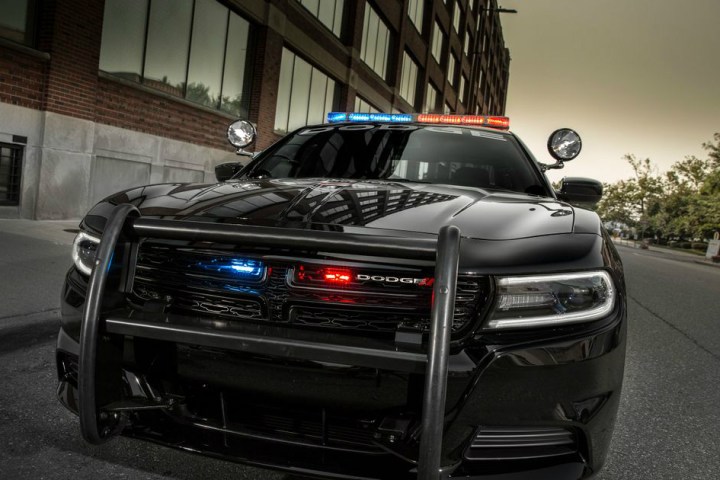
FCA announced a technology that will enhance safety for police officers working in parked vehicles. The Officer Protection Package detects movement behind police vehicles using cameras and radar and warns the driver. The plan is to implement the module in all 2017 Dodge Charger Pursuit law enforcement vehicles, which are the best-selling high-performance police vehicles in the U.S.

The new feature comes from a collaboration between FCA US and InterMotive Inc. of California. It will be provided at no cost to law enforcement agencies.

Recommended Videos

“This technology is designed to prevent an officer from being ambushed from the rear while parked,” Jeff Kommor, Vice President of U.S. Sales Operations, Fleet, and Small Business Sales, said in the press release. “While it does not replace vigilance, this technology acts as a second set of eyes and provides police officers with added peace of mind when they are in a parked Charger Pursuit.”

Ambushes of police officers last year pushed agencies to seek technology of this sort, according to Intermotive.

The Officer Protection Package comes into play when an officer is pulled over and working inside his or her vehicle. While focused on the task at hand, the officer may not sense somebody coming up behind their vehicle. The package uses the Charger Pursuit’s existing rear park assist system and rear backup camera to alert the officer of movement.

It is a simple installation to attach the module, which can be secured under the dash and plugged into the OBDII port. To activate it, officers press the Aux 1 button.

Activating the Officer Protection Package also turns on the reverse sensors, which sound a chime when tripped. Upon alert, the officer can see what’s behind the vehicle via the camera display. The doors also lock, the front windows roll up, and the taillights flash.

Albert Khoury
Former Weekend Editor
Al started his career at a downtown Manhattan publisher, and has since worked with digital and print publications. He's…
Volvo is rolling out Apple Music to over 2 million cars with a simple OTA update
Your Volvo may soon get Apple Music without needing CarPlay
Interior view of the 2024 Volvo EX90.

The line between your smartphone and your car continues to blur. Volvo has announced that it is rolling out an over-the-air software update that brings Apple Music directly to the infotainment systems of more than 2 million vehicles worldwide. Instead of relying on Apple CarPlay or plugging in an iPhone, eligible drivers will be able to stream music natively from their car's built-in system, making Apple Music another integrated feature of Volvo's software experience.

The update is arriving for a wide range of Volvo models, including the EX90, ES90, XC90, S90, V90, XC60, S60, V60, XC40, EX40 and EC40, covering model year 2020 onwards. Availability, however, may vary depending on the vehicle.

Read more
Chery’s latest EV packs flagship tech for the price of a base Tesla, but you can’t buy it
Here's everything packed into Exeed's 2027 Exlantix ES, from its 27-sensor autonomous driving suite to its 860 km range, all starting under $31,000.
Car, Transportation, Vehicle

Chery's premium arm just dropped a sedan that makes you wonder why American EVs cost twice as much for half the tech.

Exeed's 2027 Exlantix ES ships with a driver-assist system called Falcon 700. It is built around an Nvidia Orin-Y chip and a genuinely stacked sensor suite.

Read more
A new AI model wants self-driving cars to think before they swerve
Forget guessing games, this self-driving AI actually shows its work.
Self driving car

Self-driving cars have gotten pretty good at driving. The harder problem is teaching them to drive safely in situations nobody planned for. We have heard horror stories of self-driving cars, behaving erratically in emergency situations, often times delaying first responders from reaching the scene.

A team at Seoul National University, led by professor Jun Won Choi from the Department of Electrical and Computer Engineering, thinks they have cracked part of that puzzle with a new AI model called SafeDrive. The research was recently selected as a highlight paper at CVPR 2026, a distinction that goes only to roughly 3% of all submissions.

Read more