  1. Home
  2. Computing
  3. Mobile
  4. News

Want the world's first Ubuntu tablet? You'll need to wait another week

Add as a preferred source on Google

If you pre-ordered a Ubuntu tablet, you’re going to be waiting just a little bit longer.

BQ, makers of the upcoming Ubuntu-powered BQ Aquaris M10, silently pushed back their delivery date from the second week of April (next week) to the second half of April (two to three weeks from now). No statement was sent to customers, OMG Ubuntu is reporting: the wording was simply silently edited on the website.

Recommended Videos

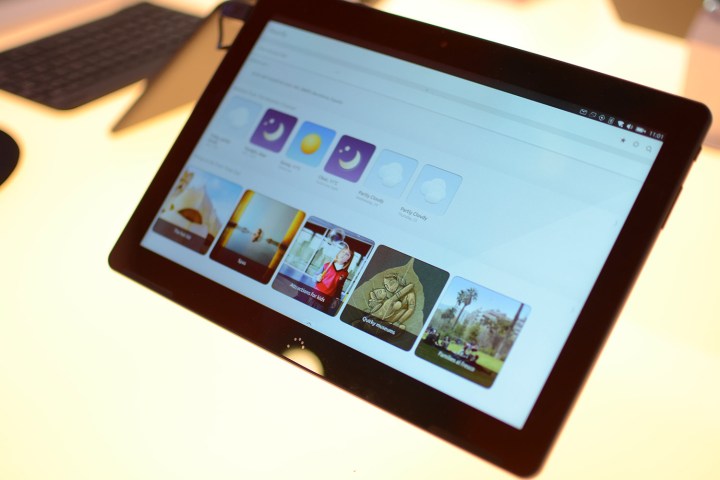
Pre-orders for the BQ Aquaris M10 Ubuntu edition started late last month. The tablet runs Canonical’s Ubuntu, a popular Linux distro that’s known to be user-friendly and widely supported. This tablet is noteworthy because of it’s versatility. Plug in a keyboard, mouse, and external display and you can use it as a desktop computer.

There are two versions of the tablet — the Aquaris M10 FHD Ubuntu Edition, which costs €299.90 (around $340) and the M10 HD, which costs €259.90 (around $295). The M10 FHD sports a 1080p display, and a 1.5GHz ARM processor. The cheaper M10 HD offers 1,280 x 800 pixels and a 1.3GHz ARM processor. Both models offer 2GB of RAM, 16GB of onboard storage, and an 8MP rear camera.

Those are not the most impressive specifications compared to the market, and notably BQ offers cheaper versions of both tablets running Android. Users who pre-ordered the device are already paying a premium to support their favorite OS, and potentially buy a tablet that also functions as a desktop computer.

The tablet does not come with a keyboard, mouse, or external display. Users need to provide their own display, plugged into the Micro HDMI port, and a Bluetooth keyboard and mouse. That brings the high price just a little bit higher, particularly if you were planning on just using your USB mouse and keyboard.

Still, it’s exciting to see Ubuntu come to the tablet, and the convergence feature is interesting. Here’s hoping everyone who pre-ordered gets their devices soon, and enjoys them.

Justin Pot
Justin's always had a passion for trying out new software, asking questions, and explaining things – tech journalism is the…
Should we feel bad about deleting an AI? One expert says it’s time to find out
If AI can learn, remember, and make increasingly complex decisions, one expert thinks we should be more careful about how we say goodbye.
an on off toggle

Turning off an AI might sound as simple as hitting a switch, but according to futurist and University of Technology Sydney professor Rocky Scopelliti, that mindset needs to change fast. As first reported by TechXplore, Scopelliti's new book, The Conscious Code, Scopelliti argues that as AI systems get better at reflecting on their own choices, deleting them without a second thought could actually cause harm.

He's not asking us to hand robots legal rights. Instead, he wants us to accept what he calls a duty of good stewardship, basically treating AI responsibly because we're the ones holding the power, not because the AI is demanding it. As he puts it, our design choices can quietly cause damage by wiping out an AI's "learned moral dispositions" without warning.

Read more
MediaTek’s new Dimensity 9600 Pro joins Apple and Samsung in the 2nm club, with 61% lower power draw
MediaTek's newest chip bets its edge on a 61% power cut and serious on-device AI muscle.
Electronics, Hardware, Computer Hardware

MediaTek just joined an exclusive club. The company's new Dimensity 9600 Pro becomes the latest flagship chip based on the 2nm process node. It's the third chip to enter that territory after Samsung's Exynos 2600 (2nm) and Apple's A20 Pro (2nm).

It's built specifically to handle the kind of always-on, multi-step AI tasks flagship phones are increasingly expected to run entirely on the device, without leaning on the cloud.

Read more
OpenRGB 1.0 is finally here, and it wants to end your RGB software headaches
No more juggling five different apps just to make your keyboard glow the right color.
A PC featuring Lian Li's wireless RGB ecosystem showcased at Computex 2024.

Anyone who has dealt with gaming peripherals knows the RGB software struggle is real. Every brand wants you to install its own app, and most of these run quietly in the background, eating up resources just to keep your lights synced. OpenRGB has been trying to fix this mess for years, and the project just hit a big milestone with the release of version 1.0.

What's new in OpenRGB 1.0?

Read more