
  1. Home
  2. Computing
  3. News

Chuwi reveals powerhouse Ryzen AI MAX+ PRO 495 workstation with a slick design at IFA 2026

Chuwi's new AI workstation is small in size but massive in brainpower.

Add as a preferred source on Google
Chuwi Ryzen AI MAX+ PRO 495 workstation
Chuwi
Purple, Art, Graphics
This story is part of our coverage of IFA Berlin 2026

Running massive AI models has usually meant relying on the cloud or building a hefty rig. Chuwi’s newest mini PC squeezes that kind of power into a box small enough to sit on your desk.

At IFA Berlin 2026, the company unveiled the UniBox AI495 Pro, a mini workstation built around AMD’s flagship Ryzen AI Max+ PRO 495 chip, codenamed Gorgon Halo. AMD first teased this processor back in May 2026, and now Chuwi is putting it to work.

What makes the UniBox AI495 pro so powerful?

The headline feature is memory. Chuwi has packed 192GB of unified LPDDR5x-8533 memory with 273GB/s of bandwidth, and up to 160GB of it can be allocated as VRAM. That’s enough to run local AI models with up to 300 billion parameters at 4-bit quantization, right on your desk, without sending a single prompt to the cloud.
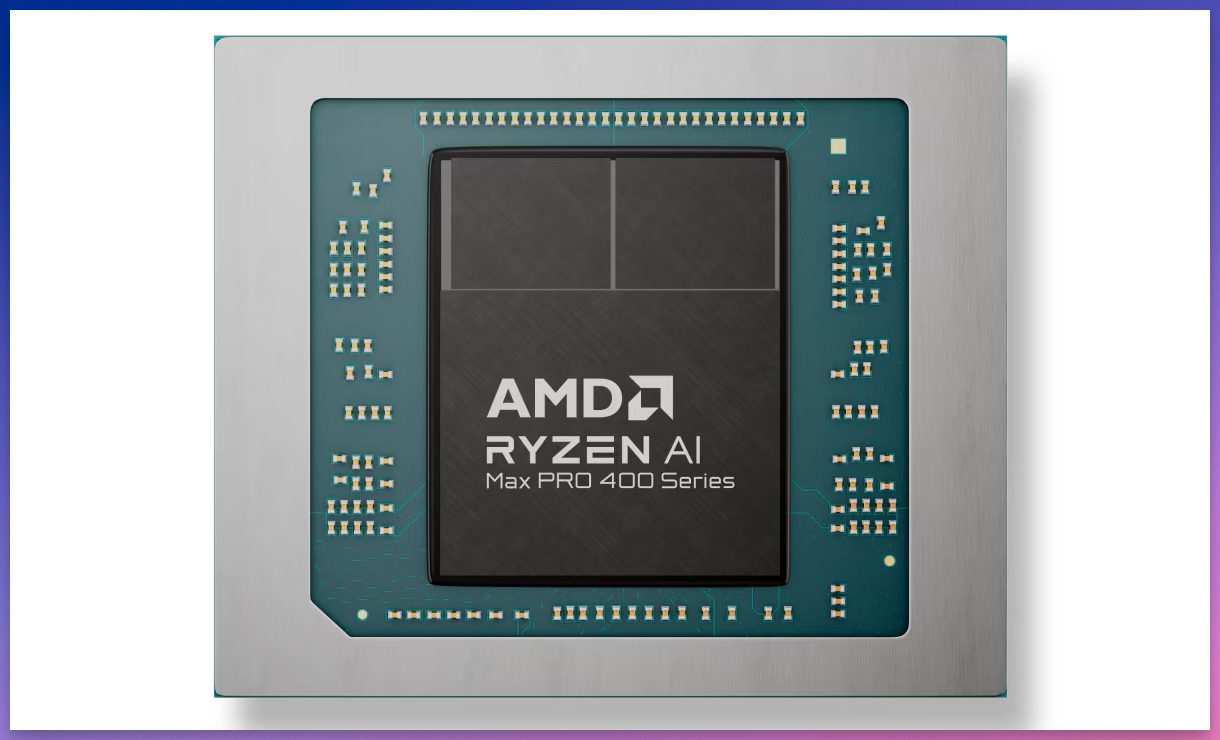
Under the hood, you get a Zen 5-based chip with 16 cores and 32 threads, boosting up to 5.2GHz, paired with a 40-core Radeon 8065S GPU that Chuwi claims can outperform an RTX 4060 for 1080p gaming. On the AI side, the machine offers up to 131 TOPS of total compute, including 55 TOPS from its XDNA 2 NPU, which meets Microsoft’s Copilot+ PC standard.

Recommended Videos

Despite all that hardware, the UniBox AI495 Pro stays compact at just 209.6 x 209.6 x 67mm, or about 2.9 liters in volume. While Chuwi is not the first one to do this, packing this much memory and AI compute into a 2.9 liter box is still a serious flex. You also get a 2TB SSD, three M.2 PCIe ×4 slots for expansion, dual 10Gbps Ethernet ports, an OCuLink port, and dual USB4 ports rated for 40Gbps.

A more affordable UniBox option

Alongside the Pro, Chuwi is also launching the UniBox AI395, which swaps in AMD’s Ryzen AI Max+ 395 (Strix Halo) chip. It tops out at 128GB of memory with up to 96GB allocatable as VRAM, and it can handle local models up to 235 billion parameters using MoE and low-bit quantization. Both machines run Windows 11 Pro and share the same 240W charger, Wi-Fi 7, and Bluetooth 5.4.

Chuwi hasn’t announced pricing or availability for either model yet, so if a personal AI workstation is on your wish list, you’ll have to wait a bit longer to see what it’ll cost you.

Rachit Agarwal
Rachit is a seasoned tech journalist with over ten years of experience covering the consumer technology landscape.
Google finally lets you turn any website into an app on Googlebook
Google heard your complaints, and now every website can be an app on your Googlebook.
Using the HP Googlebook

Googlebook users, rejoice. Google is rolling out a Chrome update that turns any website into a web app, and you have the community to thank for it.

When Googlebook first arrived, Chrome was picky about which sites you could install. Only websites that developers had set up as web apps got the Install option. Everything else ended up as a shortcut that simply launched a browser tab.

Read more
DigUp lets users find Mac files by describing them, not remembering their names
Can't remember where that screenshot, PDF or recording went? Just describe it and let AI do the digging.
DigUp App in Use screenshot

There's a particular kind of frustration that comes with knowing a file exists somewhere on a computer but having absolutely no idea what it's called. Was that screenshot saved as IMG_4837? Which PDF contained that clause? And where did that podcast recording mention the thing worth remembering? DigUp wants to end the filename guessing game, letting Mac users search for files by describing what they remember instead. The free, open-source app uses Google's EmbeddingGemma 2 to search across photos, documents, PDFs, audio recordings and videos, all without sending personal files to the cloud.

DigUp turns everyday descriptions into file searches

Read more
A new AI detector looks beyond words to check whether the ideas came from AI
This could help journals distinguish AI-written research from human work polished with AI.
ai-writing-book

Most AI detectors look for telltale signs of AI-generated text by examining word and sentence patterns. A new tool called IdeaLens takes a different route to solving this problem. It spots AI-generated research by looking at the ideas behind it instead of the wording itself (via TechXplore).

Researchers from the University of Maryland, Google DeepMind, and Simon Fraser University built IdeaLens to check whether a document's core arguments came from a human or a machine, regardless of who wrote the final draft.

Read more