Lenovo is expanding its commercial PC portfolio with a clear goal: make AI a more practical part of everyday work rather than something businesses experiment with on the sidelines. At Lenovo Innovation World at IFA 2026 in Berlin, the company unveiled new ThinkCentre desktops, ThinkBook laptops, ThinkVision monitors, security technologies and several proof-of-concept devices built around its broader Hybrid AI strategy.
The idea is to combine on-device AI with cloud-based intelligence, allowing workloads to run where they make the most sense. Lenovo says this approach is becoming increasingly important as companies move AI from testing into actual business operations.
Johnson Jia, senior vice president of Lenovo’s Global Innovation Center, said 96% of organizations plan to increase AI investments in 2026, highlighting the growing demand for computing systems that can support those deployments.
Lenovo builds PCs for the agentic AI workplace
At the top of the new desktop lineup is the ThinkCentre X Ultra, a compact 1.6-liter system powered by up to AMD Ryzen AI Max+ PRO 495 Series processors and supporting up to 128GB of unified memory. Lenovo says its cluster-ready architecture can connect up to four systems, allowing businesses to expand compute and memory resources for larger AI models, longer context windows and multi-agent workloads.
More conventional business systems are getting AI upgrades too. The ThinkCentre M75s Gen 6 offers up to 50 TOPS of local AI acceleration, while the tiny ThinkCentre M75q Gen 6 supports up to 64GB of memory and up to four displays.
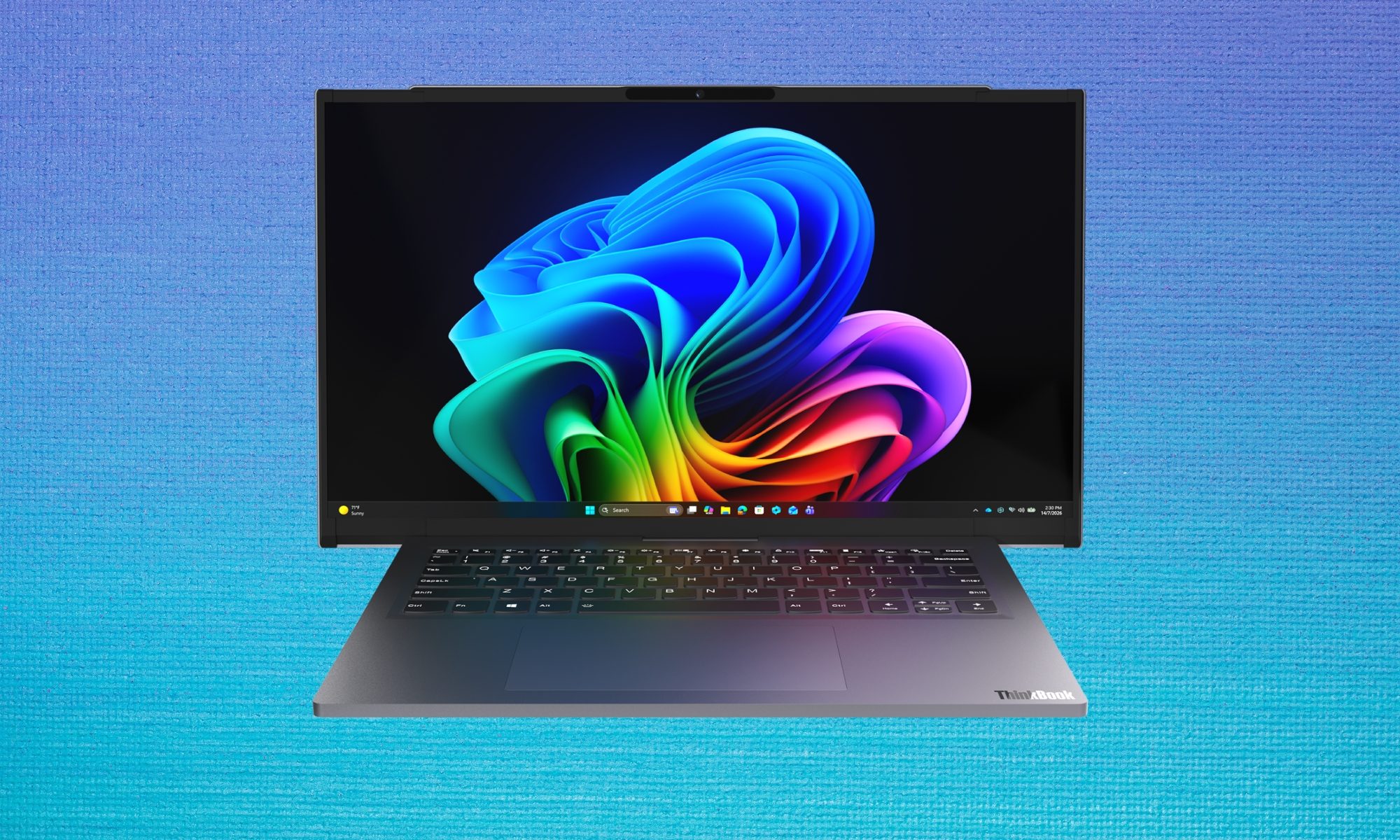
For mobile workers, Lenovo is introducing the ThinkBook 14 Gen 9, with Snapdragon X2 Plus processors and 80 TOPS of AI performance. It combines Copilot+ PC capabilities with Lenovo Qira features designed to help users stay on top of meetings and missed conversations. Lenovo claims up to 26 hours of local video playback.
The interesting part may be what comes next
Lenovo is also using IFA to show where its commercial PCs could go. Project AeroBlade is a fanless 14-inch concept measuring under 10mm thick and weighing under 830g. Its solid-state AirJet-based cooling system is designed to sustain AI performance without conventional fans. Project Swan, meanwhile, transforms from a 14-inch laptop into a 17-inch display for a larger workspace.
The company is simultaneously upgrading the desk itself. The ThinkVision P34WD-4v combines a 34-inch curved display, Thunderbolt 4 docking, a 5MP camera, and AI-powered features such as automatic framing, speaker adjustment, privacy detection, and brightness controls.
Security is another part of the Hybrid AI equation. Lenovo’s ThinkShield portfolio now includes technologies for tracking lost devices and monitoring enterprise AI usage, with the company emphasizing governance alongside performance.
The first products begin arriving from September through November 2026, while several ThinkVision models follow in 2027. The bigger question is whether businesses will find enough value in Hybrid AI to move beyond pilots and make these systems part of their everyday infrastructure.