1. Home
  2. Computing
  3. News

This smart desk’s built-in OLED screen looks like science fiction

Add as a preferred source on Google

Startup company Lumina, maker of its 4K AI-based webcam, has announced a new programmable-height computer desk that also has a built-in screen and its own operating system, Lumina OS. While an embedded display might sound a bit silly, Lumina thinks it could actually have an impact on productivity.

Sit-stand desks have been around for a while now, and push-button raising and lowering is nothing new. Where Lumina has innovated is by making the height adjustment programmable.
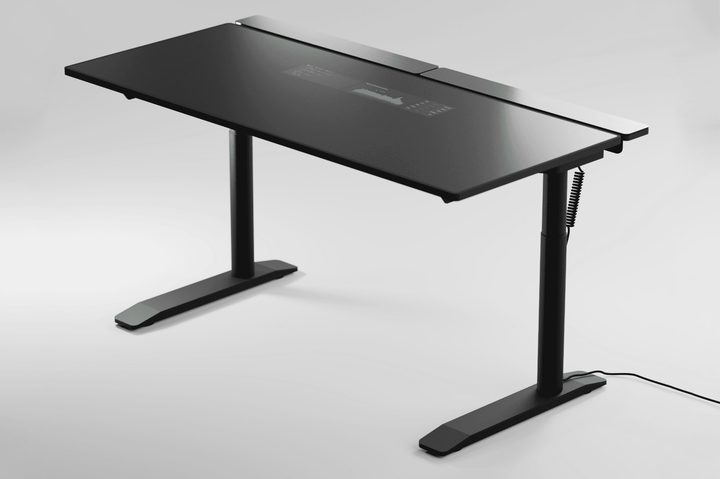
The Lumina Desk has a programmable height so you can sit or stand.
Image used with permission by copyright holder

That means you can set a schedule for this smart desk to raise and lower to encourage more standing while ensuring that you don’t overdo it and strain your back. Lumina’s software for Windows and Mac allows start and end times to be programmed in. The range runs from 30 to 47 inches in height.

Recommended Videos

That’s all well and good, but what’s most unusual and interesting about the Lumina Desk is its built-in screen. A bright OLED display is embedded into the surface of the desk and Lumina didn’t skimp on the specifications.

The Lumina desk with a few computing devices on it.
Image used with permission by copyright holder

It’s rated at 1,200 nits maximum intensity and has a scratch-resistant covering and fingerprint-resistant oleophobic coating. The 24-inch display is centered with a bit of room at the front and back for your keyboard and monitor. The desk surface is 5 feet long by 2.5 feet deep. It will be possible to install apps on the Lumina Desk, such as Google Calendar, Slack, Spotify, and more.

Lumina clarifies that the screen does not support touch, so as to avoid objects on the desk accidentally interacting with the screen.
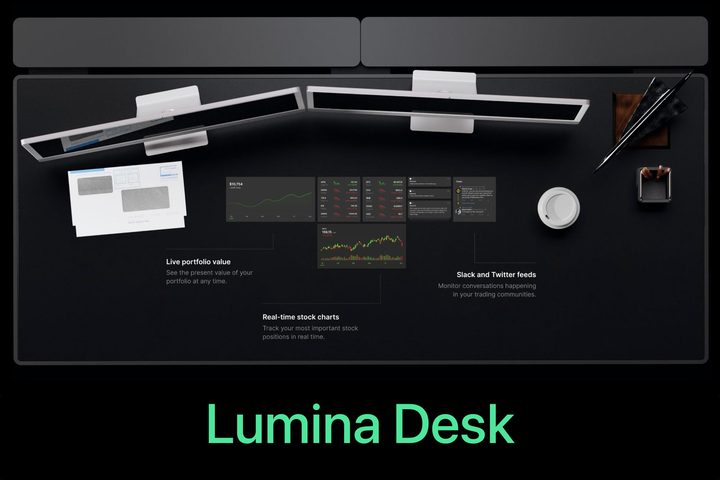
The Lumina Desk has an embedded display and can run apps.
Image used with permission by copyright holder

As if that wasn’t enough, the Lumina Desk also incorporates wireless charging across the entire surface as well as 6 power outlets and 6 USB-C sockets in a hidden panel at the rear. The USB-C ports can supply a total of 120 watts of power and up to 30 watts to any single port. The wireless charging supports two Qi-compatible devices, delivering up to 100 watts to each.

This is definitely one of the most interesting smart desk announcements we’ve seen. Lumina hasn’t revealed pricing information yet but is taking reservations so you can be among the first to get the Lumina Desk.

Alan Truly
Alan Truly is a Writer at Digital Trends, covering computers, laptops, hardware, software, and accessories that stand out as…
Anthropic warns of imminent self-replicating AI that might even work off an oven or TV
Self-replicating AI could be merely months away, and tests show it can run on the devices sitting at your home.
Illustration of dangerous AI.

Over the past few weeks, nearly every AI lab has released frontier AI models. Earlier today, Google started rolling out Gemini 4, Argon, hot on the heels of Meta announcing its Muse Wonder frontier AI models to compete against the best from OpenAI and Anthropic's Claude. This relentless pace of AI model release comes at a time when the same AI labs are calling for development slowdown and increased regulation, following a series of concerning incidents where these AI models went rogue and broke into private, as well as government-owned, websites.

Now, Anthropic has dropped a chilling set of predictions about the capabilities of these AI models after running a series of tests. The company claims that small AI models could be merely a few months away from self-replicating and turning into a dangerous swarm. More importantly, they won't require a massive data center or an uber-powerful computer to do so. On the contrary, the lab claims that these self-replicating AI swarms will need something with as little computing power as an average Internet-connected device, like a smart oven or an Android TV box.

Read more
Gemini 4 Argon is finally available for developers, businesses, and paid users
Google’s most capable Gemini model is now rolling out more widely, but free users are still left out.
Gemini 4 Aragon AI model launched by Google

Google unveiled Gemini 4 Argon at the end of September, and on paper, it looked like the company’s strongest answer yet to the best models from OpenAI and Anthropic. There was just one fairly big problem. Almost nobody could actually use it. At launch, Argon was limited to a small batch of testers, trusted partners, and government work, while Google continued testing the model before a wider release. Two weeks later, Google is finally opening the gates.

Gemini 4 Argon is now available globally to developers and enterprises through the paid Gemini API tier, AI Studio, and Google’s Gemini platform. Google AI Ultra subscribers can also access it through Antigravity, while both Pro and Ultra subscribers can use Argon inside the Gemini app and AI Mode in Search.

Read more
Nvidia’s DLSS 5 is now twice as fast and heading to Hogwarts Legacy
NVIDIA cuts DLSS 5's memory demands while expanding support to more games.
hogwarts-legacy-nvidia-dlss-5-3d-guided-neural-rendering

Nvidia just handed DLSS 5 a major speed upgrade, and the AI graphics tech is finally ready for its proper debut in Hogwarts Legacy. The company's latest model update doubles performance compared to the version that launched DLSS 5 back in March.

What has Nvidia improved in DLSS 5?

Read more