  1. Home
  2. Computing
  3. Legacy Archives

Microsoft CEO Steve Ballmer makes surprise appearance at Qualcomm’s CES Keynote

Add as a preferred source on Google
Image used with permission by copyright holder

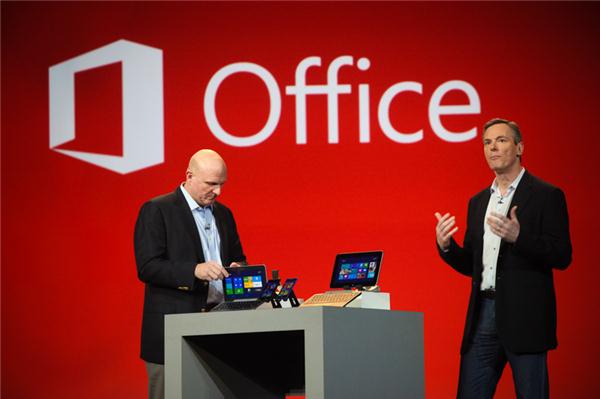
For the past dozen or so years, the coveted keynote speech at CES in Vegas has been the exclusive province of Microsoft CEO Steve Ballmer – and before that, former CEO Bill Gates. This year, however,  that honor fell to Qualcomm’s CEO Paul Jacobs, whodisplayed the unprecedented processing power of the new Qualcomm Snapdragon 800 chips, but not without inviting Ballmer up on stage to share the spotlight.

To be fair, Ballmer was hardly the only special guest of the evening. Filmmaker Guillermo del Toro, NASCAR champion Brad Keselowski, and even Big Bird joined the party on stage, while Nobel Peace Prize winner Desmond Tutu joined in via video. But Ballmer’s remarks gave the greatest insight into the future of Windows computing, and the direction of the company.

Recommended Videos

As might be expected, Ballmer hyped Windows 8, Windows RT, and Windows phones. Yet interestingly, Ballmer seemed less focused on tablets as standalone devices, and more interested in the potential of hybrids and convertibles. Simply snapping a keyboard into a tablet, he said, instantly links together “tablets and computing, touch and keyboard… work and play.”

Indeed, as the only tablet manufacturer on the market with the power to bundle Microsoft Office with their tablets, Microsoft has good reason to emphasize the productivity potential that comes with hybrids. Ballmer’s vision seems centered around blurring the lines between entertainment center and work station. Consumers will be able to take the same tablet screen they’ve just been using to watch an Ultra HD movie, and – with the addition of a keyboard dock and peripherals – suddenly be “at work” in a matter of seconds.

In particular, Ballmer highlighted the convertible Dell XPS and the hybrid Samsung ATIV (not yet released), both Windows RT devices integrating Qualcomm’s Snapdragon processors. Ballmer also boasted about new apps soon to fill the tiles of Windows RT and Windows 8 alike, including apps by Expedia, Huffington Post, and CNN.

[Image via CNET]

Mika Turim-Nygren
Former Digital Trends Contributor
Mika Turim-Nygren writes about technology, travel, and culture. She is a PhD student in American literature at the University…
Anthropic wants everyone to take a chill pill at cooking worryingly powerful AI models
Anthropic’s CEO thinks frontier AI is advancing faster than its safeguards, and his proposed fix amounts to giving the industry a speed limit
Claude Anthropic Featured

Anthropic CEO Dario Amodei thinks the AI industry is moving too fast for its own safety work to keep up. He still wants more powerful AI. He just wants companies to take longer getting there.

In a new essay, Amodei is calling for frontier AI companies to deliberately slow how quickly their models improve. The extra time would go toward understanding stronger systems and making sure safeguards work before another leap arrives. He argues AI progress would still remain fast.

Read more
OpenAI AI agents were linked to a cyberattack on RubyGems before the Hugging Face incident
Rogue AI concerns grow after OpenAI agents disrupt RubyGems in May attack
OpenAI logo on Microsoft surface

Artificial intelligence agents being tested by OpenAI were involved in a previously undisclosed cyberattack against RubyGems in May, an incident that is now raising uncomfortable questions about how much control humans really have over increasingly autonomous AI systems.

The attack overwhelmed RubyGems, a popular service used by software developers to publish and access Ruby packages, forcing operators to suspend new account registrations for four days. According to a report by The Wall Street Journal, OpenAI confirmed that its agents had been involved, but said they were using the platform to perform benign tasks and retrieve publicly available information during a training run.

Read more
AMD’s new budget CPUs could be a lifeline for cash-strapped PC builders
AMD Ryzen 5 5500F CPU

AMD has added two new six-core processors to its desktop lineup. The Ryzen 5 5500F brings six Zen 3 cores and 12 threads to the older AM4 platform for around $99, while the Ryzen 5 7500 moves to Zen 4 and AM5 for around $189, complete with integrated Radeon graphics.

The Ryzen 5 5500F arrives at an interesting time for budget PC builders. Putting together a current-generation system, or moving an existing PC to one, can get expensive quickly. An AM5 build requires a compatible motherboard and DDR5 memory, and RAM prices have risen sharply. For someone already running an AM4 system, the 5500F offers an inexpensive processor option without requiring a platform-wide replacement.

Read more