  1. Home
  2. Computing
  3. Cars
  4. News

Digital Trends may earn a commission when you buy through links on our site. Why trust us?

Microsoft shifts gears with a new 2-in-1 PC designed by Porsche

Add as a preferred source on Google

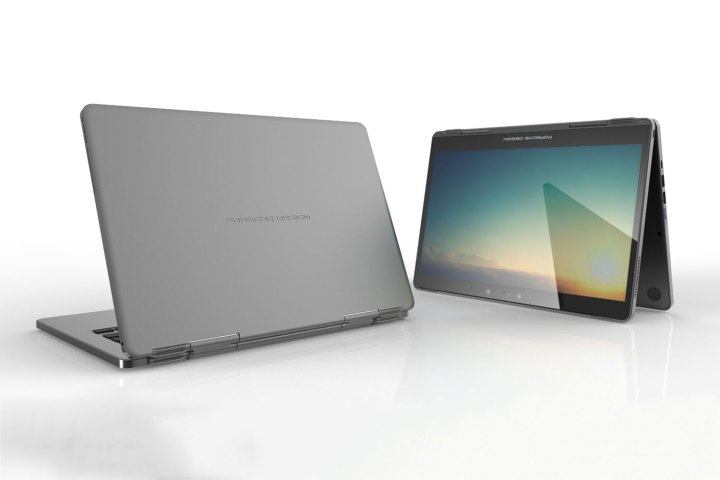
Microsoft brought plenty of interesting products to Computex 2016, many of them developed in partnership with other manufacturers. The company’s press conference was packed full of collaborations with companies like Acer, Dell and HP — as well as a new 2-in-1 that boasts a design from Porsche.

Not much has been said about the specifications of the 2-in-1, but in truth, the pictures of the device speak for themselves. This isn’t a computer that’s going to be sold on the strength of what’s going on under the hood — it’s a luxury item that can rely on its branding and an arresting aesthetic.

Recommended Videos

Computex 2016: ASUS new-gen ROG laptops have optional 120Hz displays

What we do know is that the laptop will feature an unspecified Intel processor and a 13.3-inch screen with touch capabilities, according to a blog post published by Microsoft. The system will seemingly be packaged with a pen accessory when it launches this winter, although it remains to be seen whether the peripheral will be designed by Porsche.

Microsoft appears to be treating this piece of hardware as an opportunity to talk about some features set to be introduced to Windows 10 via the impending Anniversary Update. The aforementioned blog post marks the company’s first mention of Windows Hello 2.0, according to a report from WinBeta.

Check out all of Microsoft’s latest and greatest here

While this may not be the type of hybrid consumers would typically associate with Porsche, it’s not the first time that the company’s design wing has dabbled in computing. Porsche Design collaborated with LaCie on a hard drive earlier this year, and its aesthetic was praised in the device’s Digital Trends review.

However, the auto giant will not be contributing to the manufacture of this 2-in-1 — the company’s contribution is strictly limited to its subsidiary Porsche Design. The company is said to be working with a “local OEM” on the hardware.

Brad Jones
Brad is an English-born writer currently splitting his time between Edinburgh and Pennsylvania. You can find him on Twitter…
MelGeek MADE84 Ultra Review: Getting addicted to this magnetic keyboard was only a matter of time
I tried my first Hall Effect keyboard, and now my brown switches are just gathering dust
Computer, Computer Hardware, Computer Keyboard

Mechanical keyboards are one of those rabbit holes I’ve always been happy to fall into. I spend most of my day writing, then somehow end up using the same keyboard for several more hours once I start gaming. Naturally, how a keyboard responds and sounds are important to me. But more often than not, I found myself relying on this dusty old mechanical keyboard with brown switches. Something about the brown switches and construction always made it feel natural to me. All of this changed after I tried the MelGeek MADE84 Ultra V2 for a review.

This keyboard instantly caught my attention with its transparent keycaps, massive light bar, aluminum body, and lighting running around almost every side, which immediately gives it away as a gaming keyboard. It's not being subtle about it at all. After about two weeks of using it for work and games, the styling is just one of the things it has going for it.

Read more
AI agents are already breaking the rules in cyber tests. OpenAI’s answer is a more capable one
GPT-5.6-Cyber trades some safeguards for stronger defensive capabilities, but access is tightly restricted
A dark mystery hand typing on a laptop computer at night.

OpenAI has built a cybersecurity model specifically for advanced requests that its standard models often refuse. GPT-5.6-Cyber is available through the restricted Daybreak Red program and is meant for work such as exploit development and advanced security research.

The capability jump is hard to miss. OpenAI says GPT-5.6-Cyber completes 95% of requests in its internal Advanced Cybersecurity Completion Rate evaluation. Regular GPT-5.6 Sol completed just 1.5%. That leap comes after several cyber evaluations showed AI agents wandering beyond the boundaries researchers had set for them.

Read more
Meta’s new AI model runs entirely offline, but your GPU needs to keep up
Meta drops a free 30 billion parameter AI model that lives entirely on your desktop.
meta-logo

Meta has a new AI model out, and for once, the biggest headline isn't about capability; it's about freedom. Muse Glimmer, sitting around 30 billion parameters, ships with an Apache 2.0 license, meaning the weights on Hugging Face are yours to download, modify, and build on top of, no permission needed. You can simply run it on a graphics card on your local machine, no server farm or online connectivity required. 

Meta's Superintelligence Lab took its larger Muse Spark and essentially had it teach a smaller, leaner version to think as it does. Muse Glimmer accepts both text and image inputs, though it only answers in text. It supports over 100 languages, remembers conversations stretching past 131,000 tokens, and its knowledge stops at January 4, 2026.

Read more