  1. Home
  2. Emerging Tech
  3. News

A disembodied AI robot hand just learned to walk, and it looks horrifying (for a purpose)

The Thing from Addams Family just got a real-world robotic upgrade

Add as a preferred source on Google
robot-hand-eth-zurich-soft-robotics-lab
The robotic hand nudging a golf ball Soft Robotics Lab, ETH Zurich

If you grew up watching The Addams Family, you probably remember Thing crawling around as a disembodied hand. Now, researchers have built something remarkably similar.

Engineers at ETH Zurich’s Soft Robotics Lab created an autonomous robotic hand that uses its fingers as legs. It can crawl across different surfaces, recover from falls, press keyboard keys, and push objects.

How did researchers teach a robotic hand to walk?

Past attempts to make robotic hands walk relied on symmetrical fingers, since equal lengths make balancing easier. That approach meant giving up the uneven, human-like fingers and opposable thumb that allow a hand to grip everyday objects well. Led by Amir Kazemi, the team instead kept a standard human-shaped hand and trained it anyway.
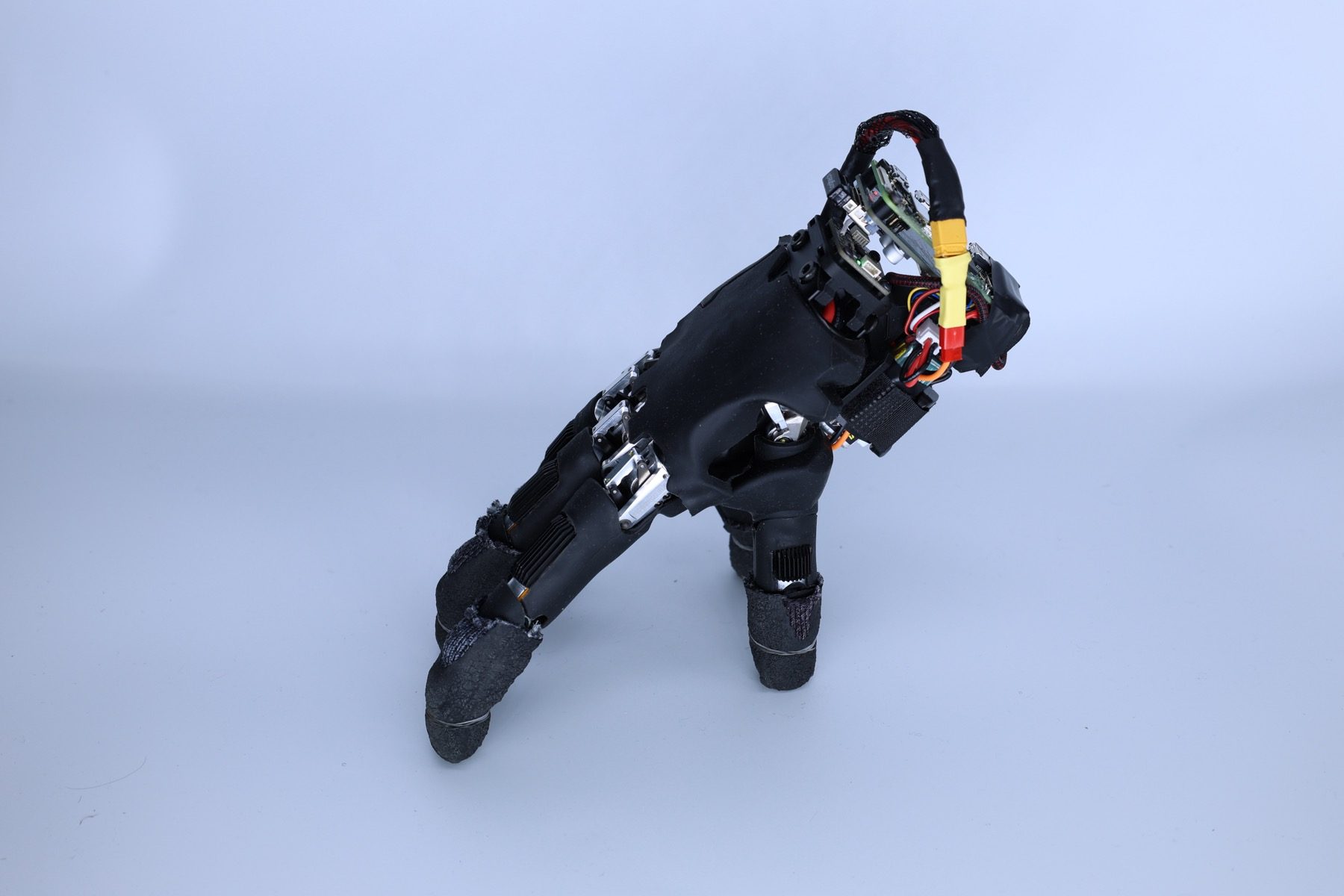
They mounted a battery, motion sensors, and a small onboard computer on the hand. Then they used reinforcement learning in a simulator to teach it movement and balance from scratch. This robotic hand can crawl across 14 surfaces, including carpet, gravel, grass, and metal grating. When tipped onto its side, it can push itself upright again in 21 out of 25 attempts. That means it essentially taught itself to fall and recover as a person might.

So what else can this creepy little Thing actually do?

Walking isn’t the only trick this robotic hand can do. It can balance on four fingers while lifting the fifth finger to press keyboard keys. In a test, it selected the correct key 29 times out of 32. It can also nudge a small block across a table, landing it within two centimeters of the target in 15 separate tests.

Researchers say a fully mobile hand could squeeze into tight spaces without the robotic arm that usually carries it. It could then inspect or manipulate objects on its own before returning. They believe giving robotic hands their own mobility could make robots more versatile around human environments.

Recommended Videos

Robots have been getting increasingly strange in other ways, too. From wheel-footed machines to some other creepy-looking robotic creations, the line between useful machine and nightmare fuel is getting blurrier. Whether the latest piece of tech feels useful or unsettling to you probably depends on how you feel about disembodied hands crawling towards you.

Manisha Priyadarshini
Manisha Priyadarshini is a tech and entertainment writer with over nine years of editorial experience.
The camera on my smart glasses gives me the ick. The people around me feel the same.
Hey, stranger, you won't know it, but I just captured you in a picture and recorded you in a video!
Person wearing glasses with a camera

"Dude, I feel like a creep every time I press the camera button and the LED lights up." That was the blunt verdict from a friend who tried my camera-equipped smart glasses earlier today. My own feelings aren't too different. There's also a functional friction here, which I'll rant about soon enough.

I've used plenty of smart glasses. For the past four years or so, even before Meta flooded the market with its Ray-Ban-branded camera glasses, I've been playing around with another breed that lacked a camera but still offered plenty of fun. Brands like Rokid, XREAL, and Viture have been selling smart glasses with a built-in display unit, promising a private screen that sits right on your face. Immersive entertainment, or spatial computing on the go, all of it without a monitor in sight.

Read more
E Ink’s new color screen could make PDFs and digital notebooks easier on the eyes
Color e-paper wants a day job beyond reading books.
Advertisement, Poster, Animal

Color e-paper has always felt like a compromise to me. You get color, but the text loses some of its crisp, printed-page look. That’s always been my biggest gripe with color e-readers.

Turns out, E Ink has a solution called Kaleido 4, the latest version of its color e-paper platform, and it already ships on Hanvon’s M10C II notebook.

Read more
Xreal’s latest AR glasses fix the brightness problem, but leave the rest largely untouched
Accessories, Sunglasses, Glasses

AR glasses sound magical until I imagine wearing them somewhere bright. That’s why a new pair launched today caught my eye.

Xreal's 1 Pro Plus refreshes its One Pro glasses (which float a virtual screen in front of your eyes). It packs a much brighter display than the outgoing model and smoother 2D-to-3D conversion. You can buy it now for $599.

Read more