  1. Home
  2. Emerging Tech
  3. News

A new sunlight-powered trick could make smelly trash bins a thing of the past

Researchers found a way to make the sun do the dirty work of fighting garbage smells.

Add as a preferred source on Google
trash cans
Jan van der Wolf / Pexels

If you have ever lifted the lid of a trash bin on a hot day, you know the smell I am talking about. One of the culprits behind that sour, vinegary stench is acetic acid, which builds up as food waste starts to rot. Now, a team of researchers from several Chinese institutions, including Central China Normal University and the Beijing Academy of Science and Technology, has found a way to tackle it using sunlight.

How does sunlight get rid of the smell?

The team started with manganese oxide, an affordable material that can already break down acetic acid. To give it a boost, they added a small amount of lithium, which makes the oxygen inside the material far more active and better at tearing apart acetic acid molecules.
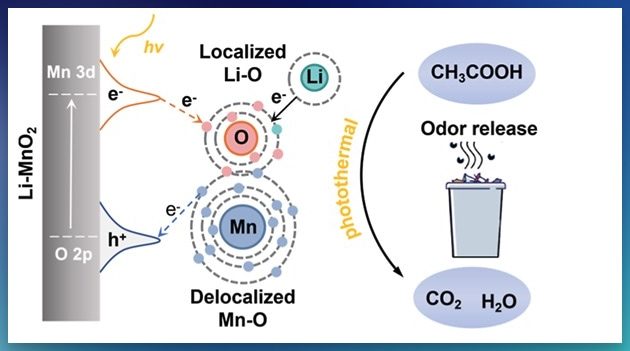
The clever part is the power source. Odor-fighting catalysts usually depend on electric heating to get going, but here the sun handles that job. According to the team’s calculations, lithium helps the catalyst turn light into heat more efficiently and hold that heat on its surface where the action happens.

Recommended Videos

The team designed an add-on that slots into the lid of an everyday wheeled bin. Its see-through, breathable top lets in both sunlight and bin air, and a built-in lens aims that light right at the catalyst. Under simulated sunlight, the lithium version outperformed plain manganese oxide and activated carbon, the stuff inside many odor filters.

Does it actually work outside the lab?

To find out, the researchers filled waste bins with nearly 3 kilograms of bananas, apples, oranges, pears, tangerines, bread, and even red wine. They then tracked the smell for around 1,000 hours, and the bin with the catalyst generally had lower acetic acid levels than the one without it.

The catalyst also held up in humid conditions, removing over 90% of the acetic acid for most of a 50-hour test. That is good news, since trash bins are rarely dry places.

This is still lab research, so don’t expect a sun-powered trash can at your local store just yet. That said, if this tech makes it into real products, taking out the trash might finally become a little less painful.

Related coverage:

Rachit Agarwal
Rachit is a seasoned tech journalist with over ten years of experience covering the consumer technology landscape.
Checking body medication levels may now be as easy as sucking on a peach-flavoured lollipop
Forget the clinic swab; this lollipop wants a lick
Lollylab

Checking your body’s medication levels is usually no one’s idea of fun. Now researchers are trying to change that with Lollylab, a candy-coated, lollipop-like device that can collect saliva and measure levels of acetaminophen in under two minutes.

The prototype created by researchers whose work was published in ACS Sensors transforms a familiar object into a miniature testing device. In a pilot study, six adults ingested the peach-flavored Lollylab before and one hour after a standard 650-milligram dose of acetaminophen. The device repeatedly detected the pain reliever in their saliva, and participants reported it was more comfortable and easier to use than traditional saliva swabs.

Read more
A US state just approved an AI doctor. For now, it’ll only prescribe acne cures.
Aside from acne, Nolla's AI can also handle redness, fine lines and wrinkles, hyperpigmentation and dark spots, and under-eye bags.
Nolla Derm AI doctor app.

The first AI doctor is here. Despite all the skepticism and risks associated with AI models going haywire, the state of Utah just approved Nolla Health, a company that is providing an AI healthcare expert capable of writing prescriptions without any human in the chain. For now, it will only write acne prescriptions for Utah residents over 18 years of age, willing to pay a token monthly subscription fee that's lighter than your Spotify bill.

The big push here is that the Nolla Derm app will reduce the costs of medical consultation, save users the hassle of clinic visits, and take out the problem of waitlisting from the entire healthcare equation. “Unlike telehealth platforms that use AI only to collect information before handing patients off to clinicians, Nolla's AI system is designed to independently issue initial prescriptions within tightly defined, physician-approved treatment protocols,” writes the company. 

Read more
AI’s massive appetite could make cheap smartphones much harder to find
The smartphone aisle is getting pricier, and AI may be partly to blame.
Electronics, Mobile Phone, Phone

Buying a genuinely cheap smartphone could soon become a lot harder, and the reason has little to do with what’s happening inside the smartphone industry itself. The enormous amount of hardware being poured into AI data centers is pressuring global memory supplies. That has helped drive up the cost of making phones, and manufacturers appear increasingly reluctant to absorb those extra costs at the cheapest end of the market.

According to Counterpoint Research, prices of existing smartphones have increased by around 15% globally this year, while newly launched devices are roughly 25% more expensive than comparable models from last year. The impact hasn't been equal everywhere, either. Smartphone prices have climbed 21% in India and 19% across Asia-Pacific, compared with just 5% in the US.

Read more