  1. Home
  2. Emerging Tech
  3. News

An AI-designed drug might help slow aging, but we’re not there yet

The results hint at a possible anti-aging effect, but there’s still a long way to go before we know what it means.

Add as a preferred source on Google
medical test tubes
Testalizeme / Unsplash

Rentosertib, a drug Insilico Medicine designed almost entirely using AI, was created to treat idiopathic pulmonary fibrosis, a disease that scars and stiffens the lungs over time. But fighting lung disease was only half the plan from the start.

According to a new study published in Nature Biotechnology, the drug’s target was chosen specifically because it overlaps heavily with the biology of aging, and the whole trial was designed to test whether treating the lungs could also mean turning back the body’s biological clock.

Recommended Videos

Researchers ran the drug through a 12-week phase 2a trial with 42 patients split across three doses and a placebo group. Alongside tracking lung function, the team was also checking whether the drug was quietly changing how fast these patients were biologically aging.

How do you even measure biological age from a blood sample?

Scientists used something called proteomic aging clocks. Instead of looking at your birth certificate, these tools study the proteins floating around in your blood and estimate how “old” your body actually behaves. The team ran six different clock models on the same blood samples, and all six agreed on one thing: patients taking rentosertib showed a drop in biological age compared to the placebo group. 
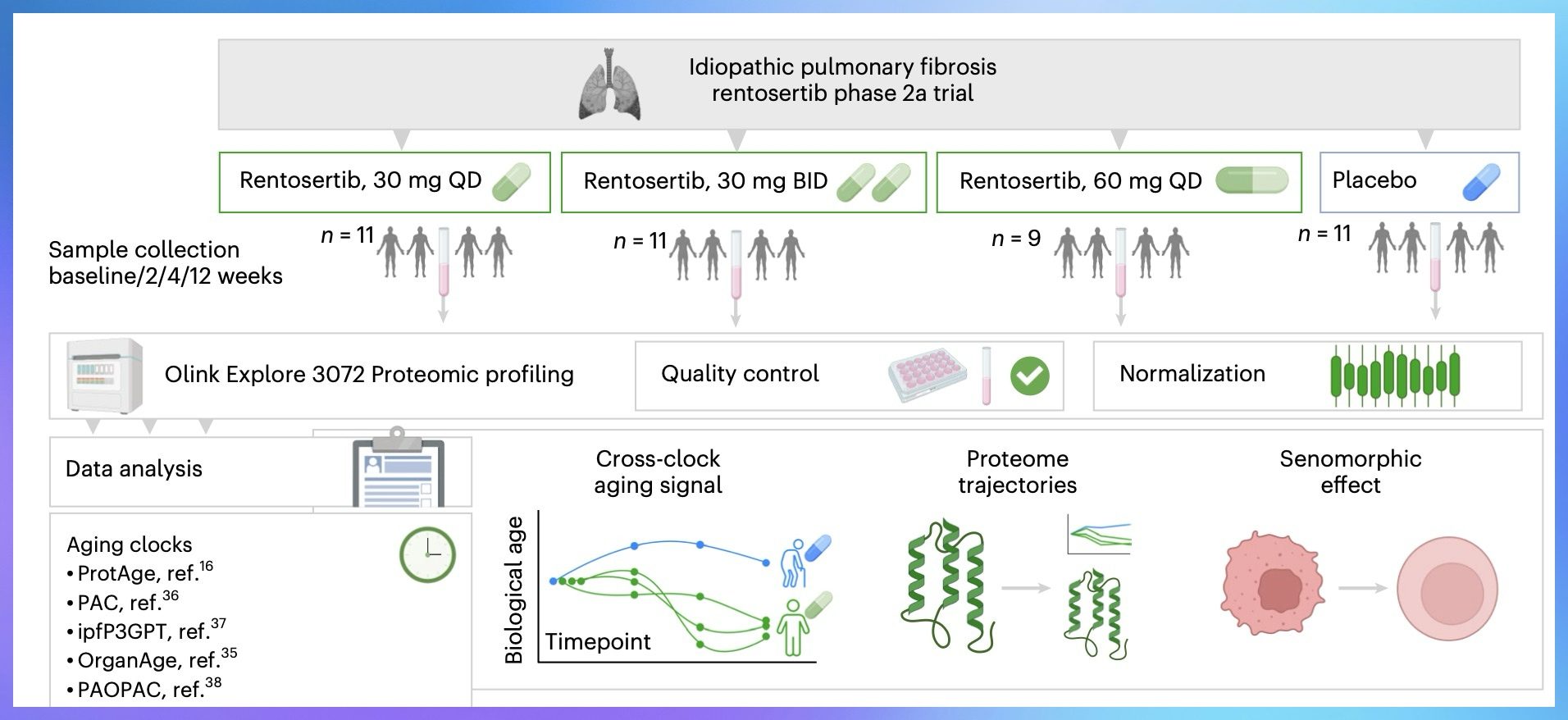
Interestingly, the effect was strongest at the lower 30mg dose taken twice a day rather than a single larger 60mg dose, even though both add up to the same amount of drug per day. Something about splitting the dose seems to matter.

Is this really an anti-aging effect, or just the drug doing its job?

That’s the tricky part. Since rentosertib is built to fight fibrosis, it’s hard to say if the biological age drop is a genuine aging reversal or simply a byproduct of patients getting healthier lungs. 

To dig deeper, researchers compared the protein changes to aging patterns from over 55,000 people in the UK Biobank. The twice-daily 30mg group showed a real reversal of normal age-related protein changes, something the once-daily 60mg group didn’t show at all, despite that group posting the best lung function results in the original trial.

Nothing here confirms rentosertib as an anti-aging drug just yet, and even the researchers say more direct testing is needed before anyone can call this a proven geroprotective effect. But it’s an early sign that building a drug around aging biology from the ground up, rather than treating it as an afterthought, might actually be a smarter way to develop treatments going forward.

Rachit Agarwal
Rachit is a seasoned tech journalist with over ten years of experience covering the consumer technology landscape.
A tiny humanoid robot uses an Android phone as its brain, and costs just $400
Your old Android phone might have a second career in robotics.
Agile's first humanoid robot, the Agile ONE.

We've all got an old smartphone lying around somewhere, collecting dust in a drawer. Maybe you've kept it as a backup, or perhaps you haven't gotten around to selling it. But what if that forgotten Android phone could actually power a walking robot? It sounds like something you'd build for a science fair, but researchers at the University of California, Los Angeles (UCLA) have turned that idea into a working prototype.

That's exactly the idea behind PhoneBot, a small humanoid robot developed by UCLA researchers. Instead of relying on expensive hardware, it uses an ordinary Android smartphone to understand its surroundings and control its movement. Even more interesting, the robot costs around $400 to build, excluding the phone. And you don't need the latest flagship either. Even an older Android phone can do the job.

Read more
Intelligent UI turns ChatGPT answers into interactive tools while GPT-6 rolls out to a broader audience 
Plain text answers just got a very interactive rival.
Intelligent UI in ChatGPT.

Would you rather read instructions for splitting a dinner bill or tap a bill splitter and let it do the math? I'd pick the latter. 

OpenAI's SOl-6 rollout, starting October 7, 2026, adds Intelligent UI. Basically, it lets the chatbot assemble interactive answers instead of replying in plain text.

Read more
Checking body medication levels may now be as easy as sucking on a peach-flavoured lollipop
Forget the clinic swab; this lollipop wants a lick
Lollylab

Checking your body’s medication levels is usually no one’s idea of fun. Now researchers are trying to change that with Lollylab, a candy-coated, lollipop-like device that can collect saliva and measure levels of acetaminophen in under two minutes.

The prototype created by researchers whose work was published in ACS Sensors transforms a familiar object into a miniature testing device. In a pilot study, six adults ingested the peach-flavored Lollylab before and one hour after a standard 650-milligram dose of acetaminophen. The device repeatedly detected the pain reliever in their saliva, and participants reported it was more comfortable and easier to use than traditional saliva swabs.

Read more