
Your smartphone can do pretty much everything: browse the Web, send emails and text messages, and make calls. But take it abroad and it ends up being as useful as a rock. While our phones are designed to keep us always connected while stateside, anyone who has traveled, particularly internationally, knows that the experience isn’t always seamless.
Sometimes, it’s a country’s poorly developed network infrastructure that keeps you from getting online. But most often it’s a business thing: Sure, you can use your phone’s existing carrier to go abroad, but you’d be charged exorbitant charges for roaming on another carrier’s network, even if you’re heading to Canada or Mexico. You could rely on public Wi-Fi, but hotspots can be hard to find, or aren’t always reliable.
We have experienced this first-hand: Traveling to a country with excellent cell service, for instance, only to find our phones locked to U.S. carriers. Or heading to Starbucks or McDonalds for Wi-Fi, only to find it so slow it’s unusable. Even with a smartphone packed with various options to get connected, we’ve often struggled to actually do so.
But the beauty of today’s technology is that there are ways around these barriers, and getting connected doesn’t require spending a lot of money. Whether it’s calling back home, getting on the Internet, conversing with locals, or catching up on U.S. entertainment, here are some of our favorite tips, products, and services.
Dual-SIM smartphone


As the name suggests, a dual-SIM phone is one that lets you use one device on two different networks. You can keep your normal domestic SIM in one slot, and purchase a temporary local SIM for use when you’re in a different country. This way you can use your roaming SIM only when you need to, like for receiving messages and calls. It helps you save money by using the temporary SIM to make calls within that country, but still keeps you in touch with home.
While popular in certain parts of Asia and Europe, dual-SIM phones are difficult to find in the U.S., as they aren’t readily available at retail. “You can buy from places in the U.S. that sell the international SIMs, like Telestial, but Amazon is a great place to pick them up as well,” says Charles Barkowski of Running with Miles. “One of my favorites is the Samsung S4 Mini – it can be had new for about $195.” (If you don’t need a smartphone, Telestial sells a basic cell dual-SIM cell phone for as low as $30.)
Samsung Galaxy S4 Mini on Amazon ($207) Telestial Dual SIM-phone on Amazon ($29)
Portable Wi-Fi hotspot
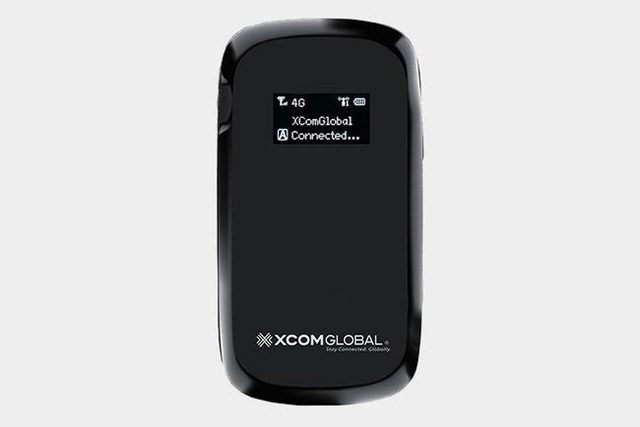
Wi-Fi is ubiquitous in major cities. It’s a cost-effective way to get online or make calls using messaging apps like Skype, WhatsApp, or FaceTime. But locating a Wi-Fi hotspot isn’t always a guarantee, nor are all Wi-Fi networks fast and reliable.
Instead of relying on public Wi-Fi (or praying there will be one), carry an international hotspot from XCom Global. Currently being used by the Solar Impulse pilots who are circumnavigating the globe in their solar-powered aircraft, XCom Global rents out portable Wi-Fi hotspots to travelers who are heading to places with shoddy Internet access. You tell XCom Global where you are heading, and a portable hotspot is dispatched to you before you set sail. The service costs $15 a day, per country (there are discounted packages as well). Once you’re done, you simply send the device back. If you see yourself having to go online often or make calls, or you’re going to a place that is known to have poor networking, this portable world Wi-Fi is a handy solution.
Media-streaming stick


If a hotel’s TV programming isn’t doing it for you, and you desperately need to catch up on Game of Thrones, pack a portable media-streaming device like the Roku Stick, Amazon Fire TV Stick, or Google Chromecast. Since many hotel rooms now come with HDMI-ready HDTVs and high-speed Wi-Fi, you can plug one of these devices into the television for expanded programming and other entertainment.
However, there are some things to note: certain services like HBO Go or Netflix may not be available if using the device internationally, and there may be issues connecting to certain Wi-Fi networks. But because these devices are so small and easy to pack, it doesn’t hurt to carry one with you, just in case. A plus: the Google Chromecast lets you mirror content from a computer, so you could use a hotel TV as an external display. Chromecast vs. Roku Streaming Stick vs. Amazon Fire TV Stick
Portable Wi-Fi router


Although most hotels in the U.S. offer Wi-Fi, internationally it isn’t a guaranteed amenity, especially if you’re staying in a non-chain property. But these hotels may offer high-speed Internet via Ethernet, and that’s where a travel router comes in handy. Even in hotels with paid Wi-Fi, you could use the router to share the connection with multiple devices.
“My tiny Wi-Fi router is always in my bag since some of the foreign hotels I hit do not have Wi-Fi,” Barkowski says.
The N150 Wireless Nano Travel Router from TP-Link is small, yet it can support up to 150 Mbps data rates. Because it’s powered via Micro USB, you can use the port on your computer, a standard AC outlet, or even a portable battery when you’re in a jam. Another option is Apple’s Airport Express, which is also compact and easy to set up.
TP-LINK N150 on Amazon ($19) Apple Airport Express at the Apple Store ($99)
Translator
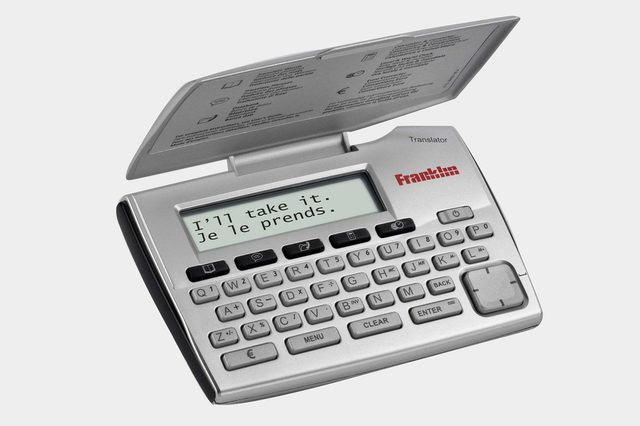
It’s amazing what Google Translate has done for international travel – just type in what you want to say, and the free Google Translate app (iOS and Android) will spit it out in a variety of common and obscure languages. The catch is that your phone needs an Internet connection for the app to work, but if you ever find yourself lost or needing to relay information in another language, Google Translate is the best and most effective app we’ve used.
For times when you don’t have an Internet connection, a good-old electronic translator is handy. And no company is more famous for making them than Franklin. The ET-2105 will help you figure out words for Spanish, French, Italian, and German.
Next-gen walky-talky
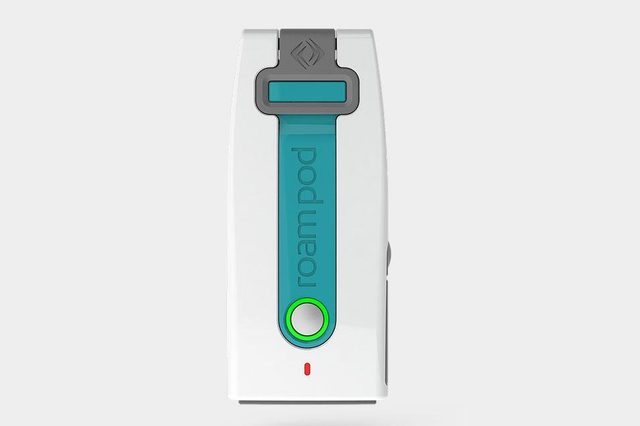
If you’re in a metro area, you’re pretty much covered when it comes to cell service – not necessarily so in rural areas or nature preserves. An upcoming gadget called the Roampod aims to bridge that gap by essentially creating a walkie-talkie-style network for smartphones.
Here’s how it works: You pair a Roampod with an iOS or Android smartphone over Bluetooth. Using a long-range frequency, you can use your smartphone to send messages to any other Roampod-connected smartphone within range. This is useful for campers who decide to split up, or for parents to contact their kids within an amusement park. If there are enough Roampods being used in a certain area, like a national park, users could use their phones to seek help in case of emergencies.


