  1. Home
  2. Emerging Tech
  3. News

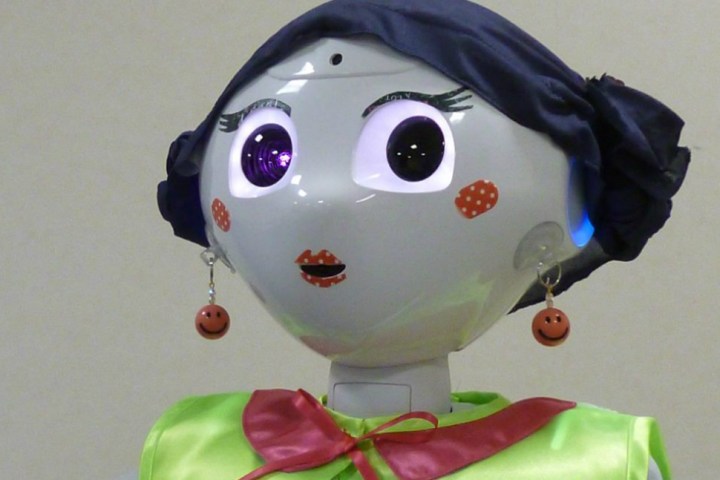
Check out what Pepper the robot looks like in a wig and makeup

Add as a preferred source on Google

SoftBank’s Pepper robot isn’t just the world’s first android to understand human emotions – it’s also the first to inspire the launch of an online store offering a range of clothing and accessories made especially for a droid.

Since going on sale in Japan in June, the 120-centimeter-tall robot appears to have won itself plenty of fans, among them two buddies who’ve got together to make and sell a range of garments and other gear so owners can personalize their Pepper.

Recommended Videos

Mitsuru Numata, who runs a Pepper fan club, came up with the idea for an online store after a chat with friend Reiko Kawauchi, according to a Wall Street Journal report.

pepper kimono
Rierie

But the task of designing clothes, jewelry, and other gear for Pepper turned out to be trickier than expected. Early designs saw materials interfere with the robot’s sensors or become caught in its joints and hinges, causing it to malfunction.

Determined to prettify Pepper, they eventually found a way of dressing it up without causing any operational issues, and once they’d knocked together a few different items, they started selling the stuff online.

Current offerings include a range of dresses for around 20,000 yen ($163), as well as a red kimono, also for 20,000 yen. For a more formal look – ideal if Pepper is acting as your butler – a tux and bow tie can be yours for 15,000 yen ($122).

And with Christmas just around the corner, the duo have just added some seasonal costumes, too.

The store also includes necklaces, earrings, hairpieces, and stickers that act as makeup.

Commenting on the venture, Numata told the Journal, “We’re not doing it for the money. We aim to offer the joy of the experience of personalizing humanoid robots.”

Pepper, which is the result of a partnership between SoftBank and French robotics company Aldebaran SAS, is being marketed in Japan as an assistant for businesses and also as a companion for families and those living by themselves.

When it went on sale in June, the first batch of 1,000 Peppers sold out in just 60 seconds. Since then SoftBank has been producing a further 1,000 a month, though demand indicates it should be making plenty more.

The robot has been designed to understand the feelings of humans it interacts with by processing information gathered via on-board cameras and sensors. It can then respond with its own emotions through body posture, tone of voice, and color changes shown on its “heart display,” essentially a tablet strapped to its torso. It can also sing, dance, and tell jokes.

Pepper costs $1,650, though buyers also have to spend an additional $200 a month to cover various service charges. The droid should arrive in the U.S. and Europe next year, so if you happen to get one and feel like making it look less naked, you’ll be pleased to know that Numata’s online store ships overseas.

Trevor Mogg
Contributing Editor
Not so many moons ago, Trevor moved from one tea-loving island nation that drives on the left (Britain) to another (Japan)…
Anker just exposed a big problem with portable power stations
Appliance, Device, Electrical Device

When you're shopping for a portable power station, there's one number that's almost impossible to ignore: battery capacity. A 2 kWh battery should give you roughly 2 kWh of usable power, right? Unfortunately, things aren't quite that simple. Anker SOLIX has published new efficiency data for its S Series portable power stations, and it's putting the spotlight on something that doesn't get nearly as much attention as capacity: how much of the energy stored inside the battery actually makes it to your devices.

According to Anker, portable power stations are commonly advertised with efficiency figures measured under relatively heavy loads, where they can reach roughly 89% to 92% efficiency. But that's not necessarily how most people use one during an outage. Think about what you'd actually plug in. A Wi-Fi router might sip power continuously, a refrigerator switches its compressor on and off throughout the day, and a CPAP machine could run overnight. Together, those devices may draw just a fraction of what a large power station is capable of supplying. And that's where efficiency can start slipping.

Read more
OpenAI’s first gadget sounds like a tiny expressive AI companion
The device will have a doughnut-shaped body, built-in cameras, and moving parts
OpenAI press image

For months, reports have suggested that OpenAI’s first hardware product would be a screen-free smart speaker designed to act more like an AI companion. We already knew it could understand its surroundings, be carried around the home, and proactively help users. A new Bloomberg report now gives us a clearer picture of what the device may actually look like.

As per the report, OpenAI’s first gadget will be shaped like a doughnut and measure about the same size as a hockey puck. You will be able to carry it between rooms or leave it nearby on whatever surface is convenient. The device is expected to be on the expensive side, as the company has pondered pricing it around $300 to $400. A release is currently planned for 2027.

Read more
Google Antigravity just built an AI translator that works without the internet
Electrical Device, Switch, Robot

Google has shown off a new AI project that could make language barriers a little less intimidating, and it doesn't need an internet connection to do it. The company has introduced the Gemma Translator, a compact prototype built in collaboration with Antigravity. Unlike most AI translation tools that rely on cloud processing, this device runs entirely offline using Gemma 4 E2B, Google's lightweight open model. Everything happens locally on the device, making it both portable and independent of an internet connection. The prototype is powered by a Raspberry Pi 5 and includes a microphone and speaker inside a custom 3D-printed enclosure, creating a self-contained translator you can carry almost anywhere.

AI translation, without the cloud

Read more