  1. Home
  2. Emerging Tech
  3. Health & Fitness
  4. News

Touch-free device uses a frickin’ laser to monitor your well-being from afar

Add as a preferred source on Google
Digital Domain/Marvel

Whether it’s heart rate, breathing rate or muscle activity, there are wearable devices that are capable of measuring just about biometric data point you can think of. But what about no-contact methods of measuring that don’t involve physically touching you at all? That is something researchers from Israeli startup ContinUse Biometrics have been working on. Their resulting device — capable of monitoring these vital signs from meters away — is set to hit shelves as soon as the end of 2018. And it all works thanks to the wonder of lasers.

“The technology has been investigated for eight years in my lab, in collaboration with the lab of Professor Javier Garcia from Valencia, Spain,” Zeev Zalevsky, professor of electrical engineering and nanophotonics at Israel’s Bar-Ilan University, told Digital Trends. “Two years ago, it was commercialized to ContinUse Biometrics, which is going to release its advanced prototypes toward the end of 2018. During the eight years of research, various sensing capabilities were investigated involving vital signs: Blood pressure, hematology, hemodynamics, and more. ContinUse’s first product is focusing on vital signs and blood pressure, [in addition to heartbeat and respiration.]”

Recommended Videos

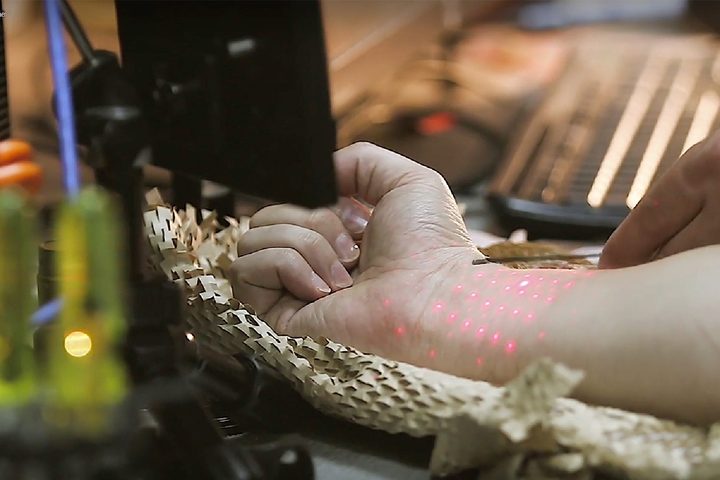
The SmartHealth Mod technology can measure these biometrics from a distance, even through a person’s clothes. It works by using a laser to illuminate a person’s chest, and a special camera fitted with optics which allow it to analyze backscattered light. When a person’s heart beats or they breathe, this causes unique “nano-vibrations” in the body which are observable by the device. These tiny vibrations can be associated with different biomedical parameters.

Using higher quality lasers and cameras, the device could reportedly be used to monitor people from as far as 0.25 miles away. Adding an extra magnetic field also allows it to estimate glucose levels in a person’s blood.

In terms of possible applications, Zalevsky said that two examples might include smart homes or smart cars. “In a smart home, the sensor [could] be part of a telemedicine system connecting subscribed patients and health providers,” he said. “In smart cars, the sensor [may be used to] monitor the condition of the driver or the people sitting in the car.” In the event that a person is determined to be unwell, authorities could be alerted as soon as possible or, in the illustration of an in-car technology, the car safely brought to a stop.


Luke Dormehl
I'm a UK-based tech writer covering Cool Tech at Digital Trends. I've also written for Fast Company, Wired, the Guardian…
Trending Forward: Fold’s CEO spills on the real future of everyday bitcoin
What if the future of Bitcoin is not the US Dollar? What if it's mainstream future is earning small rewards on everyday bills?
Bitcoin crypto wallet featured

Saying the word crypto out loud, or posting on social media sites, is almost a guaranteed road to passionate commentary. And by passionate, I mean the two extremes of the conversation — the optimist side and the vitriolic detractions. There is a big pool of leaders who still see it as the future, while others aren't quite sold on the idea. In the latest episode of Trending Forward, I sat down with Fold CEO Will Reeves to discuss whether Bitcoin actually needs to replace the US dollar to become genuinely useful to mainstream consumers.

While I've long been skeptical of crypto's wild volatility and its viability as everyday cash, our conversation explored a pragmatic alternative: continuing to live, spend, and pay bills in dollars while quietly accumulating Bitcoin in the background as a long-term savings asset.

Read more
Tiny robots could shrink weeks of heart infection treatment into a single day
Forget open-heart surgery, because these rice-sized robots take the express route to your heart.
heart being treated by tiny robot

Treating a heart infection is no walk in the park. Patients often spend weeks on IV antibiotics, and if that fails, open-heart surgery enters the picture. Johns Hopkins University engineers may have found a better way.

The team has developed magnetic “millirobots” that are about as wide as a pencil tip and roughly as long as a grain of rice. As detailed in their study published in Advanced Materials Technologies, the robots are designed to deliver medicine directly to infected heart tissue.

Read more
Meta goes toe-to-toe with the big boys as it launches Muse Wonder AI models
Illustration of Meta Muse Wonder AI model.

It's raining frontier AI models. Soon after Anthropic set alarm bells ringing with its Claude Fable model at the summit of AI peformance, OpenAI answered with GPT-6 Astra. Not one to be left behind, Google released Gemini 4 Argon. The race is now getting hotter as Meta enters the fray with two new AI models in the Muse series: Wonder and Wonder Full. Cheesy naming aside, these Meta AI models mean business, or at least that's what the benchmark figures suggest. More importantly, these AI models are already making their way to Muse users.

https://twitter.com/DigitalTrends/status/2109699549375988120

Read more