  1. Home
  2. Emerging Tech
  3. News

Meta and Google just got beaten by an AI giant you might not expect

Add as a preferred source on Google
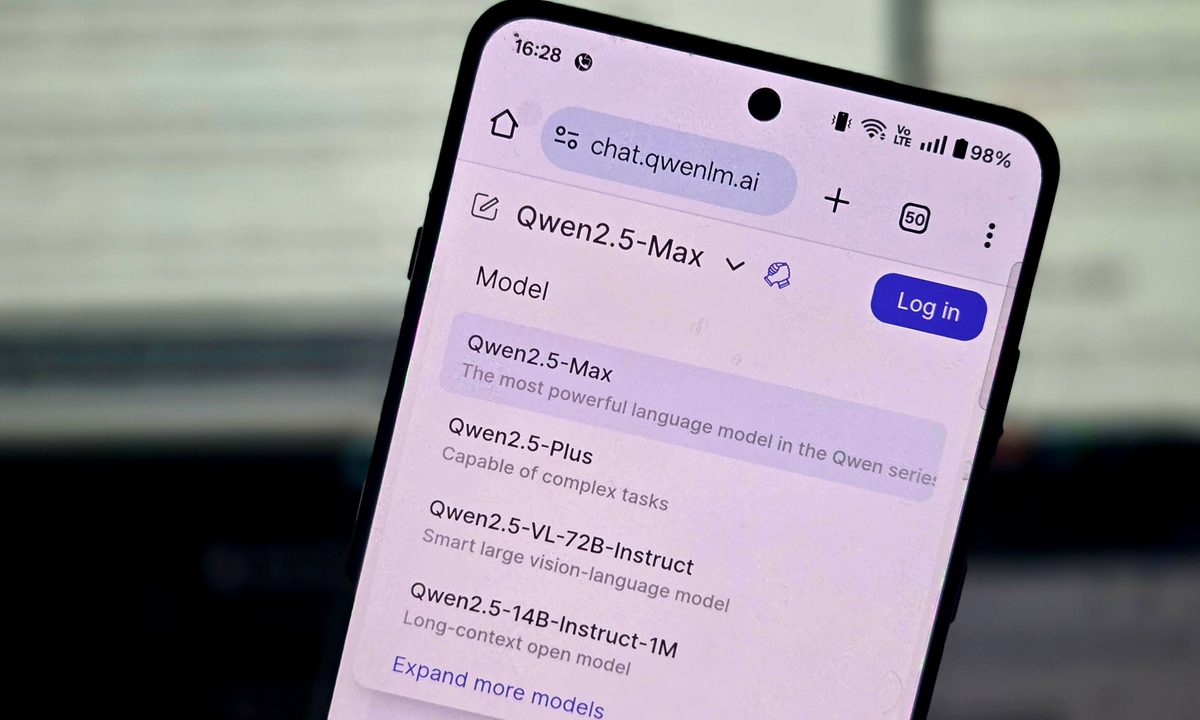
Alibaba's Qwen AI model running on an Android phone.
Alibaba's Qwen AI model Nadeem Sarwar / Digital Trends

The AI race usually revolves around familiar names like OpenAI, Google, Meta, and Anthropic. But when it comes to models developers can actually download and build upon, another company has raced to the front — and by quite some distance. Alibaba says its Qwen family of open-weight AI models has crossed 3 billion downloads globally over the past six months. That puts Qwen ahead of some of the biggest names in AI, including models from Meta and Google.

The difference is especially striking in Hugging Face data for 2026. Google’s open models have recorded around 418 million downloads, while Meta sits at roughly 227 million, according to Hugging Face’s latest State of Open Models report. Qwen, meanwhile, is becoming much more than one popular model. Alibaba has released more than 460 Qwen models, and developers have created over 300,000 derivative models from them.

Developers are building on Qwen, not just downloading it

Those download numbers matter because open models work differently from closed AI services. Developers can take them, customize them for a particular job, fine-tune them with their own data, and use them as the foundation for entirely new AI products. In other words, every download can become something else. That appears to be happening with Qwen at a huge scale. Hugging Face describes it as one of the biggest foundations of today’s open AI ecosystem, with the model family increasingly becoming a go-to choice for developers deciding what they want to fine-tune or deploy.

It can also create something of a snowball effect. More developers using Qwen means more specialized versions of it become available. Those models can then attract even more developers, further expanding the ecosystem. Alibaba has another advantage here: its cloud business. The company is bringing Qwen to enterprise customers outside China, including markets across Southeast Asia and Africa, potentially putting its models in front of businesses that might otherwise gravitate toward American alternatives.

China’s open AI push is getting difficult to overlook

Qwen’s growth also adds another dimension to the AI rivalry between China and the US — Alibaba isn’t alone. Chinese companies, including DeepSeek, Moonshot AI, and MiniMax, are all developing increasingly capable models while trying to narrow the performance gap with leading closed systems from companies such as OpenAI and Anthropic.

The fight for developers is only getting busier. Meta and Nvidia have both introduced new open AI models in recent weeks, giving developers even more options when deciding what technology to build around. For Alibaba, however, reaching 3 billion downloads shows Qwen has already found an enormous audience beyond its home market. The next big AI battle may not simply be about who builds the smartest model; it could be about whose model everyone else chooses to build with.

Shimul Sood
Shimul is a contributor at Digital Trends, with over five years of experience in the tech space.
AI can’t tell if you’re gay or straight, but it thinks it knows what both look like
AI knows it shouldn't judge a face, but apparently, drawing one is a different story.
Emilia Clarke AI generated stock image. Gemini / Nano Banana is on the left

We've all been told not to judge a book by its cover, and you'd think AI would follow that rule, too. Ask an AI chatbot to guess someone's sexual orientation just by looking at their face, and it'll likely tell you that there's no reliable way to know. But what happens when you ask that same model to change someone's appearance to match a particular sexual orientation? Well, that's where things get uncomfortable.

A new study, accepted for presentation at the 2026 Conference on Empirical Methods in Natural Language Processing, found that AI models from OpenAI and Google can be inconsistent when handling sensitive personal characteristics. They might refuse to make assumptions about someone based on their appearance, but when asked to generate those same assumptions visually, the results tell a very different story.

Read more
A clinical study with Google’s special chatbot shows a strong future for AI in healthcare
Google’s medical AI could give doctors a useful second set of eyes
Google Articulate Medical Intelligence Explorer chatbot

AI is a useful tool for handling many tasks in private as well as professional settings, but medical advice, especially diagnosis, is one area where I generally draw the line. General-purpose chatbots tend to sound confident and convincing while giving medical advice, even when they are wrong, as studies have previously found.

That being said, Google's new research points to a much more convincing use for AI in healthcare. Its Articulate Medical Intelligence Explorer chatbot, or AMIE for short, could help prepare both sides before the appointment even begins.

Read more
Relaxation music had one job in this pain study, and favorite songs did it better
Patients who chose their music reported less pain after an IV insertion
Book, Publication, Indoors

Patients’ favorite songs helped ease pain after an IV insertion in a new study, while music specifically chosen for relaxation didn’t show a significant benefit. The soothing soundtrack could apparently use a second opinion.

Researchers at University Hospital Zürich studied 204 patients receiving an IV cannula before an MRI scan. Those listening to their chosen music reported less pain 30 seconds and two minutes after insertion. Across the full sample, the clearest relief came after the needle went in.

Read more