  1. Home
  2. Emerging Tech
  3. News

Meta and Google just got beaten by an AI giant you might not expect

Add as a preferred source on Google
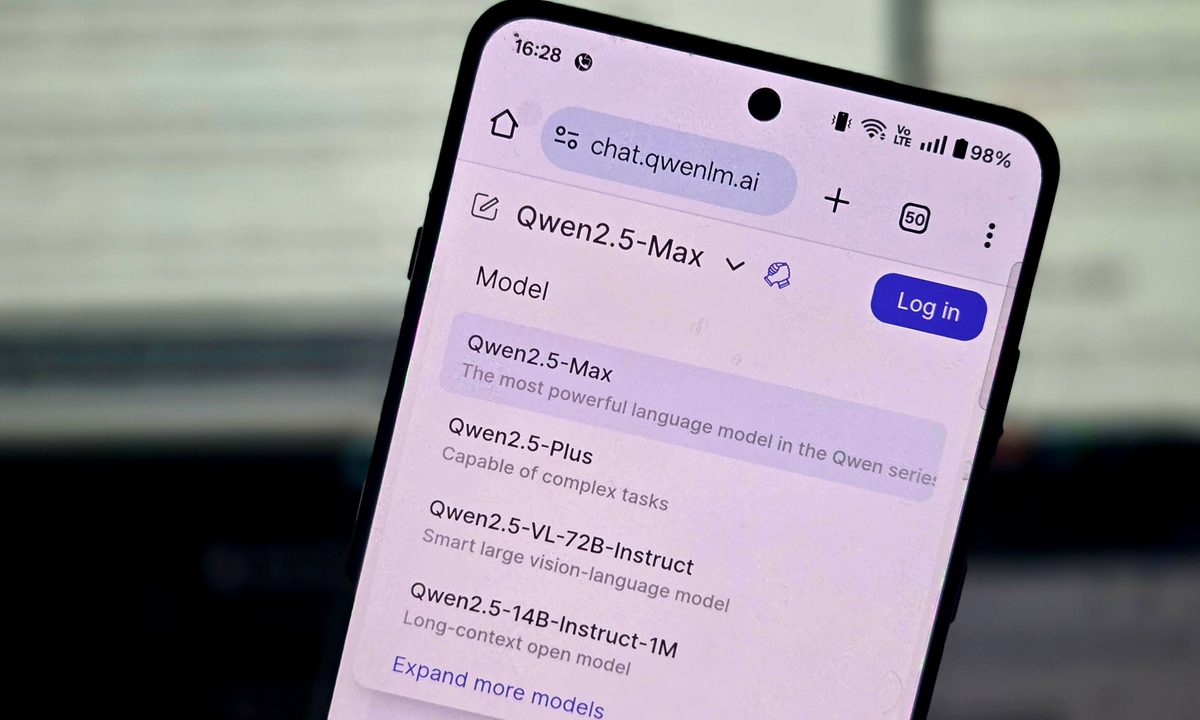
Alibaba's Qwen AI model running on an Android phone.
Alibaba's Qwen AI model Nadeem Sarwar / Digital Trends

The AI race usually revolves around familiar names like OpenAI, Google, Meta, and Anthropic. But when it comes to models developers can actually download and build upon, another company has raced to the front — and by quite some distance. Alibaba says its Qwen family of open-weight AI models has crossed 3 billion downloads globally over the past six months. That puts Qwen ahead of some of the biggest names in AI, including models from Meta and Google.

The difference is especially striking in Hugging Face data for 2026. Google’s open models have recorded around 418 million downloads, while Meta sits at roughly 227 million, according to Hugging Face’s latest State of Open Models report. Qwen, meanwhile, is becoming much more than one popular model. Alibaba has released more than 460 Qwen models, and developers have created over 300,000 derivative models from them.

Developers are building on Qwen, not just downloading it

Those download numbers matter because open models work differently from closed AI services. Developers can take them, customize them for a particular job, fine-tune them with their own data, and use them as the foundation for entirely new AI products. In other words, every download can become something else. That appears to be happening with Qwen at a huge scale. Hugging Face describes it as one of the biggest foundations of today’s open AI ecosystem, with the model family increasingly becoming a go-to choice for developers deciding what they want to fine-tune or deploy.

It can also create something of a snowball effect. More developers using Qwen means more specialized versions of it become available. Those models can then attract even more developers, further expanding the ecosystem. Alibaba has another advantage here: its cloud business. The company is bringing Qwen to enterprise customers outside China, including markets across Southeast Asia and Africa, potentially putting its models in front of businesses that might otherwise gravitate toward American alternatives.

China’s open AI push is getting difficult to overlook

Qwen’s growth also adds another dimension to the AI rivalry between China and the US — Alibaba isn’t alone. Chinese companies, including DeepSeek, Moonshot AI, and MiniMax, are all developing increasingly capable models while trying to narrow the performance gap with leading closed systems from companies such as OpenAI and Anthropic.
The fight for developers is only getting busier. Meta and Nvidia have both introduced new open AI models in recent weeks, giving developers even more options when deciding what technology to build around. For Alibaba, however, reaching 3 billion downloads shows Qwen has already found an enormous audience beyond its home market. The next big AI battle may not simply be about who builds the smartest model; it could be about whose model everyone else chooses to build with.

Shimul Sood
Shimul is a contributor at Digital Trends, with over five years of experience in the tech space.
Intelligent UI turns ChatGPT answers into interactive tools while GPT-6 rolls out to a broader audience 
Plain text answers just got a very interactive rival.
Intelligent UI in ChatGPT.

Would you rather read instructions for splitting a dinner bill or tap a bill splitter and let it do the math? I'd pick the latter. 

OpenAI's SOl-6 rollout, starting October 7, 2026, adds Intelligent UI. Basically, it lets the chatbot assemble interactive answers instead of replying in plain text.

Read more
Checking body medication levels may now be as easy as sucking on a peach-flavoured lollipop
Forget the clinic swab; this lollipop wants a lick
Lollylab

Checking your body’s medication levels is usually no one’s idea of fun. Now researchers are trying to change that with Lollylab, a candy-coated, lollipop-like device that can collect saliva and measure levels of acetaminophen in under two minutes.

The prototype created by researchers whose work was published in ACS Sensors transforms a familiar object into a miniature testing device. In a pilot study, six adults ingested the peach-flavored Lollylab before and one hour after a standard 650-milligram dose of acetaminophen. The device repeatedly detected the pain reliever in their saliva, and participants reported it was more comfortable and easier to use than traditional saliva swabs.

Read more
A US state just approved an AI doctor. For now, it’ll only prescribe acne cures.
Aside from acne, Nolla's AI can also handle redness, fine lines and wrinkles, hyperpigmentation and dark spots, and under-eye bags.
Nolla Derm AI doctor app.

The first AI doctor is here. Despite all the skepticism and risks associated with AI models going haywire, the state of Utah just approved Nolla Health, a company that is providing an AI healthcare expert capable of writing prescriptions without any human in the chain. For now, it will only write acne prescriptions for Utah residents over 18 years of age, willing to pay a token monthly subscription fee that's lighter than your Spotify bill.

The big push here is that the Nolla Derm app will reduce the costs of medical consultation, save users the hassle of clinic visits, and take out the problem of waitlisting from the entire healthcare equation. “Unlike telehealth platforms that use AI only to collect information before handing patients off to clinicians, Nolla's AI system is designed to independently issue initial prescriptions within tightly defined, physician-approved treatment protocols,” writes the company. 

Read more