  1. Home
  2. Emerging Tech
  3. News

Researchers at the University of Washington just developed a real-life ‘freeze ray’

Add as a preferred source on Google

In a groundbreaking study soon to be published by the National Academy of Sciences, researchers at the University of Washington have successfully developed a laser capable of refrigerating liquids instead of heating them. By making use of an infrared laser, the team was able to cool a single microscopic crystal by an astounding 36 degrees Fahrenheit, accomplishing the task of laser-refrigeration in real-life conditions for the first time.

While the breakthrough certainly wasn’t made to satisfy evil villains the world over, the technology does have the potential for a wide range of applications. According to a published announcement from UW itself, the experimental tech may allow for more efficient information processing, possessing the ability to prevent overheating in microchips by cooling specific parts. Moreover, the university posited that scientists could also use it to “precisely cool” portions of cells as they divide or repair themselves, allowing for an incredible opportunity to see exactly how cells work.

Recommended Videos

“There’s a lot of interest in how cells divide and how molecules and enzymes function, and it’s never been possible before to refrigerate them to study their properties,” says senior author and UW assistant professor of materials science and engineering Peter Pauzaskie. “Using laser cooling, it may be possible to prepare slow-motion movies of life in action. And the advantage is that you don’t have to cool the entire cell, which could kill it or change its behavior.”

Peter Pauzauskie, Xuezhe Zhou, Bennett Smith, and Matthew Crane of the UW engineering team
Peter Pauzauskie, Xuezhe Zhou, Bennett Smith, and Matthew Crane of the UW engineering team Dennis Wise / University of Washington

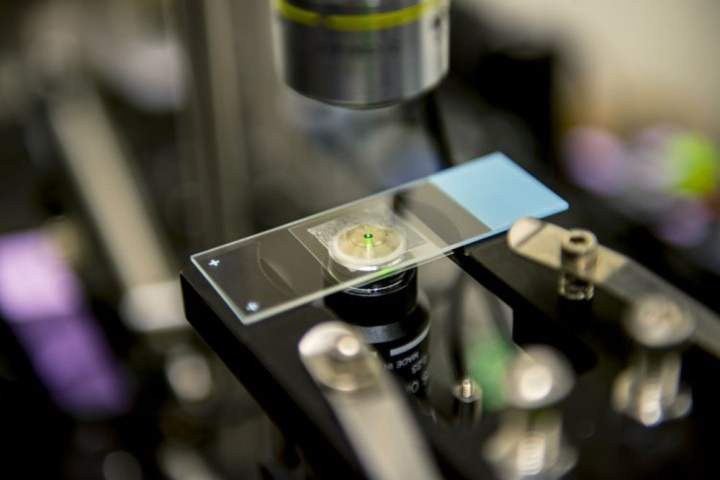
Concerning the laser itself, the University of Washington decided on using infrared due in large part to the fact that visible light has the potential to harm or “sunburn” cells. By first taking material typically found in commercial lasers, the University of Washington says it “essentially ran the laser phenomenon in reverse.” During the test, the team used the infrared laser to highlight a single microscopic crystal suspended in a water sample. Once illuminated, the crystal gave off a unique reddish-green glow visible to the naked eye which contained slightly more energy than light it absorbed. Moreover, the resulting high-energy glow actually removes heat from the crystal, as well as its surrounding water.

“The real challenge of the project was building an instrument and devising a method capable of determining the temperature of these nanocrystals using signatures of the same light that was used to trap them,” says lead author and Intel Corp. employee Paden Roder.

UW’s testing only demonstrated the laser’s ability on a single nanocrystal, a process which proved to be wildly energy intensive. In order to excite multiple crystals, Pauzaskie says an incredibly high amount of laser power would be required, but that the team intends to continue research on the tech to find a way to make it more efficient. Ideally, UW’s laser could one day be used to cool high-powered lasers (the normal, heat-producing type), which can overheat or melt down.

Funded by the Air Force Office of Scientific Research and the University of Washington, the study’s complete findings will be published in the Proceedings of the National Academy of Sciences this week.

Rick Stella
Former Associate Editor, Outdoor
Rick became enamored with technology the moment his parents got him an original NES for Christmas in 1991. And as they say…
Anker just exposed a big problem with portable power stations
Appliance, Device, Electrical Device

When you're shopping for a portable power station, there's one number that's almost impossible to ignore: battery capacity. A 2 kWh battery should give you roughly 2 kWh of usable power, right? Unfortunately, things aren't quite that simple. Anker SOLIX has published new efficiency data for its S Series portable power stations, and it's putting the spotlight on something that doesn't get nearly as much attention as capacity: how much of the energy stored inside the battery actually makes it to your devices.

According to Anker, portable power stations are commonly advertised with efficiency figures measured under relatively heavy loads, where they can reach roughly 89% to 92% efficiency. But that's not necessarily how most people use one during an outage. Think about what you'd actually plug in. A Wi-Fi router might sip power continuously, a refrigerator switches its compressor on and off throughout the day, and a CPAP machine could run overnight. Together, those devices may draw just a fraction of what a large power station is capable of supplying. And that's where efficiency can start slipping.

Read more
OpenAI’s first gadget sounds like a tiny expressive AI companion
The device will have a doughnut-shaped body, built-in cameras, and moving parts
OpenAI press image

For months, reports have suggested that OpenAI’s first hardware product would be a screen-free smart speaker designed to act more like an AI companion. We already knew it could understand its surroundings, be carried around the home, and proactively help users. A new Bloomberg report now gives us a clearer picture of what the device may actually look like.

As per the report, OpenAI’s first gadget will be shaped like a doughnut and measure about the same size as a hockey puck. You will be able to carry it between rooms or leave it nearby on whatever surface is convenient. The device is expected to be on the expensive side, as the company has pondered pricing it around $300 to $400. A release is currently planned for 2027.

Read more
Google Antigravity just built an AI translator that works without the internet
Electrical Device, Switch, Robot

Google has shown off a new AI project that could make language barriers a little less intimidating, and it doesn't need an internet connection to do it. The company has introduced the Gemma Translator, a compact prototype built in collaboration with Antigravity. Unlike most AI translation tools that rely on cloud processing, this device runs entirely offline using Gemma 4 E2B, Google's lightweight open model. Everything happens locally on the device, making it both portable and independent of an internet connection. The prototype is powered by a Raspberry Pi 5 and includes a microphone and speaker inside a custom 3D-printed enclosure, creating a self-contained translator you can carry almost anywhere.

AI translation, without the cloud

Read more