  1. Home
  2. Emerging Tech
  3. News

Researchers built a robot that turns a fall from the sky into a sailing trip

Inspired by the way maple seeds spin through the air, ALBATROSS can drop from a plane, land upright on water, and sail away using nothing but the wind.

Add as a preferred source on Google
ALBATROSS robot in water
SUTD / Science Robotics

Keeping an eye on remote waters is harder than it sounds. Boats take ages to get there, and aircraft can’t stick around long enough to be useful. As reported by TechXplore, researchers at the Singapore University of Technology and Design (SUTD) think they have cracked the problem, and nature gave them the idea.

Meet ALBATROSS, short for Airborne Lander with Buoyant AuToROtating Sailing Sensor. You drop it from the air, it lands on the water, flips itself upright, and then sails around on its own using wind power.

Recommended Videos

“We designed ALBATROSS to use the environment rather than fight it,” said Dr. Shane Kyi Hla Win, lead author of the study published in Science Robotics.

How does one robot fly and sail?

The trick lies in its rigid wingsails, which pull double duty. As ALBATROSS falls, the wings spin like a maple seed, slowing it down and keeping it steady, so there’s no need for a parachute. Once it lands, those same wings become sails. A fish tail-inspired rudder helps it steer when the wind is weak.

This keeps things simple. ALBATROSS uses just three actuators and three navigation sensors, while similar air-to-sea robots need six to eight actuators and more sensors.
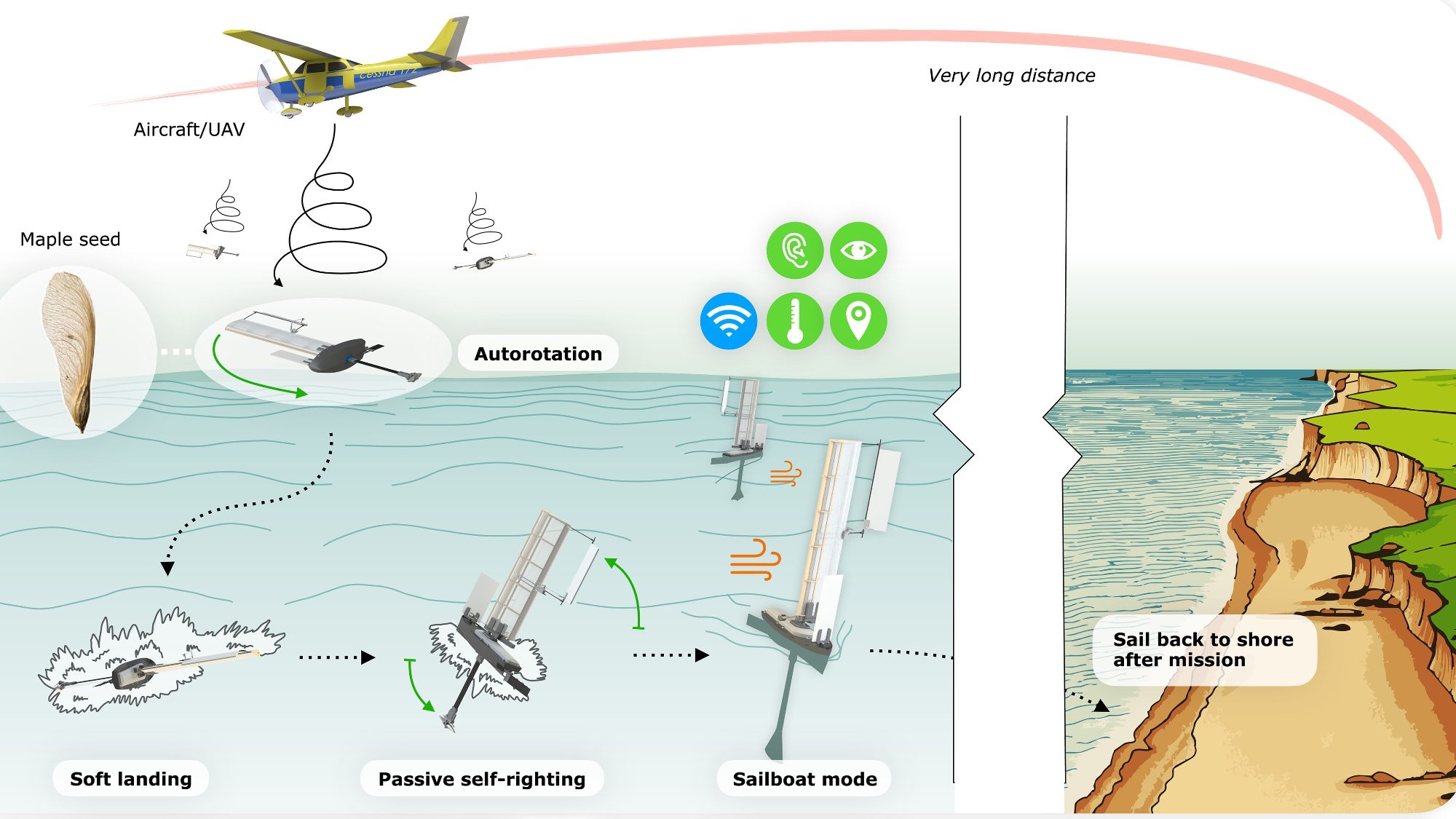
In field trials, the team dropped it from 150 meters (490 feet). It spun down gently, righted itself, and sailed away without any help. Without those spinning wings, researchers estimate it would hit the water with about 18.5 times more impact energy. That would be quite the belly flop.

In Singapore’s reservoirs, a larger test version reached just under 1 km/h and ran for around three hours, recording humidity, heat levels, and wind direction.

Can it brave the open sea?

The answer is not yet. ALBATROSS is still a proof of concept and has only been tested in calm, sheltered waters. The team now wants to make it more rugged so it can survive stronger winds, currents, and waves.

Future versions could also carry underwater sensors, sonar, and bigger energy storage. If it all comes together, ALBATROSS could help with climate research, search and rescue, and maritime security. That’s not bad for a robot that learned its best moves from a tree seed.

Related coverage

Rachit Agarwal
Rachit is a seasoned tech journalist with over ten years of experience covering the consumer technology landscape.
A Swiss startup has found a clever way to charge electric buses through their tyres
Winduction's tyre-based charging technology could let electric buses top up at bus stops, allowing smaller batteries, lower costs and more passenger space.
diagram showing bus induction charging

Bus fleets across Switzerland and Europe are going electric, but keeping them running isn't cheap. Today's e-buses carry massive batteries and rely on heavy-duty chargers at the depot, and operators pay a lot for both upfront and over time. According to ETH Zurich, its spin-off Winduction has a smarter idea: let buses charge through their tyres at bus stops.

How does a tyre charge a bus?

Read more
A US state just approved an AI doctor. For now, it’ll only prescribe acne cures.
Aside from acne, Nolla's AI can also handle redness, fine lines and wrinkles, hyperpigmentation and dark spots, and under-eye bags.
Nolla Derm AI doctor app.

The first AI doctor is here. Despite all the skepticism and risks associated with AI models going haywire, the state of Utah just approved Nolla Health, a company that is providing an AI healthcare expert capable of writing prescriptions without any human in the chain. For now, it will only write acne prescriptions for Utah residents over 18 years of age, willing to pay a token monthly subscription fee that's lighter than your Spotify bill.

The big push here is that the Nolla Derm app will reduce the costs of medical consultation, save users the hassle of clinic visits, and take out the problem of waitlisting from the entire healthcare equation. “Unlike telehealth platforms that use AI only to collect information before handing patients off to clinicians, Nolla's AI system is designed to independently issue initial prescriptions within tightly defined, physician-approved treatment protocols,” writes the company. 

Read more
AI’s massive appetite could make cheap smartphones much harder to find
The smartphone aisle is getting pricier, and AI may be partly to blame.
Electronics, Mobile Phone, Phone

Buying a genuinely cheap smartphone could soon become a lot harder, and the reason has little to do with what’s happening inside the smartphone industry itself. The enormous amount of hardware being poured into AI data centers is pressuring global memory supplies. That has helped drive up the cost of making phones, and manufacturers appear increasingly reluctant to absorb those extra costs at the cheapest end of the market.

According to Counterpoint Research, prices of existing smartphones have increased by around 15% globally this year, while newly launched devices are roughly 25% more expensive than comparable models from last year. The impact hasn't been equal everywhere, either. Smartphone prices have climbed 21% in India and 19% across Asia-Pacific, compared with just 5% in the US.

Read more