  1. Home
  2. Emerging Tech
  3. Cars
  4. News

Too buzzed to drive? Don’t worry — this autonomous car-bar will drive to you

Add as a preferred source on Google
Gary di Silvio (CRA) with Carlo Turati and Marco Conte (Makr Shakr)

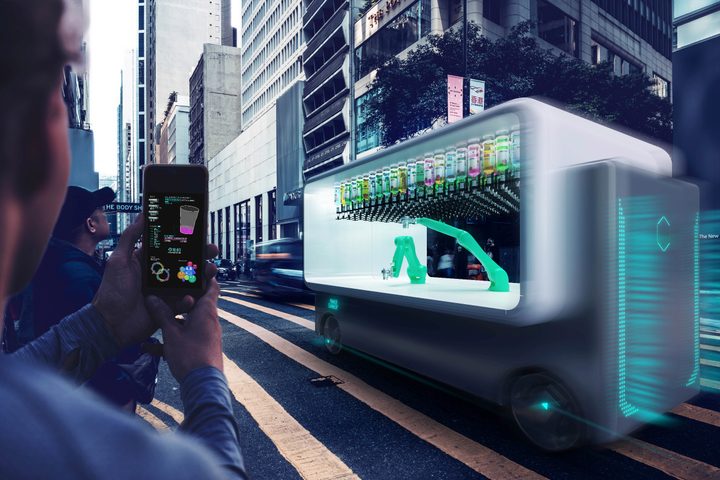
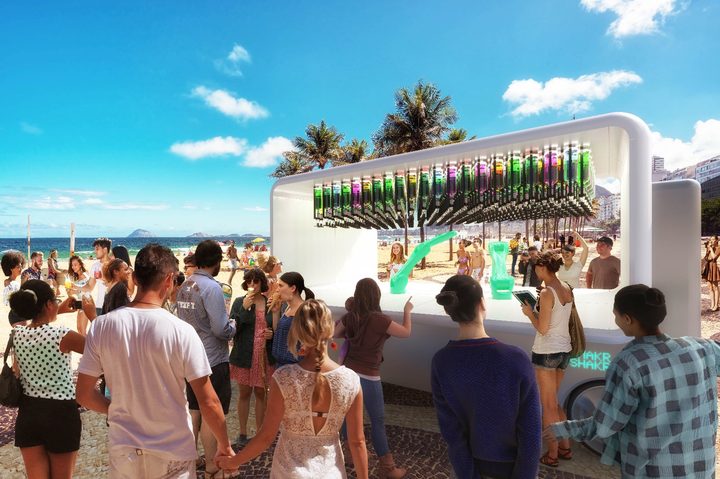
Whether it’s Netflix’s promise of streaming video or the rise of on-demand robot delivery companies, it’s no secret that the tech world is all about services on tap. Taking that idea literally is the startup Makr Shakr, a self-driving robot bar that promises to (quite literally) let you summon up a perfectly mixed cocktail wherever you are. While it’s still only a concept right now, the “Guido” barmobile will one day let users place and pay for their complex beverage order by app, and then have a robot mix it — all without having to interact with another person.

“With Guido, we wanted to create new on-demand ways to enjoy leisure in our cities,” Emanuele Rossetti, CEO of Makr Shakr, told Digital Trends. “Guido represents an experiment combining the two technologies that are poised to impact our lives the most in the next few years: Robotics and self-driving. Furthermore, Guido conveys, so to say, a ‘wow’ effect. In a society that is eager to always find new ways of enjoinment, our self-driving café — designed in collaboration with [Carlo Ratti Associati] — offers an alternative; imagining that different parts of the city can be activated by the opportunity to enjoy one’s leisure time on their streets.”
Gary di Silvio (CRA) with Carlo Turati and Marco Conte (Makr Shakr)

As noted, this is far from the first startup promising to deliver physical goods to customers, as summoned by app. Other initiatives in this area include companies promising to autonomously deliver everything from mail to snacks to self-driving wheelchairs when and where requested. Nor is it the only company building robotic bartenders. We’ve previously covered multiple such projects, designed to perfectly whip up the drink of your choice with all the attention-grabbing skill of Tom Cruise’s character in Cocktail. Makr Shakr, however, may well be the first time these concepts have been combined. And, if tech has taught us anything, it’s that sometimes the best ideas (think Steve Jobs’ original pitch for the iPhone) are as much about combining existing cool ideas as they are coming up with something entirely new.

Recommended Videos

So when can we expect to be pulling our smartphones and ordering up a robot mojito (robito?) as and when required? Keep your eyes peeled.

“Currently, Guido is in its concept phase,” Rossetti continued. “It will be developed in the course of 2019 in collaboration with international municipalities. For those who want to already enjoy a portable version of our robotic bartender, a few months ago we launched Makr Shakr 4.0, a robotic bartender that can travel everywhere — albeit still driven by humans. There is also our fixed Makr Shakr 3.0 system, that can be ordered for 99,000 euros, plus a small fee per drink that covers all maintenance costs.”

Luke Dormehl
I'm a UK-based tech writer covering Cool Tech at Digital Trends. I've also written for Fast Company, Wired, the Guardian…
Meta goes toe-to-toe with the big boys as it launches Muse Wonder AI models
Illustration of Meta Muse Wonder AI model.

It's raining frontier AI models. Soon after Anthropic set alarm bells ringing with its Claude Fable model at the summit of AI peformance, OpenAI answered with GPT-6 Astra. Not one to be left behind, Google released Gemini 4 Argon. The race is now getting hotter as Meta enters the fray with two new AI models in the Muse series: Wonder and Wonder Full. Cheesy naming aside, these Meta AI models mean business, or at least that's what the benchmark figures suggest. More importantly, these AI models are already making their way to Muse users.

https://twitter.com/DigitalTrends/status/2109699549375988120

Read more
AI can’t tell if you’re gay or straight, but it thinks it knows what both look like
AI knows it shouldn't judge a face, but apparently, drawing one is a different story.
Emilia Clarke AI generated stock image. Gemini / Nano Banana is on the left

We've all been told not to judge a book by its cover, and you'd think AI would follow that rule, too. Ask an AI chatbot to guess someone's sexual orientation just by looking at their face, and it'll likely tell you that there's no reliable way to know. But what happens when you ask that same model to change someone's appearance to match a particular sexual orientation? Well, that's where things get uncomfortable.

A new study, accepted for presentation at the 2026 Conference on Empirical Methods in Natural Language Processing, found that AI models from OpenAI and Google can be inconsistent when handling sensitive personal characteristics. They might refuse to make assumptions about someone based on their appearance, but when asked to generate those same assumptions visually, the results tell a very different story.

Read more
A clinical study with Google’s special chatbot shows a strong future for AI in healthcare
Google’s medical AI could give doctors a useful second set of eyes
Google Articulate Medical Intelligence Explorer chatbot

AI is a useful tool for handling many tasks in private as well as professional settings, but medical advice, especially diagnosis, is one area where I generally draw the line. General-purpose chatbots tend to sound confident and convincing while giving medical advice, even when they are wrong, as studies have previously found.

That being said, Google's new research points to a much more convincing use for AI in healthcare. Its Articulate Medical Intelligence Explorer chatbot, or AMIE for short, could help prepare both sides before the appointment even begins.

Read more