1. Home
  2. Emerging Tech
  3. Legacy Archives

Startup successfully tests space tourism balloon, service set to lift off in 2016

Add as a preferred source on Google

If Virgin Galactic’s $250,000 asking price for a ride aboard SpaceShipTwo to the edge of space is a little on the steep side, perhaps you can scrabble together the $75,000 required for a balloon-based experience also offering a view of Earth from up high.

Arizona-based World View Enterprises, a startup born out of the Paragon Space Development Corporation, announced this week the successful completion of a high-altitude test flight of a stratospheric balloon and capsule based on a final design being prepped for commercial service in 2016.

Recommended Videos

“We couldn’t be any more excited about the results from this test flight,” World View CEO Jane Pointer said this week, adding that it represents “a foundational achievement that moves us one step closer to offering a life-changing experience” for its future passengers.

The five-hour test flight, which launched from Roswell, New Mexico, involved taking the massive helium balloon and capsule to an altitude of 120,000 feet (36,600 meters) – about the height from which Austrian extreme skydiver Felix Baumgartner jumped in 2012.

Once the team was satisfied with its performance at that altitude, the test vehicle was brought down to 50,000 feet (15,200 meters), at which point it deployed a parafoil to bring it gently back to terra firma.
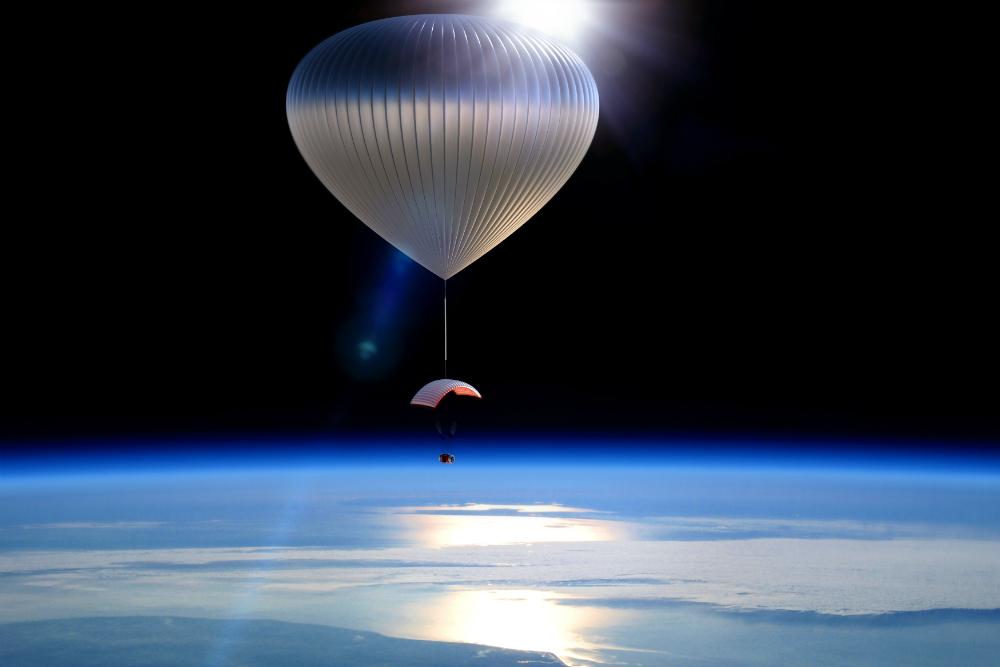
world view space balloon
Image used with permission by copyright holder

The plan is to offer regular folk – or regular folk with $75,000 to spare – a “peaceful” flight to the edge of space “for a two-hour sailing-like experience,” World View explains on its website. In contrast, SpaceShipTwo fliers would only experience suborbital conditions for several minutes.

Those aboard World View’s eight-person capsule (two crew and six passengers) will be able to “marvel at the beauty of the Earth below and watch the sun slowly rise above the curvature of our planet suspended in a vast, black and infinite universe,” according to the startup.

It also plans to attract educators, researchers, private companies and government agencies interested in making use of the near-space environment.

While Virgin Galactic’s SpaceShipTwo is designed to take passengers more than 65 miles above the Earth’s surface – compared to 23 miles with World View’s service – the longer, and more serene experience (not to mention the more attractive price tag) may well persuade some space enthusiasts with money in the bank to opt for the startup’s experience.

Trevor Mogg
Contributing Editor
Not so many moons ago, Trevor moved from one tea-loving island nation that drives on the left (Britain) to another (Japan)…
This bizarre email flaw is leaking corporate secrets to anyone who buys the right domain
Security researchers discovered companies are accidentally sending sensitive emails to domains that outsiders can register.
Maill app icon notifications

You don't always need to hack into a company's systems to get its secrets. Sometimes, the company will simply email them to you. A new report by WIRED's Matt Burgess has uncovered a bizarre email security problem in which companies are inadvertently sending sensitive information to domains that can be registered and controlled by outsiders. Security researchers Cory Solovevich and Mike Sheward discovered that seemingly harmless addresses such as noreply and deleteduser can become unexpected gateways to corporate information when the domains behind them aren't properly controlled.

The "hack" is buying the right domain

Read more
I found 3 ChatGPT features that turned out to be way more useful than I expected
ChatGPT on iPhone

I use ChatGPT pretty much every day, but somewhere along the way, I’ve also developed a habit of poking around and looking for features I haven’t tried yet. Some discoveries are genuinely useful, while others are the kind I’ll probably remember once every six months.

Every once in a while, though, I stumble across something that actually changes how I use ChatGPT. That happened recently with three features I’d somehow been overlooking. I’ve started using all three regularly now, and if you spend a lot of time in ChatGPT too, I think you’re missing out by not giving them a shot.

Read more
Anker just exposed a big problem with portable power stations
Appliance, Device, Electrical Device

When you're shopping for a portable power station, there's one number that's almost impossible to ignore: battery capacity. A 2 kWh battery should give you roughly 2 kWh of usable power, right? Unfortunately, things aren't quite that simple. Anker SOLIX has published new efficiency data for its S Series portable power stations, and it's putting the spotlight on something that doesn't get nearly as much attention as capacity: how much of the energy stored inside the battery actually makes it to your devices.

According to Anker, portable power stations are commonly advertised with efficiency figures measured under relatively heavy loads, where they can reach roughly 89% to 92% efficiency. But that's not necessarily how most people use one during an outage. Think about what you'd actually plug in. A Wi-Fi router might sip power continuously, a refrigerator switches its compressor on and off throughout the day, and a CPAP machine could run overnight. Together, those devices may draw just a fraction of what a large power station is capable of supplying. And that's where efficiency can start slipping.

Read more