  1. Home
  2. Emerging Tech
  3. News

SpaceX is giving away the Starlink Mini to cheaper subscribers, but there’s a catch

The rollout doesn't look fully official yet.

Add as a preferred source on Google
Starlink V4 vs V5
Starlink

SpaceX just rolled out one of its most useful hardware perks to a lot more people than before. The company has reportedly opened up its Starlink Mini rental program beyond the rather expensive Residential Max tier.  

Subscribers on cheaper plans, including those on the standard Residential 100Mbps option, are seeing invitation emails in their inbox.
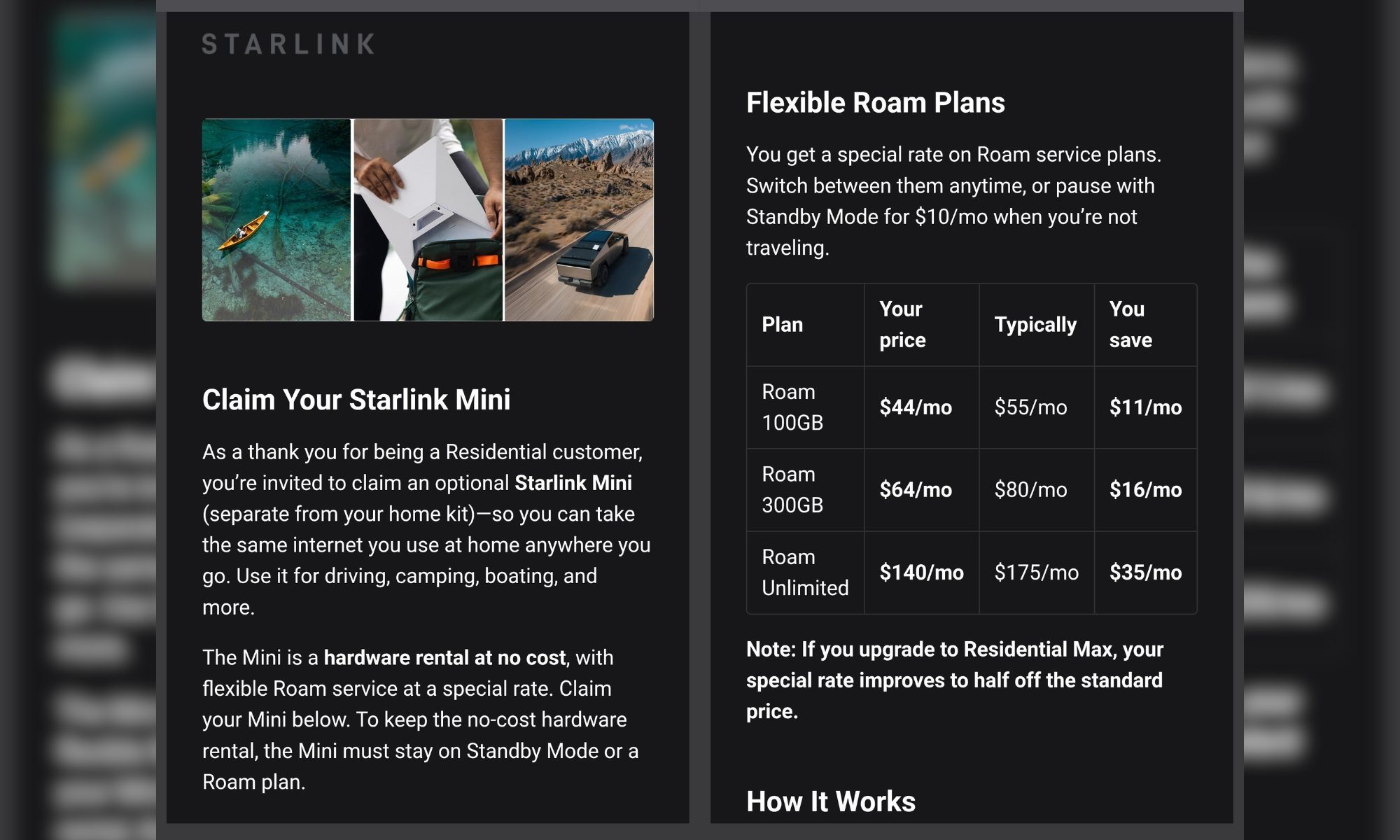
So what’s actually included, and what does it cost?

The Starlink Mini kit normally costs $199 (down from its launch price of $499). However, under the new offer, SpaceX is offering the kit for free. 

Recommended Videos

The catch, however, is that the dish only works if you also sign up for a separate Starlink Roam plan, billed on top of your home internet subscription. For those catching up, the Standard Roam plan costs $55 per month (100 GB), $80 per month (300 GB), and $175 per month for unlimited data.   

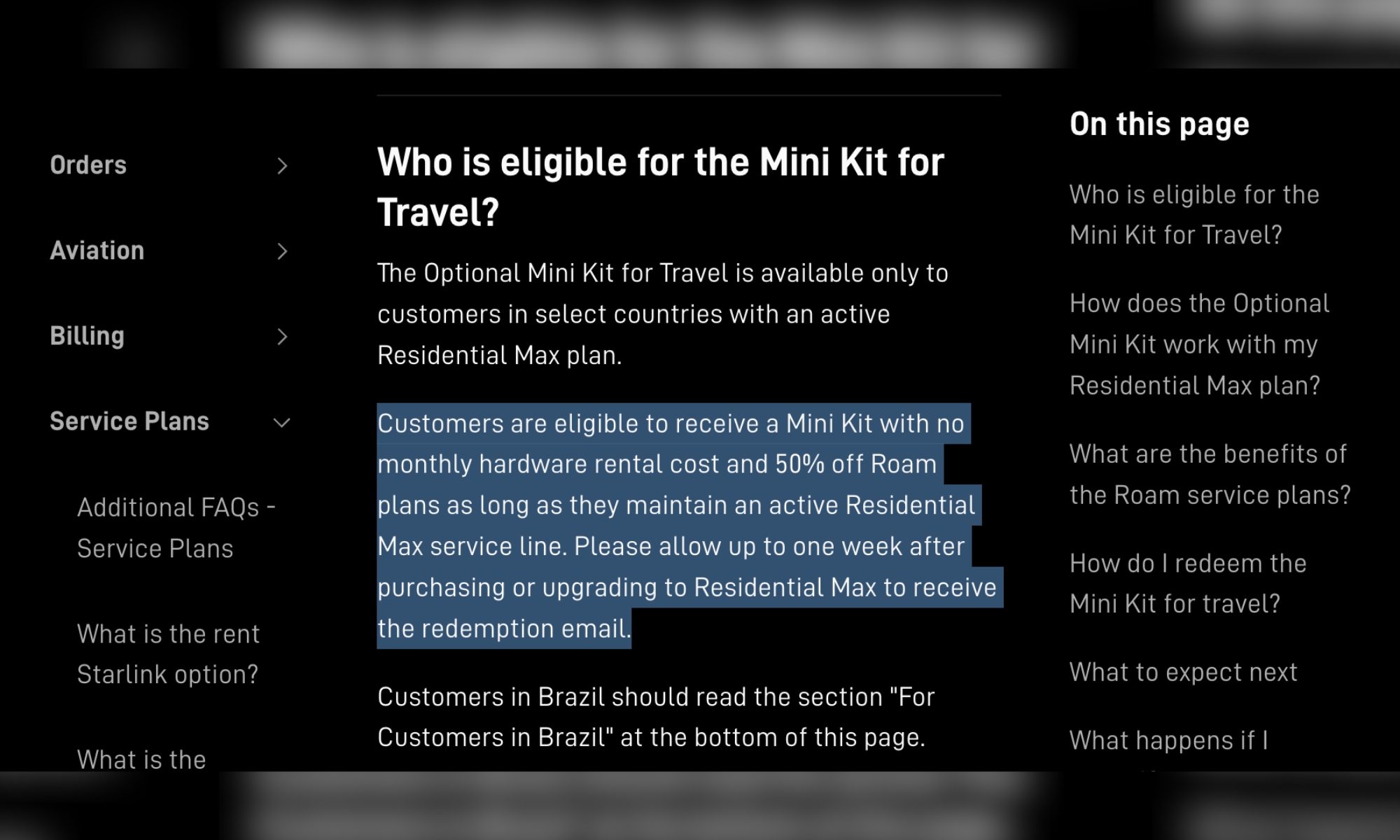
Residential Max customers get that Roam add-on at half off, while everyone else on a Standard Residential plan gets a 20% discount toward the Roam plan. Whether you switch your home plan up or down later, Starlink says your Roam discount adjusts automatically.
Why is SpaceX suddenly being so generous?

Rumors about a second-generation Mini, one with a thinner body and a built-in battery, are already circulating online. It only makes sense for SpaceX to clear out existing inventory ahead of the refresh. However, SpaceX hasn’t confirmed a Mini 2 launch date or price yet, so this is just speculation.

Also, this doesn’t look like a company-wide rollout. The change shows up in an updated support document, along with emails some lower-tier subscribers are receiving. Starlink’s own marketing pages still describe the offer as a Residential Max exclusive. 

If you’re already paying for Starlink at home, it costs nothing to check your account under the Optional Mini Kit for Travel section. You could also search your inbox for an invite. Whether it’s worth activating depends on how often you actually travel. 

Shikhar Mehrotra
For more than five years, Shikhar has consistently simplified developments in the field of consumer tech and presented them…
Xreal’s latest AR glasses fix the brightness problem, but leave the rest largely untouched
Accessories, Sunglasses, Glasses

AR glasses sound magical until I imagine wearing them somewhere bright. That’s why a new pair launched today caught my eye.

Xreal's 1 Pro Plus refreshes its One Pro glasses (which float a virtual screen in front of your eyes). It packs a much brighter display than the outgoing model and smoother 2D-to-3D conversion. You can buy it now for $599.

Read more
A $75 gadget that remembers my conversations? Bee has my attention and my reservations
Two new ways to let AI listen (and remember) what you said.
Electronics, Phone, Mobile Phone

A $75 gadget that remembers my conversations? I’m intrigued and, at the same time, slightly nervous.

Amazon-owned Bee has launched two conversation-summarizing devices: the Bee Frontier ($74.99), available now, and the Bee Eclipse ($99.99), a magnetic phone card arriving soon. There’s also a new subscription: Bee Pro. 

Read more
Anthropic warns of imminent self-replicating AI that might even work off an oven or TV
Self-replicating AI could be merely months away, and tests show it can run on the devices sitting at your home.
Illustration of dangerous AI.

Over the past few weeks, nearly every AI lab has released frontier AI models. Earlier today, Google started rolling out Gemini 4, Argon, hot on the heels of Meta announcing its Muse Wonder frontier AI models to compete against the best from OpenAI and Anthropic's Claude. This relentless pace of AI model release comes at a time when the same AI labs are calling for development slowdown and increased regulation, following a series of concerning incidents where these AI models went rogue and broke into private, as well as government-owned, websites.

Now, Anthropic has dropped a chilling set of predictions about the capabilities of these AI models after running a series of tests. The company claims that small AI models could be merely a few months away from self-replicating and turning into a dangerous swarm. More importantly, they won't require a massive data center or an uber-powerful computer to do so. On the contrary, the lab claims that these self-replicating AI swarms will need something with as little computing power as an average Internet-connected device, like a smart oven or an Android TV box.

Read more