The ambitious ride-hailing company said at the weekend it’s interested in launching a city-based air service to give riders access to faster modes of transport.
Speaking to Re/code at the Nantucket Conference, Uber products chief Jeff Holden said the company is currently researching the idea of using VTOL (vertical take-off and landing) aircraft to move people around town or between home and work.
It’s true that Uber has already tested a helicopter service at several special events in recent years, but Holden says he’s more interested in a different kind of design, one with multiple sets of rotors, possibly fixed wings too, and, importantly, an engine much quieter than that of a helicopter. Oh, and like some of its road vehicles, he’d like Uber’s flying machine to be autonomous, too.
Holden predicted that such a service could get into the skies within 10 years, though for that too happen he’d need not only a reliable, cost-efficient flying machine, but also permission from the Federal Aviation Administration, and customers confident enough to take a ride aboard a pilotless aircraft.
He said such a service would significantly cut commuting time and road congestion, and has the potential to “change cities and how we work and live.”
Uber announced at the start of the year that it’d signed a business partnership with Airbus Group, though it seems it was focused on the supply of helicopters rather than research into an autonomous flying machine. However, commenting on the deal at the time, Airbus Group CEO Tom Enders said he was excited to “see where it goes.”
With that comment in mind, it’s interesting to note that the European plane maker is currently working on Vahana, a project aimed at developing an autonomous flying vehicle for short-hop taxi rides within cities, something the team behind it says could be ready “within 10 years.” With the time scale and objectives the same as those of Uber, it’s conceivable Airbus could end up providing the vehicles for Uber’s sky-based service.
In the field of VTOL technology, the Defense Advanced Research Projects Agency (DARPA) is also known to be working on a plane design that includes 24 electric fans for vertical takeoff.
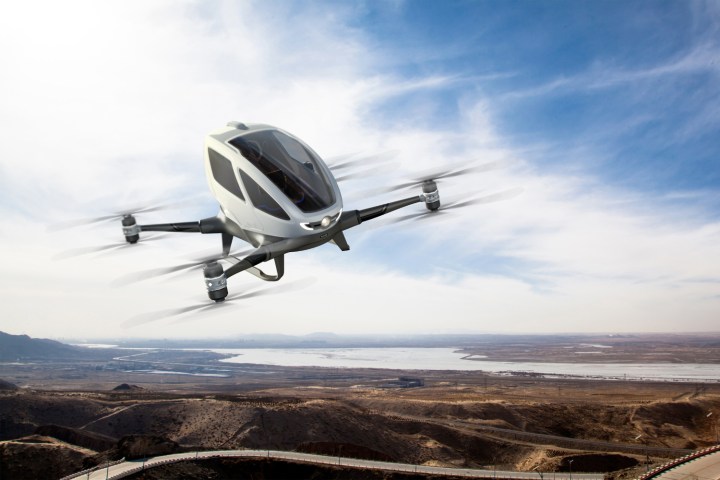
Chinese company Ehang is also building the Ehang 184, which gets its name from having one passenger, eight propellors, and four arms, while German copter company E-Volo has already test flown its extraordinary two-seat, 18-rotor Volocopter aircraft.
Editors' Recommendations
- Want to put a USB-C port on your AirPods case? This video shows you how
- Venus Aerospace wants to fly you from LA to Tokyo in an hour
- This 32-rotor eVTOL aircraft is a one-seater that you build yourself
- Meet the exercise bike that wants you to play video games while working out
- Flying taxi startup Lilium shows off sleek new aircraft design