  1. Home
  2. Emerging Tech
  3. Android
  4. Apple
  5. Mobile
  6. News

Charge your phone in seconds, use it for days? A new battery may make it possible

Add as a preferred source on Google

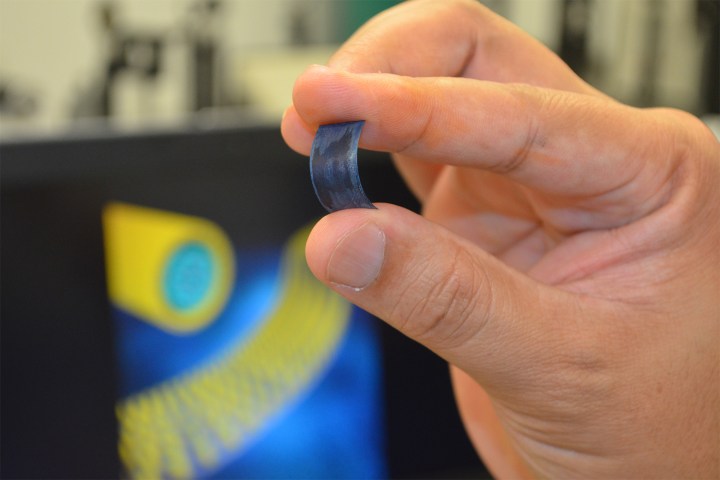
Battery technology plays a pretty major role in our digital lives and while it has certainly been refined over the past few years, there is always room for improvement. Scientists from the University of Central Florida have developed a supercapacitor battery prototype that works as if it were new even after being recharged as many as 30,000 times.

If successful, the research could mean the development of super fast-charging batteries that could last a whopping 20 times as long as today’s lithium-ion batteries. In other words, you could charge your phone in only a few seconds and not need to charge it again for an entire week, according to postdoctoral associate Nitin Choudhary, in a report from Engadget.

Recommended Videos

The reason that supercapacitors can be charged so quickly is that they store electricity on the surface of a material, instead of having to store it through chemical reactions, as happens in lithium ion batteries. Those material sheets can hold a ton of electrons.

Much of the research with batteries involves using graphene. However, the team at UCF chose to go a different route — it wrapped 2D metal materials, which are only a few atoms thick, around tiny conductive wires, which essentially allows electrons to pass from the core to the shell quickly and easily. The result was a fast-charging material with a lot of energy and power density.

It’s important to note that the research is still in early development and it is nowhere near ready for commercialization just yet, however it certainly looks promising. Currently, the tech is just a proof of concept and the team behind it is now figuring out the best way to patent the tech. While it could go nowhere, like a lot of other battery ‘breakthroughs,’ we could also hear a lot more about supercapacitor research in the near future.

Christian de Looper
Christian de Looper is a long-time freelance writer who has covered every facet of the consumer tech and electric vehicle…
Chinese startup claims its brain implant takes just 10 minutes to place, no skull surgery required
StairMed Technology's vein-based BCI could beat Neuralink's roughly two-hour surgery on speed, but the device still hasn't undergone human trials.
Art, Plate, Crystal

Brain implants, like the ones made by Elon Musk's Neuralink, typically involve open-skull surgery. But a Chinese startup says it can skip that step entirely, threading its device into the brain through a vein in a procedure that reportedly takes as little as ten minutes. According to the South China Morning Post, Shanghai-based StairMed Technology is one of several companies pursuing this approach, as the country pushes to expand its homegrown brain-computer interface (BCI) industry.

Faster than Neuralink, on paper

Read more
This bizarre email flaw is leaking corporate secrets to anyone who buys the right domain
Security researchers discovered companies are accidentally sending sensitive emails to domains that outsiders can register.
Maill app icon notifications

You don't always need to hack into a company's systems to get its secrets. Sometimes, the company will simply email them to you. A new report by WIRED's Matt Burgess has uncovered a bizarre email security problem in which companies are inadvertently sending sensitive information to domains that can be registered and controlled by outsiders. Security researchers Cory Solovevich and Mike Sheward discovered that seemingly harmless addresses such as noreply and deleteduser can become unexpected gateways to corporate information when the domains behind them aren't properly controlled.

The "hack" is buying the right domain

Read more
I found 3 ChatGPT features that turned out to be way more useful than I expected
ChatGPT on iPhone

I use ChatGPT pretty much every day, but somewhere along the way, I’ve also developed a habit of poking around and looking for features I haven’t tried yet. Some discoveries are genuinely useful, while others are the kind I’ll probably remember once every six months.

Every once in a while, though, I stumble across something that actually changes how I use ChatGPT. That happened recently with three features I’d somehow been overlooking. I’ve started using all three regularly now, and if you spend a lot of time in ChatGPT too, I think you’re missing out by not giving them a shot.

Read more