  1. Home
  2. Emerging Tech
  3. Legacy Archives

US Army adopts new breed of robotic battle vehicles

Add as a preferred source on Google
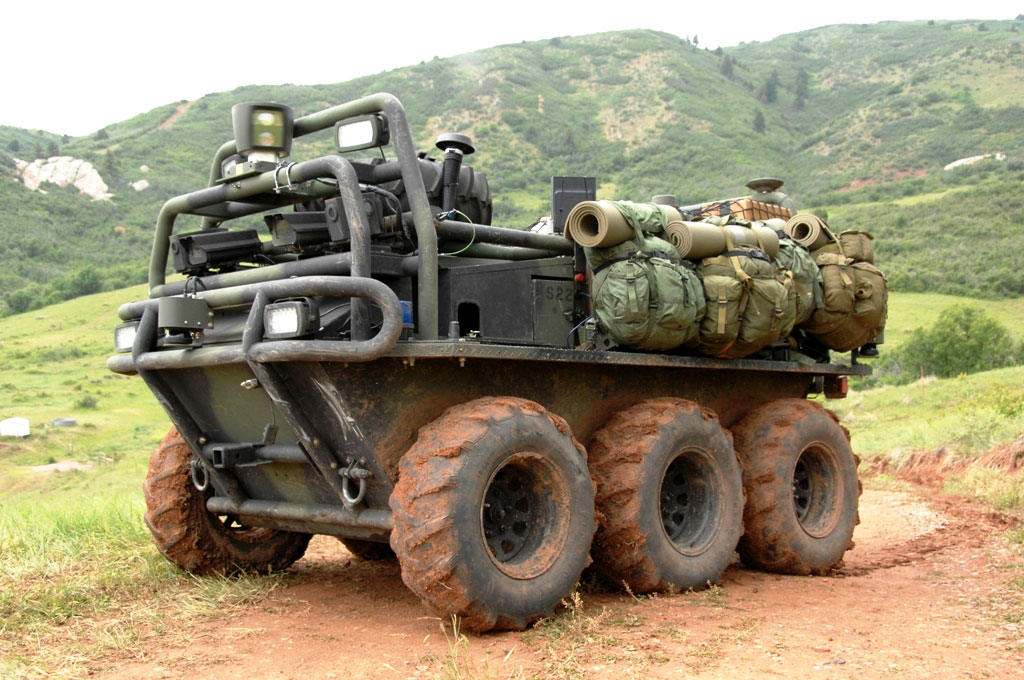
Lockheed-Martin-SMSS-Squad Mission Support System
Image used with permission by copyright holder

As part of its ongoing quest to transform into a more modern fighting force, the US Army has purchased a new line of autonomous vehicles, which will soon aid soldiers in Afghanistan.

Created by Lockheed Martin, the Squad Mission Support System (SMSS) is “the largest autonomous vehicle to ever be deployed with infantry,” said Lockheed in announcement released today. The SMSS is 11 feet long (about one foot shorter than a Mini Cooper), and is capable of carrying up to half a ton of equipment, a feature that will help ease the often heavy loads of soldiers on the ground.

Recommended Videos

“SMSS is the result of more than a decade of robotic technology development, and we welcome the opportunity to demonstrate this capability in theater, where it can have an immediate impact at the squad level,” said Scott Green, vice president of ground vehicles in Lockheed Martin’s Missiles and Fire Control business, in a statement. “The Army has tested the system’s capabilities in three domestic user assessments, and SMSS has been deemed ready to deploy.”

On top of its load-carrying abilities, the SMSS also has a remote range of up to 125 miles, and can run in three different control modes: supervised autonomy, tele-operation or manually driven. Once deployed, the SMSS uses GPS to navigate on its own, as well as onboard sensors that can “lock on and follow any person by recognizing their digital 3-D profile.”

The SMSS will now undergo three more months of testing in Afghanistan, as part of the Army’s Military Utility Assessment, which determine how well the SMSS works in on an actual battlefield. Testing will reportedly begin later this year, after additional evaluations and training for the vehicle.

In addition, the SMSS has been selected to further test its combat abilities in the Army’s Expeditionary Warrior Experiment Spiral G, which takes place in November. There, the SMSS will be tested to evaluate “its ability to field a reconnaissance, surveillance and target acquisition mission equipment package.”

Of course, the SMSS is far from the first robot to be employed by America’s military. According to Wikipedia, military robots date back to WWII. Today, the US military uses a wide variety of robots, including a variety of anti-IED bots, and more than 7000 aerial drones.


Andrew Couts
Features Editor for Digital Trends, Andrew Couts covers a wide swath of consumer technology topics, with particular focus on…
I let Gemini take care of my houseplants, and they’ve never looked better
Study guide created by Gemini

I am, by every reasonable measure, a serial plant killer. I've lost count of the pothos, the peace lilies, the one very expensive fiddle-leaf fig that judged me silently for a month before giving up entirely. My problem was never a lack of love. It was that I'd either drown them out of guilt or forget they existed for a fortnight, with no middle ground. So when I started leaning on Gemini for the odd everyday question, letting it babysit my plants wasn't some grand plan. It happened almost by accident, and now my flat looks like something a person with their life together would own.

It started the way most of my plant emergencies do, with a leaf going a color it definitely shouldn't. Instead of doom-scrolling through contradictory Google searches like I usually would, I snapped a photo, handed it to Gemini, and asked what was wrong. What I got back was a proper answer, and it was the first of many.

Read more
I underestimated this NotebookLM feature until it completely changed how I study
google-adds-data-tables-feature-in-notebooklm

I'll admit it: I ignored NotebookLM's Mind Maps feature for far longer than I should have. I mostly used the app to ask questions about my documents or generate Audio Overviews and Short Video Overviews, while that little Mind Map button sat untouched. I assumed it was more of a nice-to-have than something I'd actually use. Turns out, I was completely wrong.

I stopped drowning in my own notes

Read more
The Concorde dream is within reach. NASA X-59 just has to silence the supersonic boom
The jet built to kill the sonic boom just reached full speed
Lockheed Martin’s X-59

NASA has already proved that its needle-nosed X-59 can move seriously fast in recent test flights. Now, the next step is to find out whether it can break the sound barrier without announcing its arrival to everyone below. The experimental aircraft recently reached Mach 1.4, or about 924 mph (1,487 kph), at an altitude of 55,000 feet. Those are the target conditions NASA plans to use during future tests of the X-59’s quieter sonic signature, making the flight a major milestone for the agency’s Quesst mission.

NASA’s supersonic jet has reached full speed

Read more