  1. Home
  2. Emerging Tech
  3. Virtual Reality
  4. News

Underwater virtual reality will give you anything but a sinking feeling

Add as a preferred source on Google

Folks in tech have a thing about convergence. Whether it’s combining personal data assistants with cellphones to create smartphones, or crossing web browsing computers with televisions to create smart TVs, there’s something irresistible about combining two different concepts and hoping the results are greater than the sum of their parts.

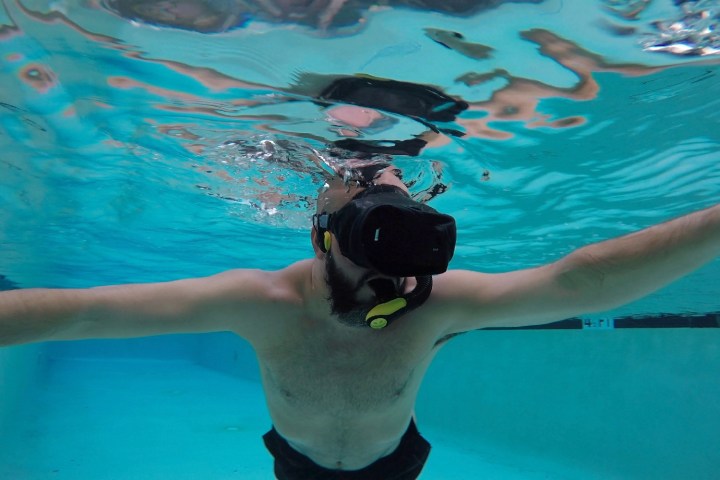
That’s what friends Stephen Greenwood and Allan Evans may have achieved when they decided to combine a scene from a popular Netflix series with virtual reality headsets to create … floating underwater VR. Sure, it sounds a bit crazy, but it’s hard not to be a little intrigued.

Recommended Videos

“We were out in San Francisco one night,” Greenwood, who is director of creative development at Discovery Digital Networks, told Digital Trends. “I had just been watching the show Stranger Things on Netflix, and was really inspired by one scene in the show where one of the characters is in a sensory deprivation tank. We started talking about sensory deprivation, and all of a sudden we came up with the idea of using a VR headset in one of these sensory deprivation tanks.”

Image used with permission by copyright holder

Evans, co-founder of headset maker Avegant, immediately set about thinking of ways to develop a prototype to see if the idea was worth exploring further. The very next day he got hold of a diving mask and 3D-printed two blocks to go inside it to allow a waterproof Android smartphone to be slotted inside like an aquatic Google Cardboard device. It was then just a matter of finding a swimming pool to test the creation in.

“The first experience I wanted to test out was simulating a space environment,” Greenwood continued. “I was able to track down a CG-rendered video of the International Space Station floating above the Earth. The impact was pretty much immediate. Even though it’s not the highest resolution or fidelity, there was a moment where — for a brief second — you really felt like you were an astronaut floating in space.”

Evans is quick to point out that this is in no way a finished product. “It’s the earliest possible stage of a prototype,” he said. “It couldn’t be any earlier.”

They’re not finished yet, though. “The next step is to see if we can incorporate a positional tracking system so that, rather than just being able to turn your head to look around at a 360 video, there’s the ability to swim toward objects in virtual reality,” he continued. “That’s going to be a big step to us.”

Hey, at the very least this neat hack promises to make bath time infinitely more enjoyable!

Luke Dormehl
I'm a UK-based tech writer covering Cool Tech at Digital Trends. I've also written for Fast Company, Wired, the Guardian…
Anti-surveillance clothing is getting cheaper, but don’t expect an invisibility cloak
Affordable shirts now claim to confuse facial recognition, although their protection depends heavily on the camera and software watching you
Chart, Plot, Adult

Anti-surveillance clothing is starting to look less like an art-school experiment and more like something you could actually wear outside. Shirts designed to confuse facial recognition systems now cost about as much as ordinary streetwear, although buying one won’t make you disappear.

The Guardian reports that designers are using face-like prints, unusual cuts and infrared lights to interfere with computer vision. These techniques target specific weaknesses, so their success depends on what happens to be watching you.

Read more
This spinning drone hides in plain sight using a visual illusion
This drone doesn't turn invisible. It tricks your brain into thinking it has.
Phantom Twist

For decades, engineers have chased the dream of an invisible drone. The usual approaches have involved transparent materials, camouflage coatings, or complex optical systems that bend light around an object. Researchers at Northwestern University decided to take a completely different route. Instead of hiding the drone itself, they chose to fool the human eye.

The result is Phantom Twist, an experimental drone that spins so rapidly it almost disappears into the background. It's not technically invisible, but to anyone watching, it looks more like a faint blur than a flying machine.

Read more
This smart knitted fabric can flip switches, count your steps, and even change shape
Grandma's knitting just entered its Iron Man era
Representative Image

For most of us, knitting brings to mind sweaters, scarves, and perhaps an ambitious grandmother determined to make winter more fashionable. Researchers at Harvard University, however, have a far more futuristic vision. They've transformed ordinary knitted fabric into a programmable material capable of changing shape, acting as an electrical switch, sensing movement, and potentially forming the foundation of tomorrow's wearable technology.

The research, published in Advanced Functional Materials by scientists at the Harvard John A. Paulson School of Engineering and Applied Sciences (SEAS), demonstrates how machine-knitted textiles can "snap" between multiple stable shapes without relying on motors or rigid mechanical parts.

Read more