Football helmets aren’t what they once were. And, while most of the time that turn of phrase is used to describe how things used to be better in the good old days, in this case, it’s certainly not.
Helmets are, in some senses, the most crucial bit of protective gear football players wear on the gridiron. Over the years, they’ve evolved from the leatherhead shell of yore to take advantage of breakthroughs on the material science front. Today’s big four helmet makers include the legacy brands Schutt and Riddell, in addition to comparative newcomers like VICIS and Xenith.
But who does the NFL turn to when it’s looking to inject some fresh thinking into helmet manufacturing and design; not for the purposes of fresh aesthetics but to fundamentally improve protection to preserve the careers and wellbeing of today’s (and tomorrow’s) players? As it turns out, the answer involves research labs like the Smart Materials and Biomechanics Lab at the University of Colorado Denver.
The group, led by associate professor and self-proclaimed “polymer dork” Chris Yakacki, has been hard at work inventing a new protective material for the next generation of football players. And it’s turning to some cutting edge technology, and the power of evolutionary science to help.
Reinventing the helmet
Back in June 2020, the National Football League and Football Research, Inc., a medical organization that investigates football injuries, handed a University of Colorado Denver spinoff called Impressio half a million dollars (well, $491,999 if you want to be precise) to support its work creating innovative helmet prototypes.
These will be submitted as part of the NFL Helmet Challenge, an open contest that seeks to make helmets significantly better than the ones currently used on the gridiron. The deadline for this challenge is July 2021, and the winning entry will receive a cool $1 million for its troubles. Provided it’s able to solve the problem, that is.
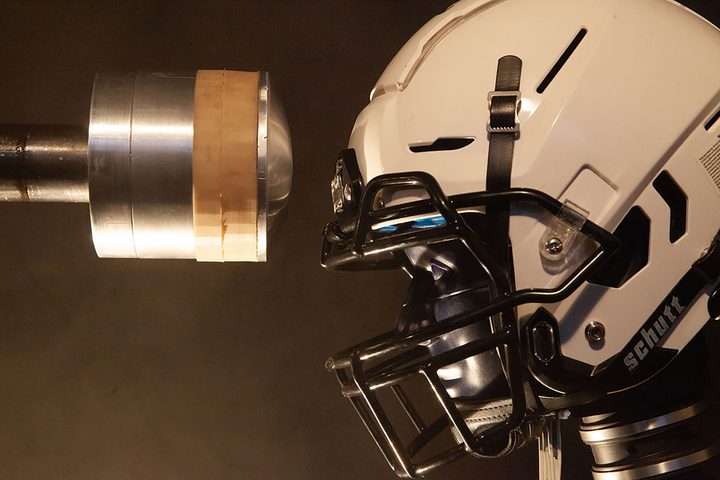
“They’re requesting a 30% improvement in reducing impacts in helmets,” Yakacki said. “I think the only way you’re gonna do that is you don’t keep using the same materials. Anyone who enters this competition using traditional foam and polycarbonate… well, we’ve been studying that stuff for 50 years. [We need something new.]”
The University of Colorado’s solution doesn’t call for a total redesign of the football helmet. “There’s a wonderful SpongeBob SquarePants episode where he puts a giant foam helmet that’s like three feet in diameter on his head,” Yakacki laughed. “I’m like, ‘well, that would solve the problem.” However, he acknowledged that this probably wouldn’t meet with particularly good feedback outside of its obvious safety advantage.
Instead, like a new smartphone that looks similar to last year’s model, but packs a bunch of exciting new tech under the hood, most of the innovation in the team’s new helmet is going to happen on the inside: specifically with the material lining the helmet.
Nature-inspired designs
Nature has already shown us the most evolutionarily sound shock absorbers in the form of muscles that expand and contract to absorb the energy of impact, such as when a person lands from a jump or goes for a run, their feet pounding against the pavement. But, until now, we’ve been unable to replicate this structure with the materials available to us. Additive manufacturing, a.k.a. 3D printing, and an innovative material called liquid crystal elastomers changes that. Muscular biomimicry is now possible.
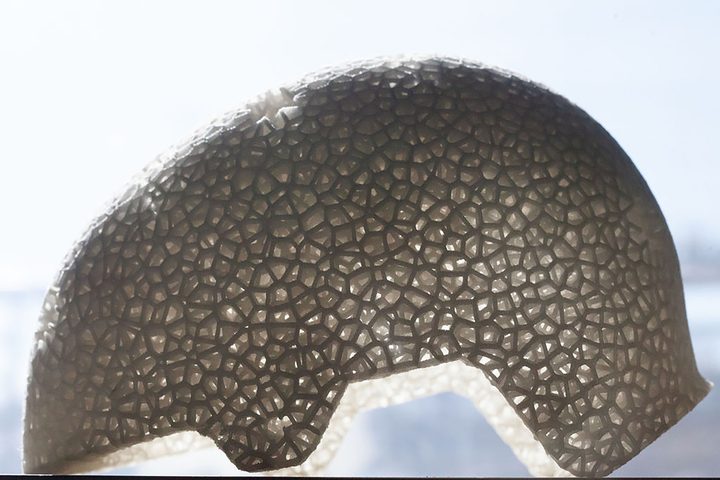
A long-term subject of investigation by Yakacki and colleagues, liquid crystal elastomers are a rubberized version of the liquid crystal materials found in LCD TVs and computer monitors. They respond to light or heat in a dynamic way similar to the way that muscles work. By using a 3D printer to print this material in a biomimetic pattern that looks similar to muscle fibers under a microscope, Yakacki believes it will be possible to create the safest, most shock absorbing-est, helmet yet.
“When you see some of these designs, it’ll become immediately apparent that you could never do this with injection molding,” he said. “It’s such an intricate spider web of struts that it could never be machined that way. No mold could be machined that way. It would be literally impossible. Machinists would just laugh you out of the building. Some of our designs just have hundreds of struts, these little interconnected beams. It’s just impossible [without 3D printing].”


The team has yet to publish exact figures about their progress, but Yakacki is optimistic. “I can’t give away too many numbers right now [from our lab],” he said. “But I will say that we’re highly confident that we can hit those improvements on impact.”
Coming to a football game (and anywhere else a helmet is required) near you, very soon.