
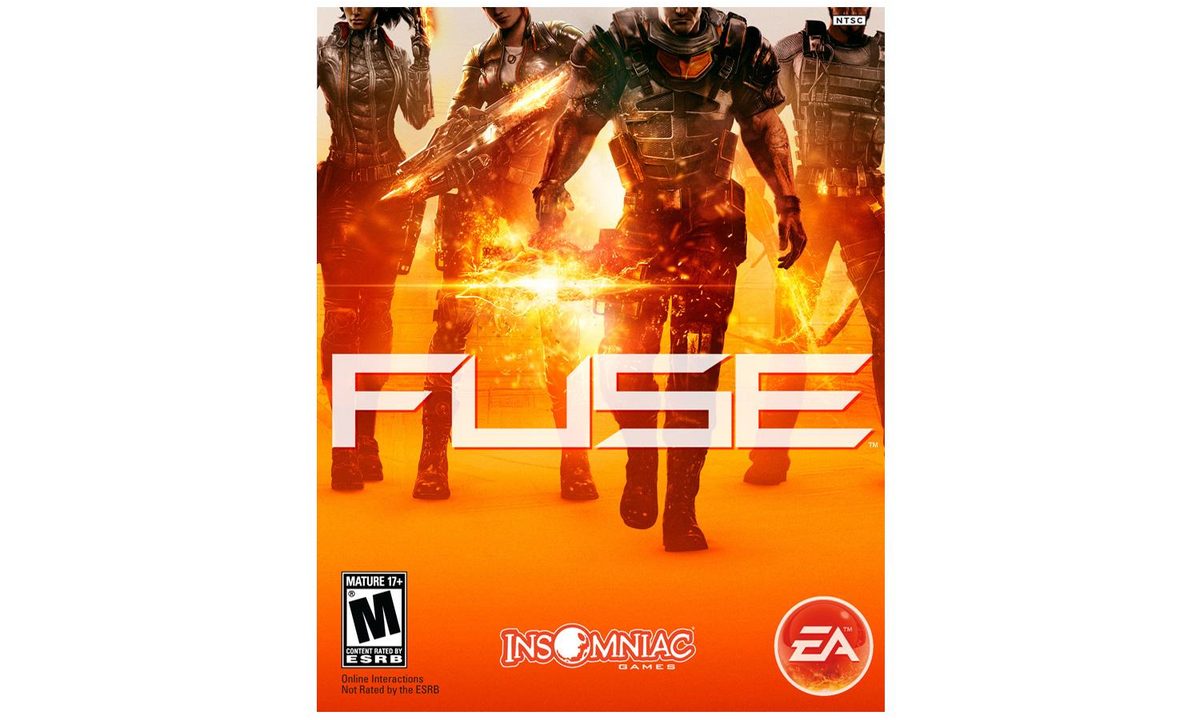
“Insomniac Games kicks off an entirely new sci-fi universe in 'Fuse,' a co-op shooter with some great ideas that don't always come together.”
- Each character feels uniquely powerful
- Assorted abilities work well together in co-op
- Wide range of environments spread across each lengthy mission
- Level design falls into a regular pattern of corridors connecting battle arenas
- Late-game feels like a grind as enemy variety tails off
- Spiking difficulty in the later missions lacks imagination, favors brute-force challenge
“Why you can trust Digital Trends – We have a 20-year history of testing, reviewing, and rating products, services and apps to help you make a sound buying decision. Find out more about how we test and score products.“

It’s hard to pin down what’s wrong with Fuse, the latest from Insomniac Games. At least at first. The game’s third-person co-op action is in tune more than it falls flat, especially when all four of the uniquely talented main characters start using their specific abilities in harmony. The missions are long and serve up a varied set of environments. Experience-boosting secrets litter each level. Unexpectedly intelligent AI simultaneously helps to lessen the sting of solo play while throwing up a generally healthy challenge.
It’s only after a sustained amount of play that shortcomings really begin to show. The enemies that challenge you lack variety and they show up for every encounter in predictable waves. The option to embrace a stealthier approach feels like an afterthought at the best of times, especially when the otherwise capable friendly AI operates under the notion that a single silent kill qualifies as a ‘fire at will’ order. Worst of all, however, is the lack of personality. The four members of Overstrike 9 come equipped with an entertaining lineup of zingers and one-liners, but sorely lacking is any sense of development or growth.
Then this thing happened
It’s enough to know going into Fuse that your Overstrike 9 team equals good, and the Raven Corporation equals bad. Positioned between the two is Fuse, the titular alien substance that provides the fuel for the game’s more fantastical weapons, including the four unique firearms carried by the main characters. Each of the six lengthy missions you’ll embark upon are sewn together by Overstrike 9’s pursuit of the organization and its plans for the Fuse.
It all seems so simple, doesn’t it? The four protagonists try to bring down an evil corporation and its megalomaniacal big bossman. Easy. Familiar, even. The sort of video game plot that we’ve seen in some form or another at least once per year since interactive stories found their audience. There is something lacking, however.

Presentation is part of it. Cutscenes exist in Fuse largely to drive the immediate action forward. You know where you are, you know where you’re going, and you know why you’re in this particular place at this particular time. Characters crack wise constantly, and the admittedly funny writing serves as a sort of verbal sleight of hand to keep you distracted from the fact that, for all of the words being spoken, not much is actually being said.
“Heroic team of soldiers takes on evil corporation” is about as low-concept as video games get. Shallow attempts are made to explore the inner workings of each of the four characters to the point that even the one-liners embrace a loose continuity. None of this ever bears out in a way that sticks, however. One of the character’s irrational fear of cats comes up repeatedly in the incidental dialogue, but it’s just a thing the characters say. There’s never any real pay off.
The Overstrike 9 foursome isn’t a tight-knit squad of people. It’s a lineup of wisecracking weapons. Tools that you can plug-and-play at will to suit any situation.
Running a repetitive gauntlet
There are plenty of opportunity to make use of those tools in the challenging combat scenarios that Fuse throws at you. Each of the game’s six missions lasts a good two hours apiece, and each presents an entirely different environment, complete with its own set of hazards and tactical concerns. There is virtually no corridor shooting, with most combat instead unfolding in giant, multi-path spaces that fill up quickly with enemy forces.
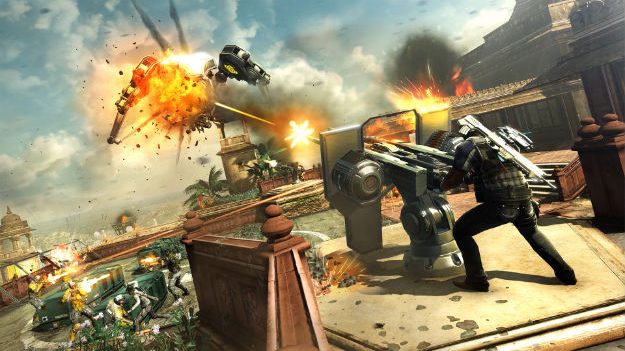
Understanding the capabilities of each Overstrike 9 squaddie is vital. Dalton is best at short ranges, with his Mag-Shield capable of stopping incoming fire and projecting out a concussive wall of force that liquefies most organic matter in front of it. Naya’s Warp Rifle turns expired enemies into miniature black holes that chain together at higher levels. Izzy’s Shattergun turns anything into solid, black Fuse crystal under sustained fire, immobilizing enemy targets and leaving them temporarily in danger of being… well… shattered. Jacob’s Arcshot crossbow is a long-range, single-fire weapon with fire effects and remote detonation capabilities.
Each character levels up over time. The main unlocks that you shoot for revolve around the Fuse weapons and secondary skills, such as Naya’s cloaking device or Izzy’s throwable, health-restoring med beacons. Secondary branches offer the choice of improving general offensive and defensive capabilities. You eventually go with both and turn your characters into super-badasses, but not in the space of a single playthrough. There’s also hard currency that can be spent on Team Perks; these rather expensive investment provide the deeper hooks for longer-term play and also encourage co-op play with different people using different perks to compliment each other.
All of this would be great if Fuse gave you more reason to want to keep going. Raven may be a powerful force in the game’s world, but they lack imagination. The combat forces basically come in two flavors: soldiers and mechs. Sure, there are snipers and riot gear troops, and flamers and grenadiers, and all manner of enemy loadouts. It all starts to look and play the same after awhile, however.

A fight breaks out and you quickly scramble into cover as some enemies take up firing positions while others rush forward. You’ll always know which is which because neither the character models nor the behaviors tied to each one ever change. You quickly figure out where fresh forces are spawning in so you can focus your fire on those locations. Heavier mech forces require more sustained fire and active flanking since they are weak to attacks from the rear. Again, the patterns never change.
The challenge spikes considerably in the latter portions of the game, but it has less to do with shifting enemy tactics and more to do with fewer resources pitted against superior numbers. You’ll start seeing two mechs at a time instead of just one. Ammo packs become less ubiquitous. The swarm of kamikaze bugs that threaten to explode in your faces balloons from 10 to 50. It’s a blunt-force approach to escalating challenge and it quickly grows tiresome.
Getting hooked
For all that doesn’t work about Fuse, the core play is so competent and finely tuned that it’s easy to overlook many of the issues. Enemy forces may be generic, but the environments you fight them in always imaginative. There are turrets, elevated locations, a multitude of flanking routes, siege-style encounters that place the focus on pure defense, and more. Uncharted-style platforming that favors danger-free traversal over challenging puzzle-solving helps to further break up the monotony.

Long-term investment comes from the skill trees and Team Perks; these are profile-wide enhancements that stick with you through multiple playthroughs and outings in the game’s wave-based survival mode, Echelon. Earn something in one mode and it carries over throughout all modes. Co-op is king here. Between Insomniac’s perfectly implemented drop-in/drop-out play, and the wide range of complementary team perks, it’s clear that Fuse is really designed with four human players as the ideal scenario.
Conclusion
Fuse lays out a healthy foundation for surface-level fun and little else. The good bits are in an even race with the bad ones, but the balance tips heavily toward the former when you’re playing in co-op with a communicative squad. There’s a fun game here to invest some hours in as you start hunkering down for a long, hot summer of air conditioned voice chat, but Insomniac has plenty of room to grow and improve if this newly formed universe survives beyond its first game.
Score: 8 out of 10
(This game was reviewed on the Xbox 360 using a copy provided by the publisher)


