

Oblivion plays its hand too soon. The forward rush to get to the movie’s “here’s what’s really going on!” moment creates a push-and-pull tension between the growing sense of mystery and an apparent need to please blockbuster audiences. It is unfortunately the latter that wins out. For his second feature gig, director, writer, and creator Joseph Kosinski once again finds himself caught between a sharp sci-fi vision and studio focus test reports.
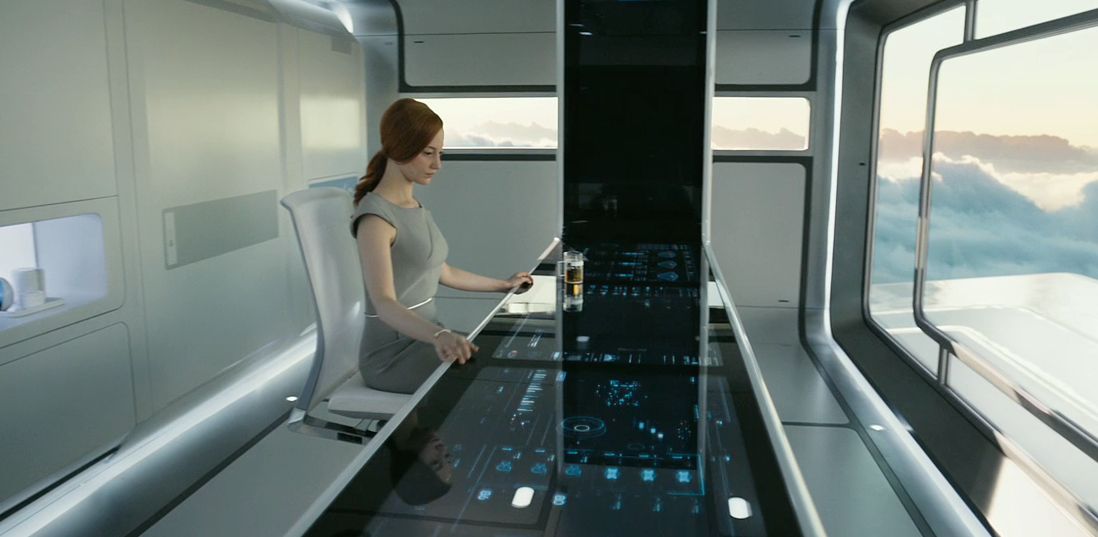
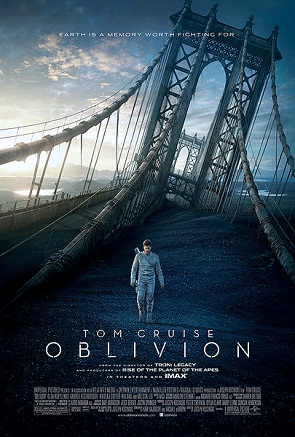 This is what happens when you hand over a $200 million budget to a relatively untested creative quantity. Kosinski’s talents as a world-builder are obvious. His TRON Legacy debut is guilty of many sins, but its expansion of the universe that Disney’s 1982 movie introduced is not among them. Oblivion is artfully painted across a fresh, new canvas; its harsh, post-invasion wasteland playing well as a sharp contrast to the clean and polished sci-fi living space erected in the clouds above.
The problem comes in when Kosinski’s creative vision runs up against the check-signer’s need to protect what amounts to a nine-figure investment. Extended action sequences in the back half of the movie serve only to neuter Oblivion‘s eye-widening narrative revelations. The depressingly one-note near-cameo from Morgan Freeman is little more than a distraction. Invisible checkboxes strike off one crowd-pleaser after another. You can’t help but wonder how much stronger this movie would have been with only the four truly necessary actors and zero explosions.
While it’s possible to single out any of the leads and point to one flawed performance or another, it is the dissonant vision that ultimately unravels Oblivion.
Jack (Tom Cruise) and Victoria (Andrea Riseborough) form the Earthbound contingent of that skeleton crew. Jack is Tech-49, a futureworld repairman who flies down to the surface each day to perform his duties while communications officer Victoria monitors the situation from their high-altitude home. The two are also lovers, and their close bond makes for what Melissa Leo’s Sally – the smiling company-lady Mission Control who oversees the operation from the orbiting Tent space station – constantly refers to as an “effective team.”

Jack’s duties are complicated by the lingering threat of Scav marauders. Earth’s alien invaders might have lost the war, but the remnants of that struggle live on as Scav gangs constantly work to bring down the towering fusion power converters and the flying robot drone orbs that are tasked with defending them. Meanwhile, frequent visions of old New York City and a mysterious woman (Olga Kurylenko) plague Jack’s dreams. It becomes clear quickly enough that all is not as it seems.
 While it’s possible to single out any of the leads and point to one flawed performance or another, it is the dissonant vision that ultimately unravels Oblivion. The push-and-pull between the unfolding mystery and the blockbuster sensibilities spills out into every corner of the movie. Actors don’t get enough screen time, which in turn stunts the character development. Explosions and gunfights chew through enough time to require a blunt-force approach to exposition in the final half hour. You don’t buy into any of it because ultimately, you’re not given any reason to really invest.
Conclusion
Oblivion will no doubt find its audience. There are enough original ideas here to guarantee that, especially when you pair them with the eye-catching sci-fi setting. Kosinski proved with TRON and now again that he knows how to paint a visually arresting movie. He also seems to have the chops of a natural-born storyteller, if the more promising bits of Oblivion‘s narrative are any indication.
Perhaps what Kosinski needs, what he really needs, is less rather than more. A cheaper, more character-focused effort here could very well have fallen into the same realm of smart sci-fi that Duncan Jones’ Moon and David Twohy’s Pitch Black did – perhaps even The Matrix, given the potent, crowd-pleasing mix of strong ideas and artistic flair. Instead, Oblivion feels like it was hatched in a creative place and then developed in a conference room.


