  1. Home
  2. Health & Fitness
  3. Emerging Tech
  4. News

Hungry worms may help scientists understand mysterious biological forces

Add as a preferred source on Google

There are strange biological forces at play within our bodies, and an interdisciplinary team of Stanford scientists is using an unconventional method to uncover them. By feeding glowing, nanoparticle-laced bacteria to millimeter-long worms, the researchers hope to measure information about these forces in real time.

The term “forces” is sort of a catchall for mechanical functions that play positive and negative roles in our bodies, from healing wounds to growing cancer cells and causing osteoporosis.

Recommended Videos

“Comparing forces exerted by healthy versus unhealthy cells … can lead to new ways to diagnosis and cure these diseases,” Alice Lay, one of the project’s leads, told Digital Trends. “Unfortunately, few available methods can measure forces in vivo. Thus, our research aims to develop a new class of in vivo sensors, with biocompatible size and robust optical readout, in order to image and record biological forces in real time.”

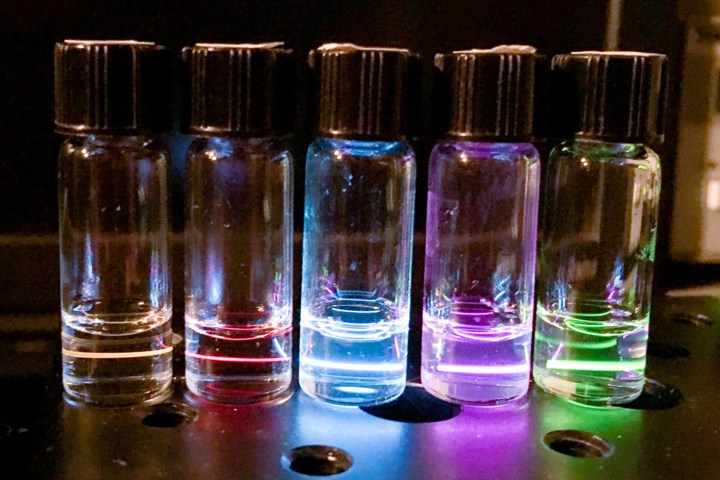
The nanoparticles used in this research glow when they’re struck by a specialized laser and the color they emit depends on the pressure exerted around them. In this way, they’re able to relay real-time data about their surroundings so that researchers can monitor and analyze the slight forces at play within the body.

Lay, who is a doctoral candidate in Jennifer Dionne’s materials science and engineering lab at Stanford, teamed up with Dionne and Miriam Goodman, a professor of molecular and cellular physiology, to investigate these forces. Although the project’s end goal is to uncover the forces at play in humans, the researchers decided to begin with tiny, transparent worms called Caenorhabiditis elegans.

Caenorhabiditis elegans are tiny roundworms and studies using this animal have informed topics ranging from developmental biology to neuroscience to ecology since the 1970s,” Goodman said. “Because their bodies are transparent, they are terrific subjects for research projects like this one that involve using light to detect physical forces and biological signals.” It helps that these worms love to gobble up bacteria, which can be easily laced with the light-responsive nanoparticles.

“To put it another way,” Goodman said, “the worms like to eat tiny things, they are not very picky about what they eat, and we can watch them chew up their food because their bodies are transparent.”

Humans and roundworms may not look alike, but our digestive mechanisms have a couple things in common — we both gnaw and swallow. By studying how the nanoparticles react to these digestive forces, the researchers can gain insight into how they might be used to investigate the forces at play in humans.

The team still have plenty of work ahead of them before they conduct human trials. They’ll begin by studying healthy worms and then introduce mutations to examine how gene expression may influence cellular forces. After that they’ll look to use these nanoparticles to study the forces at work between tissues and cells.

Dyllan Furness
Former Contributor
Dyllan Furness is a freelance writer from Florida. He covers strange science and emerging tech for Digital Trends, focusing…
Starfish-inspired patch solves key issues for wearable heart sensors
Heart rate sensor inspired by Starfish.

The domain of wearable devices has grown by leaps and bounds, not just in terms of mass adoption, but also owing to some astounding innovations. Wearable heart rate sensors can now measure everything from heart rate and blood oxygen levels to ECG in form factors ranging from a watch to finger rings.

These sensors, however, come with an inherent set of problems. Motion artifacts arising from movement or vigorous activity alter the blood flow and affect their accuracy. Optical heart rate sensors (photoplethysmography or PPG tech) also struggle with darker skin tones, tattoos, or even body placement. 

Read more
The Chairman™ Pro package is on sale — and it’s the only shaving kit you’ll ever need
manscaped products

There’s grooming, and then there’s grooming with intention. If your current routine feels more like a chore than a ritual, it might be time to rethink your tools. The Chairman™ Pro Package from MANSCAPED® is a full-face grooming system that doesn’t just clean you up—it sharpens your whole look. Right now, it’s available for $169.99 (11% off the usual $189.97), and you can drop that price even further to $159.99 when you subscribe to the Chairman Pro Package + Peak Hygiene plan. Throw in free shipping, and it’s a solid deal on a seriously well-thought-out kit.
One kit. Total control.
At the heart of the package is The Chairman™ Pro Electric Foil Shaver, MANSCAPED® top-tier tool designed for guys who want versatility and comfort in equal measure. This isn’t your dad’s shaver—it comes with two interchangeable SkinSafe® blade heads: a four-blade foil for smooth, clean-shaven skin, and a stubble trimmer that nails that 5 o’clock shadow look without wrecking your neckline.

Want a little definition without going full lumberjack? The included two length-setting stubble combs help dial in the perfect length. With FlexAdjust™ Technology that adapts to every jawline and a precision trimmer edge for hard-to-reach spots, this thing is engineered for the real world—where your face doesn’t grow hair at perfect right angles.

Read more
You Asked: What’s the most impressive thing you saw at CES?
You Asked CES Editors Cut

On today’s special edition of You Asked, we tracked down each of our editors and put them on the spot to find out what they thought was the most impressive thing they saw at CES 2025 in Early January. Let’s find out what they had to say.
Panasonic Z95B

There’s been some really cool TV tech at CES, but the thing I’m most excited about is the new Panasonic Z95B. Instead of the regular OLED display structure we’ve seen in recent years with MLA technology, this uses a four-layer panel structure. It features individual red, green, and blue layers (two of the latter) for the emissive light.

Read more