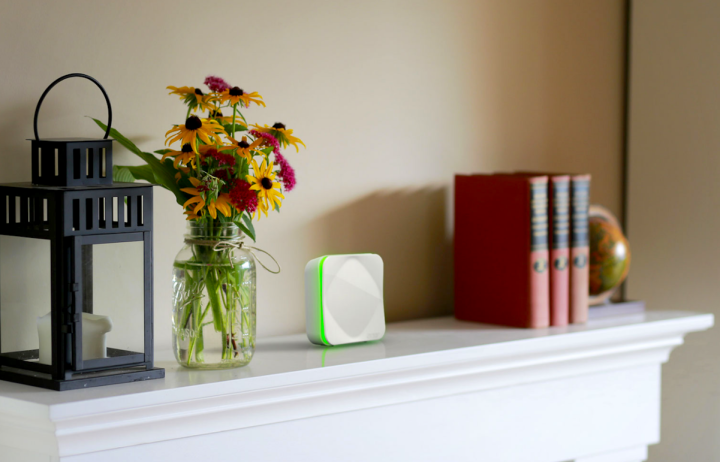
The smart device we’re talking about here is the it-does-what-it-says-on-the-can “Air Monitor.”
That’s right, this time around the company wants to help you keep track of air quality in your home, office, or any other indoor area that you spend time pottering about in.
Announced by the Taiwanese firm on Thursday, the stylish-looking machine allows real-time monitoring of a raft of key air quality indicators, namely carbon dioxide, particulate matter, temperature, humidity, and Total Volatile Organic Compounds (TVOC), which are found in some cleaning products, air fresheners, and elsewhere.
Acer’s Air Monitor lets you know if the air you’re breathing is turning nasty via its accompanying smartphone app, or through the device’s built-in LED lights, which change color to grab your attention.
Regarding the LEDs, Acer adds that “an integrated sensor automatically turns off the light when the ambient lighting is dimmed to a certain level to prevent distracting users while they sleep.” In addition, IFTTT integration means you can set up home or office automation based on the device’s air quality indicators, so if the atmosphere turns bad an air purifier, for example, can be automatically activated.
Acer points to research from the U.S. and Europe indicating that on average people spend around 90 percent of their time indoors — “at home, at work, and everywhere in between.” While you might think your indoor air quality is fine, perhaps that isn’t the case if you live on a busy street in a big city. Pollution experts also point to gas cookers, wood-burning stoves, office equipment, cleaning products, and scented candles as sources of indoor air pollution.
Acer’s Air Monitor will hit stores in selected countries from April 2017. There’s no word yet on pricing or precisely which markets it will land in, but we’ll be sure to update this article with the information as soon as we sniff it out.
Editors' Recommendations
- Acer’s TV-sized Predator gaming monitor is OLED, 4K, and living room-ready
- The Roku-YouTube-YouTube TV impasse isn’t over yet
- Don’t believe the marketing! Robot chefs aren’t what you think they are
- 7 reasons why your AC isn’t cooling your home
- When standing isn’t enough, the NextErgo will have you doing yoga at your desk