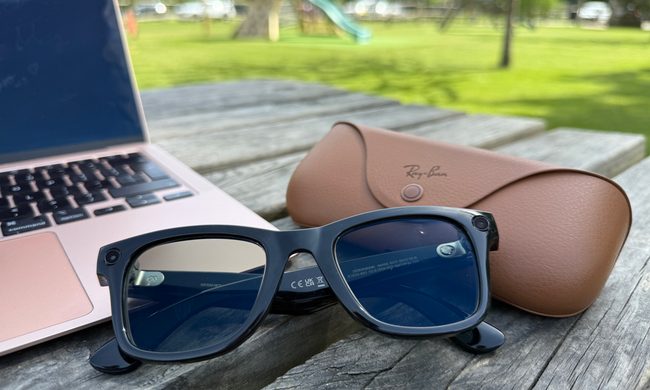
What is one of the hottest, most interesting mobile devices around at the moment? It’s Ray-Ban Meta, smart glasses that not only look great but work really well too.
They’re suitably incognito yet still highly functional, giving you a reason to wear them all the time if the mood takes you. Plus, they have AI — the big feature beloved by tech firms at the moment — built right in. So, where was Google’s competitor at Google I/O?
A tease and nothing more

Eagle-eyed viewers of the keynote presentation who were not put to sleep by the endless productivity AI demonstrations may have caught a glimpse of a pair of smart glasses at one point. During the Project Astra demonstration, and after using a phone to show off Astra’s capabilities, a Google staffer casually picked up a pair of ordinary-looking glasses, put them on, and then continued the demo.
The presentation switched to an in-person viewpoint as if we were looking through the glasses and exploring Project Astra using voice. It looked very cool, except it was obviously not a “real” product demonstration. The smart glasses were never given an introduction, and we never saw the person actually using them, only wearing them for a moment in a tiny picture-in-picture window. But it hinted at what Google thinks is possible with smart glasses and Project Astra in the future.

That was it. A blink-and-you-missed-it tease of a product that we have to assume is only a proof-of-concept and doesn’t actually exist. But why doesn’t it exist? Aside from the on-screen icon showing Gemini was listening, suggesting the smart glasses are envisaged with some type of display, it didn’t do anything the Ray-Ban Meta can’t do, and these are available to buy today, while the AI feature has been available to all owners in the U.S. for nearly a month.
Wasting the opportunity

The Google I/O 2024 keynote was packed full of AI demonstrations, mostly facilitated by a smartphone or a computer, but entirely absent of any dedicated AI-centric hardware to fire up our imagination. Yet Google pioneered the smart-glasses race more than a decade ago when it introduced Google Glass, a product so entirely ahead of its time and so misunderstood that it was vilified to the point where it was discontinued. Times have changed, though, and what was unacceptable then isn’t so problematic anymore.
A modern interpretation of Glass with Gemini integration and a greater awareness of privacy seemed like a complete no-brainer for Google, and the 2024 I/O keynote was the prime time to introduce it. Yet the best Google can manage was a brief tease with absolutely no further discussion of it afterward. Brushing the smart glasses under the rug or holding back on sharing more because it’s still early days (for some unknown reason) seems pointless when it so obviously wanted people to notice them. Otherwise, why bother to put them into the demonstration in the first place?

The trouble is, Meta is out there today proving that smart glasses are a fantastic wearable for AI, and it’s not the only one. Solos has a range of smart glasses built around ChatGPT, and Brilliant Labs’ exciting Frame smart glasses are now reaching the faces of keen early adopters.
That’s all before considering smart glasses with AI capabilities from Oppo and app-based AI-first platforms that work with smart glasses like XRAI. There’s a lot happening with smart glasses today, but Google is completely absent from any of it.
Missing the boat

This isn’t the first time Google has shown a pair of concept smart glasses during Google I/O’s keynote and then promptly ignored them forever. In 2022, it showed how live transcription through smart glasses could change people’s lives, and it was both an inspiring and exciting glimpse of the future. Where are those smart glasses with that capability today? Who knows. Perhaps Google dusted off and reused that old prop for the Project Astra demo, as they certainly aren’t on sale.
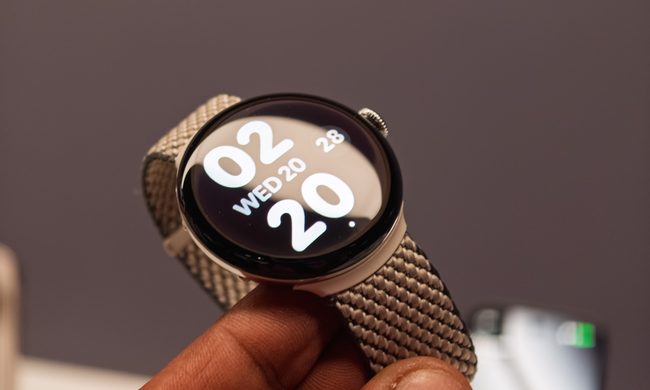
The procrastination on Google’s part over creating exciting hardware for its AI is a serious problem, as others are out there capitalizing on all this now, with XRAI’s AI subtitling and translation feature being a prime example. Google isn’t Apple, and it can’t sit back and let others experiment and then come out with its own interpretation. The Pixel Watch proved it, as the first version was a poor smartwatch with an unimaginative design that really came too late. While the sequel improved things a lot, it’s still the same on the outside, and other brands are either far ahead or already moving on.
What Google does (or used to do) well is push boundaries, and it needs to do that with its AI hardware now, not in several years’ time when its competitors have already done it all. It seems to have forgotten how to have fun and is so caught up in making AI “helpful” that it has lost sight of how to make its software innovations enticing. A pair of smart glasses would have done exactly that, and frustratingly, I think Google knows it, as it slipped that half-hearted tease into the keynote.
Buy Ray-Ban Meta instead

Google’s lackadaisical approach to smart glasses, and indeed any dedicated hardware that shows off the incredible potential of Gemini and AI, is giving its competitors the edge, and that’s the biggest problem of them all. It had a big chance to reclaim its position as a smart-glasses innovator (and an XR innovator, too) at this year’s I/O — all while exorcising the demons that still haunt Glass all these years later. But, instead, it chose to pretend they’re still tech coming in the future.
I’m here to tell you this isn’t right, as you can buy the superb Ray-Ban Meta smart glasses today, and they’re not a concept or beta test, but an everyday usable product you’ll love — complete with AI smarts right there at your fingertips. They will introduce and excite normal people to AI’s potential far more than yet another AI-generated summary of an email or PDF, which simply isn’t the “wow” moment Google seems to think it is.
Maybe Glass will return with AI in 2025, but based on the situation today, I’m more interested in seeing what Google’s competition will be doing with AI hardware next year. Considering we’re discussing Google here, not a company that has never innovated before, that really shouldn’t be the case at all, and it highlights what a misstep it made at I/O 2024.