1. Home
  2. Mobile
  3. Opinion
  4. Social Media
  5. Features

Is Facebook still flunking on phones? Our mobile report card

Add as a preferred source on Google
Image used with permission by copyright holder

Mobile is priority number one over at Facebook HQ. Since going public this past summer, the social network has made its intentions to hit mobile hard increasingly clear. While the Web has been kind to Facebook, there have remained some significant hurdles. Mobile, to a point, remains Facebook’s White Whale – and it’s an important one to conquer if the company wants remain, and further become, the ubiquitous social platform for our lives.

To that end, Facebook has introduced a handful of mobile-first, standalone apps – which are, to varying degrees copycats of other successful apps, and have experienced varying degrees of success. Consider this a quick check-up on how Facebook’s mobile product development is faring.

Camera

Facebook introduced Camera last spring during the height of Instagramania (phrase trademark pending). While it was definitely a competitor to the favored photo-sharing platform, the fact that Facebook had recently bought Instagram meant that the threat wasn’t as real. Still, Camera was meant to give users a proprietary option for filtering their photos.

So how’s it doing? According to AppAnnie, Camera’s early popularity was shortlived. After releasing the new version back in September, things got a little better, but it’s been on a slow decline ever since.

fb camera
Image used with permission by copyright holder

The thing is, Camera is a very mediocre app – generally, filter apps that aren’t Instagram have been found wanting, at least when it comes to image quality. Instagram has said very little about the technology behind its filters, but images are cleaner, clearer, less pixelated. In short, they’re better — a lot better. Creating these filters is not an easy process (this Quora question has some great answers, including one from Instagram CEO Kevin Systrom), and Camera is sort of a cop out. The drop in downloads, of course, is probably due in part to the fact that Camera has been woven into the original Facebook app itself.

Messenger

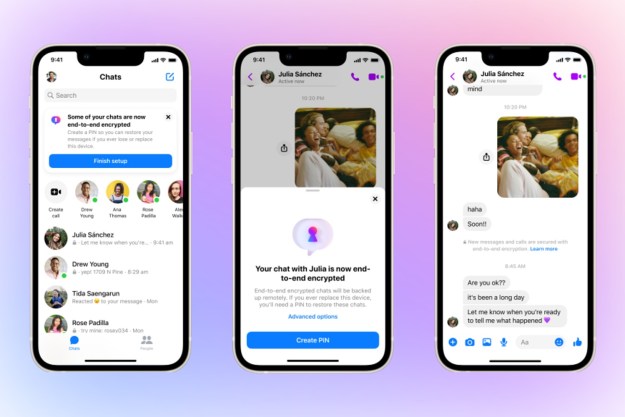
The Facebook chat app was launched nearly two years ago as a better, faster way to message your Facebook friends. It was also largely lauded as a texting workaround, and a means to reaching a person more efficiently – no more guessing about whether you should text, email, instant message … and on and on and on. It kept all private Facebook conversations in one stream instead of scattered.

Messenger was the first standalone Facebook app, and has remained a highly popular download. Facebook continues to improve the product as well, recently introducing free phone calls and voice messages. While apps like Imo.Im and WhatsApp remain popular choices for multi-platform chatting and free texting options, Messenger is certainly a worthwhile, well-managed product – and the stats prove it.

fb messenger
Image used with permission by copyright holder

Poke

Enter copycat number two. After the swift rise of Snapchat (whose founders should be thanking middle schoolers everywhere), rumors started swirling that Facebook was set to launch its own version. Within mere days, we were introduced to Poke. The clone functions much like Snapchat, complete with all the scary privacy problems that should make any of you out there taking sexy selfies nervous.

However, not long after the release, Poke ratings began to slip – hard. The drop is partially because Snapchat has manage to create an incredibly loyal user community, one that took to the App Store to hate on Poke and defend their beloved Snapchat.

fb poke
Image used with permission by copyright holder

As you can see, Poke has continued to fall (and fall fast) while Snapchat is still sitting pretty at number 14.

So what does this all mean? While App Annie is more like a sampling of what’s happening on users’ smartphones than a conclusive study, it certainly gives us an idea of what is and isn’t working. And what’s working are original products. Messenger, the proprietary Facebook app itself, and the Pages Manager app are all doing well. They’ve managed to sustain relatively even levels of installations instead of the steady declines Poke and Camera have both experienced.

What we’re witnessing is something of a scattered approach. Facebook has issued a handful of standalone apps, reattaching them to the original app to varying degrees (or not at all), and leaving users with a relatively confusing mobile experience. Only a couple of things remain clear: The Facebook app itself is a more robust, much-improved user experience. Copycatting popular platforms or app trends is a losing battle. And lastly, that there is plenty of work to be done. Truly developing innovative, original, user-friendly products that improve using Facebook via smartphone and tablet is supposed to be the priority for Facebook, but there’s still plenty of work to be done.

Right now, what’s working best for Facebook are apps that, really, just add functionality to Facebook. They aren’t really immersive or interactive or add some new feature to the platform. The attempts Facebook as made in this vein haven’t performed well — and yeah, maybe that’s because they simply tried to clone what other apps had done first and better. It’s time to just stop talking about mobile and make something that captures our attention here, because the Web won’t be enough. 

Molly McHugh
Former Social Media/Web Editor
Before coming to Digital Trends, Molly worked as a freelance writer, occasional photographer, and general technical lackey…
Snapchat Planets Meaning: Order, Rankings, and How Friend Solar System Works
Snapchat Planets turns your best friends list into a solar system, and yes, your orbit says a lot
Snapchat Planets being shown on the Snapchat app on iPhone.

Snapchat+ includes several exclusive features, but few have generated as much curiosity as Snapchat Planets. Part of the app's Friend Solar System, it transforms your Best Friends list into a planetary ranking, assigning each of your top eight friends a planet based on how often you interact.

From Mercury, which represents your closest friend, to Neptune, which represents your eighth closest, the system offers a quick visual snapshot of your interactions. But what do the different planets actually mean, and how does Snapchat decide who gets which one?

Read more
How to use WhatsApp Web
We'll show you how to use WhatsApp on your desktop or laptop
WhatsApp Web

As one of the most popular messaging services, you’ve already heard of WhatsApp. From its humble beginnings in 2009—two years before Apple introduced iMessage—to its acquisition by Facebook (now Meta) in 2014, WhatsApp has become the dominant messaging platform around the globe.

In recent years, it's grown even more potent with new features like video messages, self-destructing voice messages, the ability to edit sent messages, and more. We even finally got an WhatsApp iPad app in May 2025.

Read more
What is WhatsApp? How to use the app, tips, tricks, and more
From setting it up to mastering hidden features, here is your complete guide to WhatsApp.
WhatsApp app store listing open on iPhone

There's no shortage of messaging apps out there. The past decade has given us more options than we know what to do with, largely because smartphones demanded something better than plain old SMS.

Both the App Store and the Play Store are packed with apps that promise to revolutionize the way we communicate. Most of them didn't make it. The truth is, a messaging app is only as good as the number of people using it, and most apps never cross that threshold.

Read more