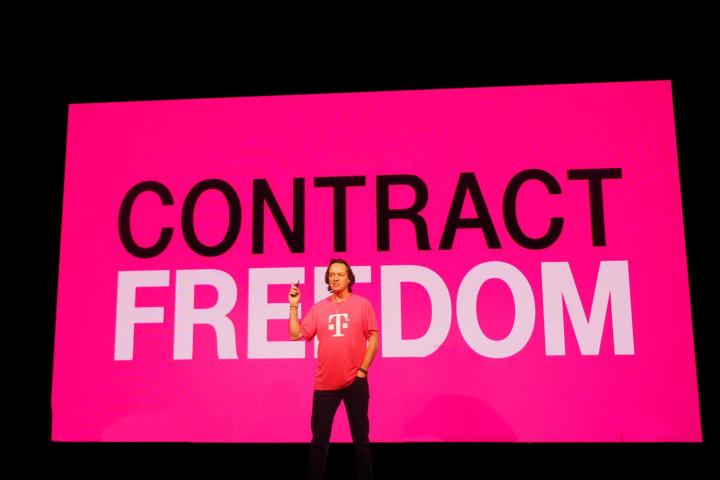
When CEO John Legere joined T-Mobile a year ago, he had a problem: T-Mobile was a distant fourth-place carrier in an industry built to prevent people from switching carriers. Most CEOs would just hire another, younger, prettier T-Mobile girl and cross their fingers. Instead, Legere started knocking down walls. Through a series of calculated announcements, he’s trying to upend the entire wireless industry and position T-Mobile on top when the dust settles. And lucky for you, consumers will end up on top too, whether they join T-Mobile or not.
Here’s how it works: When you switch from another carrier, T-Mobile will pay up to $350 of your early termination fee, and give you up to $300 for your old phone. Legere believes this will force all carriers to end contracts and ETFs for good.
If the bleeding continues, policies will only get fairer and subscriptions cheaper.
“This isn’t an offer; this is a lifestyle,” Legere announced in his typically bombastic fashion. “We will never have contracts … We are either going to take over this whole industry, or these bastards will change and we’ll still be wildly successful. I’m going to love watching the peckers scream.”
T-Mobile’s first big Uncarrier move was axing the subsidy most carriers put on phones. When AT&T sells you a $650 iPhone for only $200, they’re rolling the real cost of the phone into your monthly service fee. If you break your two-year contract and leave early, they don’t get their money back, hence the early termination fees. On T-Mobile, you can pay the full cost of the phone up front, or spread the cost across many months. You get a choice, and it’s far more transparent.
The brilliance of Legere’s plan is that if he succeeds, we all win. A completely contractless wireless industry is a boon for consumers, far beyond merely being able to change carriers on a whim. Here’s why.
Carriers will be in real competition
In a future where carriers will “pay out” each others’ early termination fees to win customers, those fees will eventually disappear altogether. At that point customers will be able to leave a carrier painlessly whenever they’re dissatisfied. This means that if carriers don’t come up with more consumer-friendly policies, promotions, and service improvements, big guys like Verizon and AT&T stand to lose millions of customers. Even with ETFs, T-Mobile is the fastest growing carrier in the United States now. Throughout 2013, T-Mobile added more customers than anyone else: 4.4 million subscribers.
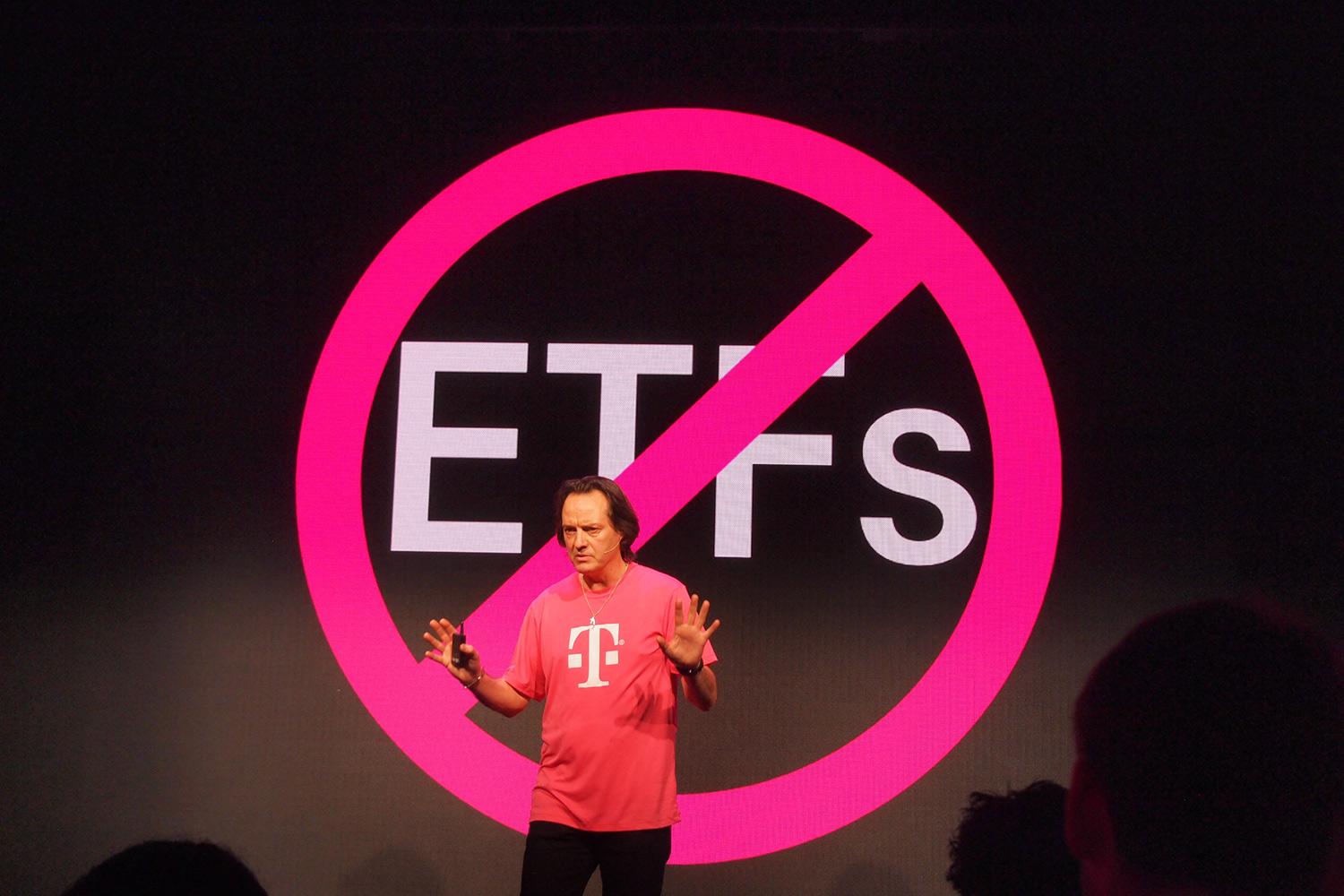
Those customers didn’t appear out of thin air. Most of them likely left AT&T, Sprint, and Verizon. These carriers have already reacted by offering some half-assed contractless options, and if the bleeding continues, policies will only get fairer and subscriptions cheaper. Faster, better service for less money. This is what the fear of losing customers, or real competition – shepherded by no ETFs – will bring.
Carriers may stop trying to limit and sell phones
Without early termination fees and contracts, carriers may also stop holding our phones hostage. Currently, for a phone to make any impact in the U.S., it has to go through a long and expensive appeasement process. Before American carriers will officially offer a model of phone, they force manufacturers to add tons of apps and services, create exclusive models specifically for their carrier, and fiddle with the appearance.
Even T-Mobile is still guilty of requiring custom phones. The Sony Xperia Z1S is a slightly modified version of the Xperia Z1. It has a new camera app feature, more memory, and T-Mobile asked Sony to move the location of the headphone jack by an inch.
The consequences are more expensive phones (the cost of the tweaks gets worked into the cost of the phone) and more consumer confusion. For instance, Nokia’s Lumia 920, 925, and 928 are all essentially the same phone, but you can only get the 920 on AT&T, the 928 on Verizon, and the 925 on T-Mobile (and now some other carriers). Which one do you want? Thanks to the fractured U.S. carrier system, you probably have no choice.
Carriers may also stop holding our phones hostage.
Recent moves by the U.S. government now allow customers to unlock their phones and take them to other carriers (we own them, after all). In a world where customers can freely switch carriers, more phones would work across multiple carriers, and be sold more like every other electronic good.
Because they would have to compete for customers, AT&T and other carriers would be incentivized to open up their networks to let you use phones from other carriers. Thanks to the growth of LTE, which has been almost universally adopted across networks, all phones can be compatible with all carriers fairly easily. If you buy an iPhone to use on Verizon, you should be able to use it on T-Mobile, AT&T and Sprint, too.
Because they would have to compete for customers, AT&T and other carriers would be incentivized to open up their networks to let you use phones from other carriers. Thanks to the growth of LTE, which has been almost universally adopted across networks, all phones can be compatible with all carriers fairly easily. If you buy an iPhone to use on Verizon, you should be able to use it on T-Mobile, AT&T and Sprint, too.
Carriers could still sell phones (lots of them) in their stores, but they wouldn’t need to be branded, stuffed with garbage apps and reconfigured. Remember how carriers used to offer their own app stores inside flip phones? The success of Apple’s App Store ended that, and now iPhone owners on all networks now have access to the same apps. We’re better off with an Apple App Store rather than an AT&T app store, and hardware is heading the same direction.
Times are a changin’
“What we’re going to do is force the industry to change … I want every customer [to be able to switch],” said Legere. He claims 40 percent of families say they would move if someone paid their termination fees, and 70 percent of individual customers.
If he’s right, then T-Mobile’s new plan to pay every other carrier’s early termination fees and give customers the ability to trade in phones for cash may change everything – not overnight, but in the years to come.
With more competition, consumers win. For an industry that has spent more than a decade doing its best to screw customers over and bleed us for money, its exciting to see things moving in a positive direction.
Editors' Recommendations
- T-Mobile just set another 5G speed record
- T-Mobile made a $325 suitcase that you may actually want to buy
- OnePlus 10T pre-orders go live in the U.S., and with a big 5G fix
- T-Mobile just achieved 3Gbps 5G speeds — without mmWave
- T-Mobile wants you to test drive its 5G home internet