“Why you can trust Digital Trends – We have a 20-year history of testing, reviewing, and rating products, services and apps to help you make a sound buying decision. Find out more about how we test and score products.“
A convenient, simple way to enhance the audio from your phone or computer, without worrying about compatibility or brand.
With hi-res music becoming more popular, and smartphones coming with support for the format built-in, more people are taking an interest in how their choice of phone performs in the audio department. LG has recently taken that to the next level with its Hi-Fi Plus module for the G5, a plug-in DAC made in cooperation with Bang & Olufsen. It’s fantastic, but what if you don’t own an LG G5, but want something similar? This is the Chord Mojo, an external DAC and amplifier that works with your phone or computer, regardless of its make.
Regular iTunes tracks sounded far superior to before, with more volume, a far stronger bass kick, and enhanced clarity
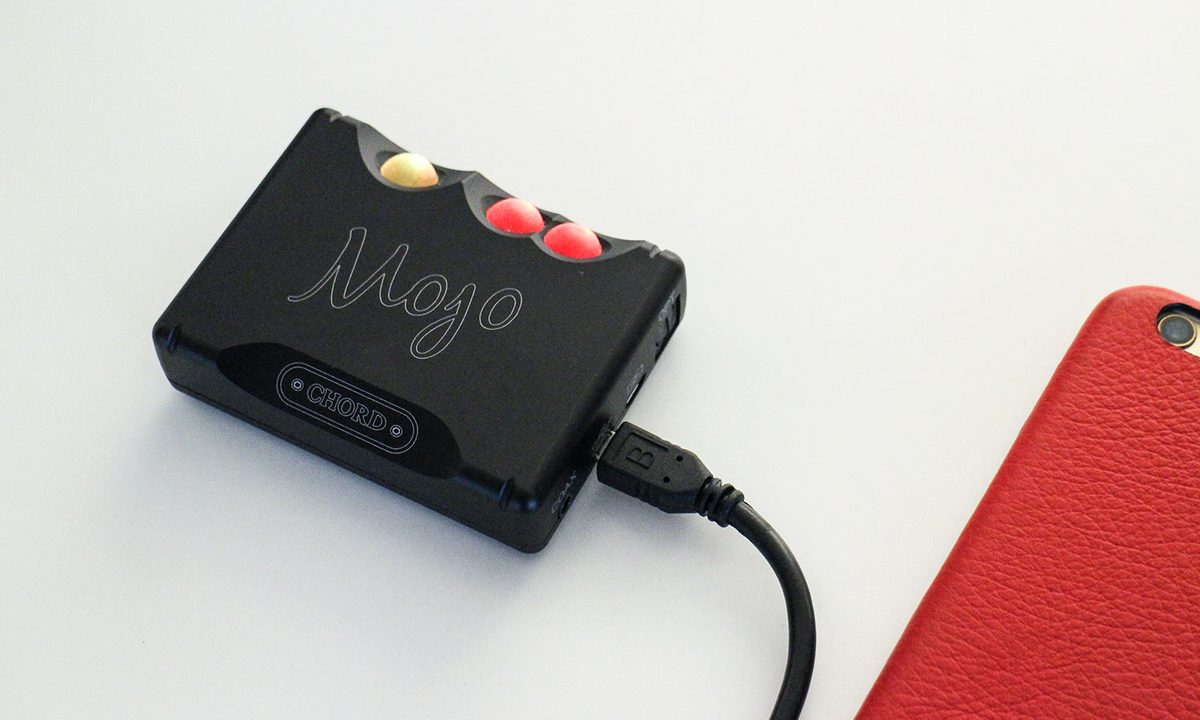
The Mojo isn’t the prettiest phone accessory you’ll buy, but once you get it going, you won’t care. It’s a cigarette-pack sized aluminum metal box, with a variety of inputs and outputs on either end, and three glowing half-dome buttons for adjusting the volume, or powering up the device. These look fantastic, and cycle through colors to indicate volume level and state of the device.
It comes with a Micro-USB connection, but if you buy Apple’s handy adapter cable, it’ll happily plug into your iPhone. Android phones need to support the USB OTG system, something most modern devices will do. Alternatively, you can use a digital coaxial or optical input.
On the opposite end are two 3.5 mm headphone sockets for you and a friend, and Chord’s proud of the fact the little box will take on any pair of headphones, from simple in-ears to high-impedance over-ears that require serious power to operate. It’s the same with file type. It doesn’t care, and will even handle studio-quality 32-bit/768kHz files. Chord designs all the components inside, rather than choosing off-the-shelf parts, for a truly tailored sound.
Transformational sound
We tried the Mojo out in a relatively noisy environment, and decided to go with what we knew rather than use Mojo’s flashier headphones and music output source. An iPhone 6S Plus provided the audio, through a pair of A-Jays Four in-ears. This way, we’d be more aware of any differences in double-quick time. And what a difference it made. Regular iTunes tracks sounded far superior to before, with more volume, a far stronger bass kick, and enhanced clarity. Music was more alive, more vibrant, and seemingly had a wider sound stage.


Because of the amplifier, the Mojo requires power, and rather than draw it from the phone, it has an internal battery that will last for around ten hours before a four hour recharge is needed. Sadly, it doesn’t have the ability to recharge the battery in your phone. The battery does make the Mojo heavier and more bulky than the LG Hi-Fi Plus, but it’s still pocketable — just. Chord makes a clip-on case for the Mojo to keep it safe, and we’d say it’s more suitable for carrying around in a bag.
While trying the DAC out on a computer, with other phones, or different headphones wasn’t possible, the potential of the Chord Mojo was obvious. If there’s a downside, it’s the price, which is $600 or £400 in the U.K., and that’s a substantial amount to spend, regardless of the improvement it brings to audio quality. However, compared to Chord’s larger, reference standard Hugo DAC and amp at $2,500, it’s great value and seems to share many of the same features and technology.
If your smartphone and computer represent your primary music source, and you want to get the best possible sound through your headphones, then the Chord Mojo might be just the device to do it. Provided you don’t mind spending potentially the same as your phone cost in the first place all over again.
Highs:
- Transforms the sound from your phone
- Portable
- Long internal battery life
- Cross-platform, wide file compatibility
Lows:
- Expensive for an accessory