1. Home
  2. Phones
  3. Android
  4. Mobile
  5. News

The Pixel 4’s coolest new feature means you don’t have to touch it

Add as a preferred source on Google

When Apple introduced Face ID on the iPhone X in 2017, many other companies were quick to launch their own version of the facial-recognition technology. Now, however, it looks like Google will include not only facial recognition on the Pixel 4, but will take it a step further by including gesture-based controls, essentially meaning that you can use the phone without even touching it.

Google showed off the tech in a new video posted to Twitter, and in a blog post in which a user can be seen unlocking the phone, then waving her hand to skip through songs on a playlist. This kind of tech could come in handy when your hands are dirty and you don’t want to touch your phone.

Recommended Videos

Look internet, no hands. #Pixel4 Learn more https://t.co/PYY0AFcnyI pic.twitter.com/f9v51VbXWd

— Made by Google (@madebygoogle) July 29, 2019

According to the blog post, the tech is based on Project Soli, Google’s research into radar-based gesture controls. Project Soli tech hasn’t yet been included on any phones or smart devices, so the Pixel 4 could end up being the first. Because it’s based on Project Soli, it could be leaps and bounds better than previous gesture-based controls we’ve seen, such as on the LG G8 ThinQ, which had hand-motion gestures that many argued rarely worked and didn’t really add to the experience of using the phone.

Google has reportedly been working hard on its facial-recognition tech. According to a report from Android Police, Google employees have been giving $5 gift certificates to people in exchange for a facial scan. The idea here is to make sure that the facial-recognition tech can work with a diverse range of faces.
Google

One of the advantages of Project Soli is that it can sense when you’re reaching for the device, proactively turning on the facial-recognition tech, and cutting seconds off the unlocking process.

Google has slowly been teasing details of the Pixel 4 before its expected launch in October. The company tweeted an image of the back of the phone in June, confirming leaks showing a glass back and square camera bump.

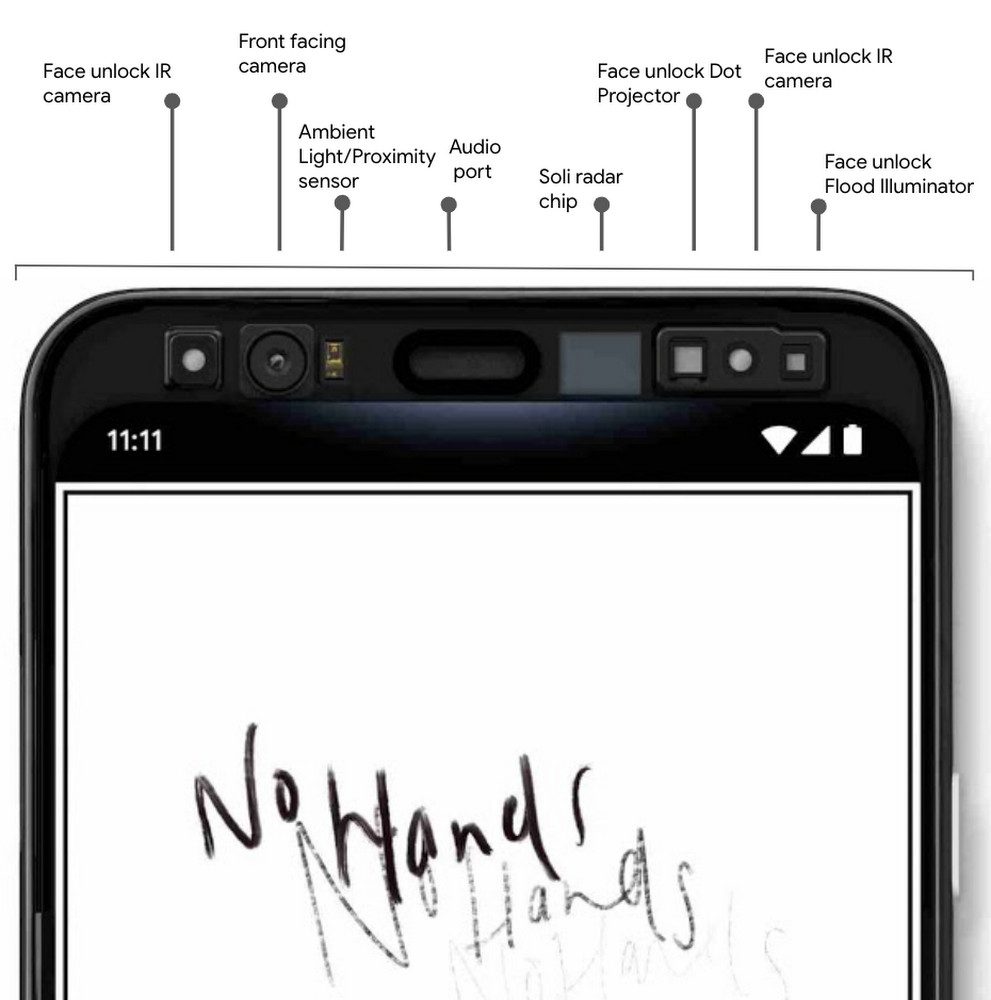
The blog post also shows some aspects of the design — in the post, Google shows the sensors needed for Project Soli, which take up much of the forehead of the device. Sensors include the Soli radar chip, as well as infrared cameras and dot projectors for facial recognition. Google says that the facial-recognition technology is processed on the device, making for a more secure experience.

The design of the Pixel 4 is in stark contrast to the Pixel 3 XL, which had a large notch that wasn’t very well-received because of its size.

Christian de Looper
Christian de Looper is a long-time freelance writer who has covered every facet of the consumer tech and electric vehicle…
A US state just approved an AI doctor. For now, it’ll only prescribe acne cures.
Aside from acne, Nolla's AI can also handle redness, fine lines and wrinkles, hyperpigmentation and dark spots, and under-eye bags.
Nolla Derm AI doctor app.

The first AI doctor is here. Despite all the skepticism and risks associated with AI models going haywire, the state of Utah just approved Nolla Health, a company that is providing an AI healthcare expert capable of writing prescriptions without any human in the chain. For now, it will only write acne prescriptions for Utah residents over 18 years of age, willing to pay a token monthly subscription fee that's lighter than your Spotify bill.

The big push here is that the Nolla Derm app will reduce the costs of medical consultation, save users the hassle of clinic visits, and take out the problem of waitlisting from the entire healthcare equation. “Unlike telehealth platforms that use AI only to collect information before handing patients off to clinicians, Nolla's AI system is designed to independently issue initial prescriptions within tightly defined, physician-approved treatment protocols,” writes the company. 

Read more
Google may be teaching Pixel Search to think one step ahead
Pixel Search could soon help finish the job after finding what you need
Electronics, Mobile Phone, Phone

Google ships its phones with Pixel Search that is built to save you from digging through your phone to find an app, email, photo, and more. Now, it appears to be taking this process even further by trying to figure out what you want to do with the results.

An APK teardown of Pixel Search version 1.0.983036833 by Android Authority has uncovered an unreleased feature called Gemini-powered suggestions. Strings inside the app describe it as a way to surface relevant information alongside Gemini-suggested actions that can help you “finish a task faster.”

Read more
Not sure if a Prime Day deal is legit? Malwarebytes has a free link checker to verify it
Scam Link Check analyzes URLs for phishing pages, redirects, and newly registered domains.
Online Scam Fraud MacBook

Amazon Prime Big Deal Days is about to kick off, which means shoppers are going to see plenty of emails, texts, ads, and social posts promising limited-time discounts. Scammers know the drill too. Fake shopping sites can now copy familiar brands, recreate convincing storefronts, and use AI-generated images or polished copy to make a bad link look legitimate at first glance.

Malwarebytes has launched Scam Link Check, a free tool for checking a questionable URL before opening it. Paste in an address and the service analyzes where it leads and looks for signs that something is wrong.

Read more