It’s been a busy few days at the Snapdragon Summit. Amidst all the silicon reveals, new partner hardware showcases, and, of course, plenty of futuristic promises, I managed to get an early look at the company’s latest mobile technologies. The most intriguing among them turned out to be Qualcomm’s next-gen approach to AI-powered gaming. Look, I know, AI and gaming are a controversial combination, but hear me out on this one.
The Snapdragon 8 Elite Extreme Gen 6 brings Adreno Neural Fusion (ANF) to Qualcomm’s mobile gaming stack, but here’s the interesting part: the company isn’t positioning it as a simple copy of NVIDIA’s DLSS or AMD’s FSR. The underlying idea will be familiar to PC gamers, which broadly entails rendering fewer pixels and using AI reconstruction to produce a higher-resolution image.

But Qualcomm is putting equal emphasis on power efficiency and sustained performance, two particularly important considerations when all that GPU horsepower has to live inside a smartphone. That doesn’t mean DLSS and FSR are purely about chasing uncapped frame rates, either. They are already valuable on power- and thermally constrained gaming laptops and handhelds. Qualcomm’s approach is better viewed as a different set of priorities for mobile gaming, where reducing the rendering workload could mean not just more frames, but less power consumption, lower heat and longer sustained performance.
The clever bit is rendering less
Qualcomm’s team explained the concept using an example that makes the potential advantage fairly easy to understand. Imagine a mobile game running at 60 frames per second while rendering at 1080p. Instead of asking the GPU to produce every one of those 1080p frames natively, ANF could allow the game to render at 540p and use AI reconstruction to produce a 1080p output.
“At a given FPS, if you are rendering the game at, let’s say, 1080p at a given power, now with upscaling and frame gen, I can do 540 and upscale to 1080, at better quality than the native.”
The important bit here is the workload reduction. A 540p frame contains only around a quarter of the pixels of a 1080p frame, meaning the conventional rendering workload can be substantially reduced. Qualcomm’s dedicated AI hardware can then take over the reconstruction process, potentially allowing the same target frame rate to be achieved using less power.
That could be particularly useful on phones where gaming performance is often limited not by what the silicon can do for a few minutes, but by how long the device can keep doing it before heat becomes the enemy. This also connects directly with my earlier conversation with Qualcomm’s Lekha Motiwala, where the company stressed the importance of sustained performance rather than short benchmark bursts.
But can 540p really look like 1080p?
This is where Qualcomm’s claim deserves a little scrutiny. Temporal reconstruction can absolutely improve image quality, particularly by producing cleaner edges and reducing some forms of aliasing. But asking an AI reconstruction system to turn a 540p source into a 1080p output is still an aggressive four-to-one pixel jump.

In fast-moving games, that can potentially introduce familiar reconstruction problems such as ghosting, motion artifacts, or excessive sharpening. Qualcomm’s claim that the reconstructed image can look better than native rendering is therefore something that needs to be judged across a much broader range of games, rather than accepted purely based on a controlled demonstration.
In my own hands-on testing of ANF, I didn’t notice obvious artifacts, and the resulting image quality did look better than I expected from the underlying resolution. But that was still an isolated demonstration. The real test will be seeing how the technology behaves across different engines, lighting conditions, and, particularly, chaotic high-motion gameplay.
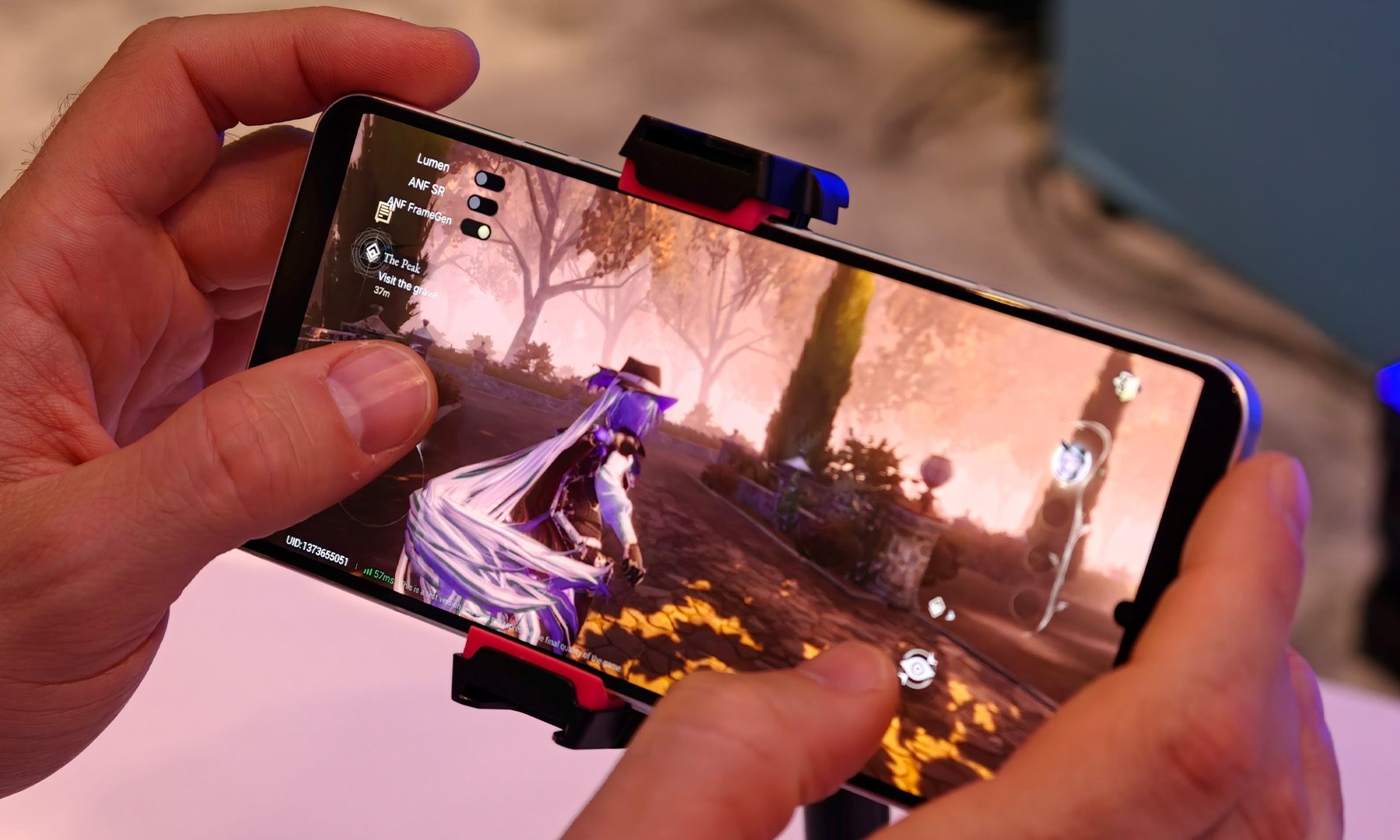
Fortunately, Qualcomm says ANF support isn’t limited to a single showcase. The company has confirmed a number of titles that will support the technology, including Where Winds Meet and Ananta. I’m particularly interested in seeing how the latter handles AI reconstruction once there’s a proper retail implementation to test rather than a controlled demonstration.
The GPU is doing some of the AI heavy lifting
There’s a hardware trick making all of this possible, too. The Snapdragon 8 Elite Extreme Gen 6 adds Adreno Matrix Cores, which Qualcomm describes as AI-dedicated GPU cores, alongside Adreno Neural Fusion and 18MB of dedicated Adreno High Performance Memory. In other words, the GPU gets its own AI muscle, allowing techniques such as super resolution and frame generation to work closer to the graphics pipeline instead of leaving all the AI heavy lifting to the NPU.

That matters, because a smartphone can’t simply brute-force its way through a demanding game. There’s no giant cooler, no wall socket, and very little room for extra heat. Qualcomm’s approach is therefore less about chasing another shiny benchmark number and more about finding smarter ways to spend the performance and power budget. If ANF can make fewer rendered pixels look good enough while keeping frame rates high and temperatures in check, that could be a much more useful upgrade than simply making the GPU faster.
The interesting question, then, isn’t whether Adreno Neural Fusion is Qualcomm’s version of DLSS. It’s whether Qualcomm can make AI-assisted rendering good enough that gamers stop caring about how the frame was produced in the first place. If it can deliver convincing image quality while reducing the GPU workload and keeping frame rates stable for longer, that’s a pretty compelling trick for a device that also has to survive being a phone.