
On a sultry summer afternoon in June 2021, India’s richest man, Mukesh Ambani, the CEO of Indian telecom giant Jio, announced a product nearly a year in the making. What made the announcement special was a brief appearance by Google CEO Sundar Pichai during the webcast. The duo would go on to announce the JioPhone Next — an affordable, full-featured Android smartphone co-developed by Jio in partnership with Google.
The JioPhone Next was touted as the best thing to ever happen to affordable phones and had the potential to revolutionize the Indian smartphone sector — a claim that did not entirely lack merit. After all, it had the backing of two billion-dollar corporations — both of which not only had access to the best technology available but also had the financial muscle to pull off something like this.
Jio initially intended to ship the phone by September 10, but eventually moved the availability date to late October. However, when the phone did launch, the pricing was not as disruptive as everyone thought it would be.
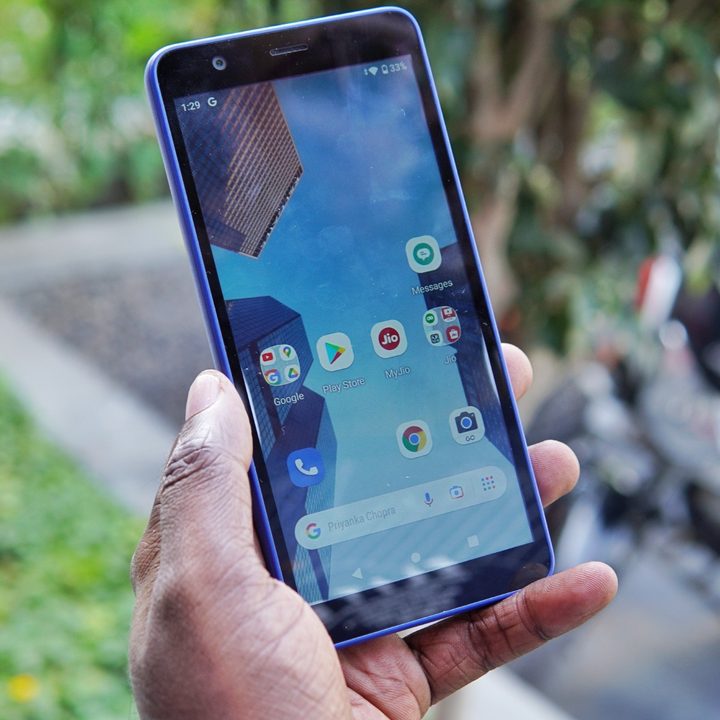
My colleague, Tushar Mehta, penned a brief explainer outlining the several challenges JioPhone Next faces in India. Even as the discussion over the JioPhone rages on, I thought now would be a good time to focus on the actual device in question. I got to spend a few hours with the JioPhone Next last week, and here are my initial impressions of the device.
Not much to look at
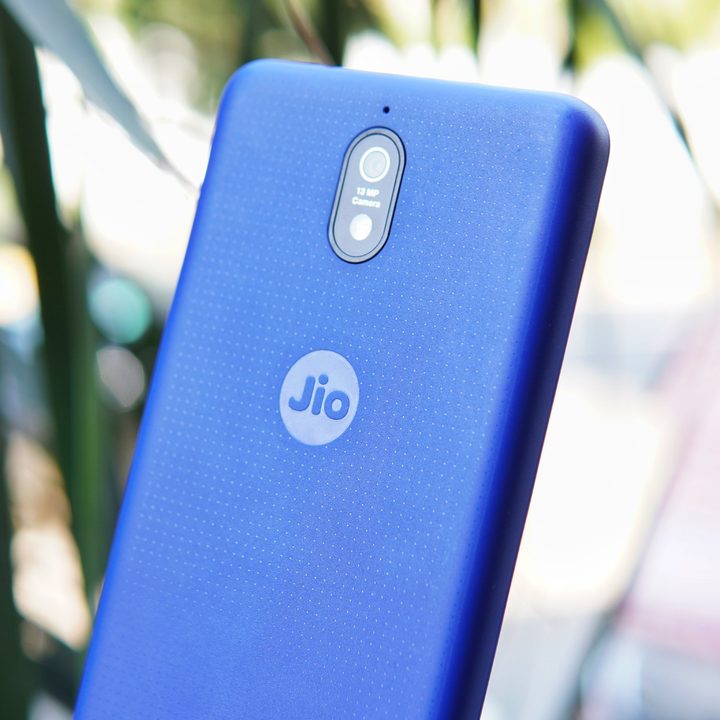
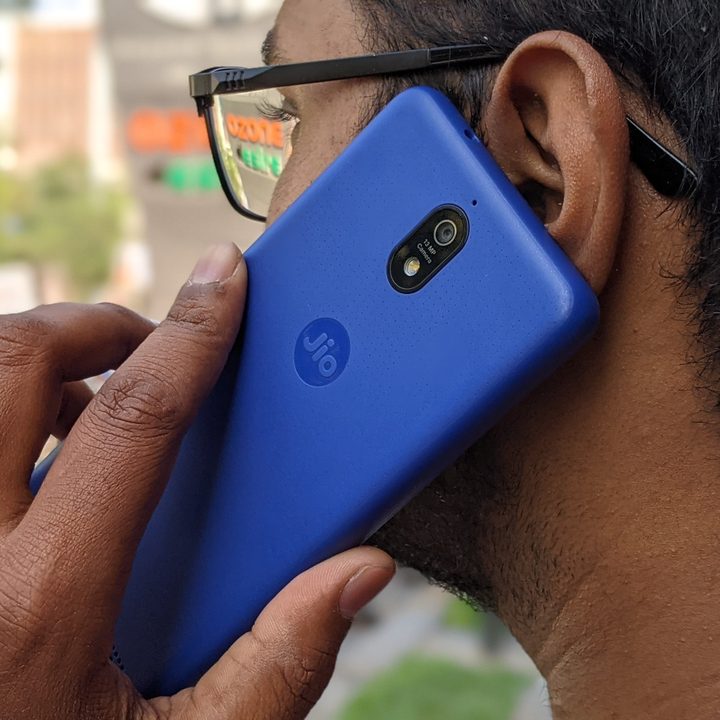
The JioPhone Next is quite unassuming to look at. Given its humble price tag (more on that below), this is hardly surprising. The phone quickly reminded me of Nokia’s Asha series feature phones from the mid-2010s. Apart from the blue color variant seen here in the pictures, Jio also offers the JioPhone Next in black. The body is made of polycarbonate and has a dotted pattern across the rear panel.
The JioPhone Next features a 5.45-inch IPS LCD panel that supports a resolution of 720 x 1440 pixels. The spec sheet also mentions that the display is protected by Gorilla Glass 3 — which I did not expect at this price point. The LCD credentials notwithstanding, I quickly noticed that the colors on the screen seemed a bit washed-out. The display is fine for indoor use and problems only arise when using it outdoors. Then again, I shouldn’t really be nitpicking about this since most JioPhone Next users would have upgraded from a feature phone.
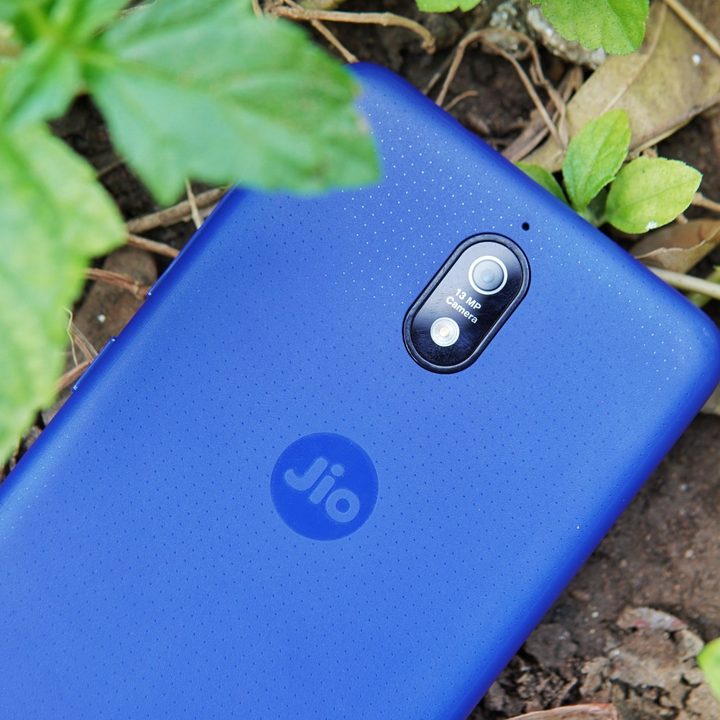
For a phone this affordable, the JioPhone Next has very good build quality. Since the device primarily targets first-time smartphone buyers who are upgrading from a feature phone, Jio has also made a conscious decision to ship the device with a removable rear panel and an exposed, removable battery. When was the last time you saw one?
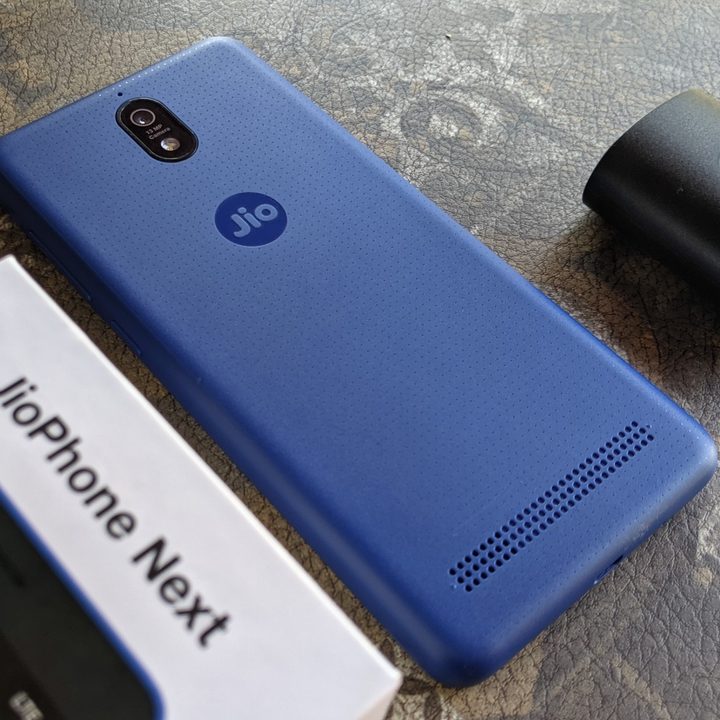
This also means you will need to open the back panel to access the dual SIM slot and the separate microSD card slot. During my brief time with the phone, I found all the physical buttons to offer good tactile feedback. To summarize, the JioPhone Next did not come across as a flimsy product and should last for quite some time if you treat it well.
Hardware
Even with its affordable price tag, the JioPhone Next doesn’t skimp on the basics. It gets a decent 8-megapixel front-facing camera with autofocus, a respectable 13MP rear camera, and a 3.5mm port for audio connectivity. The phone, unsurprisingly, uses the micro-USB standard for charging and wired connections. It also supports the USB OTG standard for attaching peripherals like a mouse, keyboard, or a pen drive.
Powering the JioPhone Next is the entry-level Qualcomm Snapdragon 215 chipset, coupled with 2GB of LPDDR3 RAM. Internal storage is limited to 32GB, with the option to add a microSD card. The removable battery has a rated capacity of 3,400mAh, and the phone ships with a 7.5-watt charger in the box.
Connectivity options on the phone aren’t too bad, either. While it does support dual SIM cards, the primary SIM slot is locked to Jio’s own 4G network — which is understandable given that this is a Jio-branded phone. However, what is perplexing is that Jio prevents users from accessing mobile data if they slide in a SIM card from a different carrier in the second slot. The JioPhone Next supports Wi-Fi b/g/n, AGPS, and Bluetooth v4.1 and also gets a 3.5mm port for audio connectivity. It was heartening to see that Jio decided to equip the phone with an accelerometer as well.
Software, user interface, performance
The JioPhone runs a customized version of Android called Pragati OS, which literally translates to progress. While many of us expected PragatiOS to be a completely new OS based on Android, it was somewhat underwhelming when we figured that it was just a rebranded version of Android Go. To Jio’s credit, the phone did ship with optimized versions of the most commonly used apps and runs Android 11.
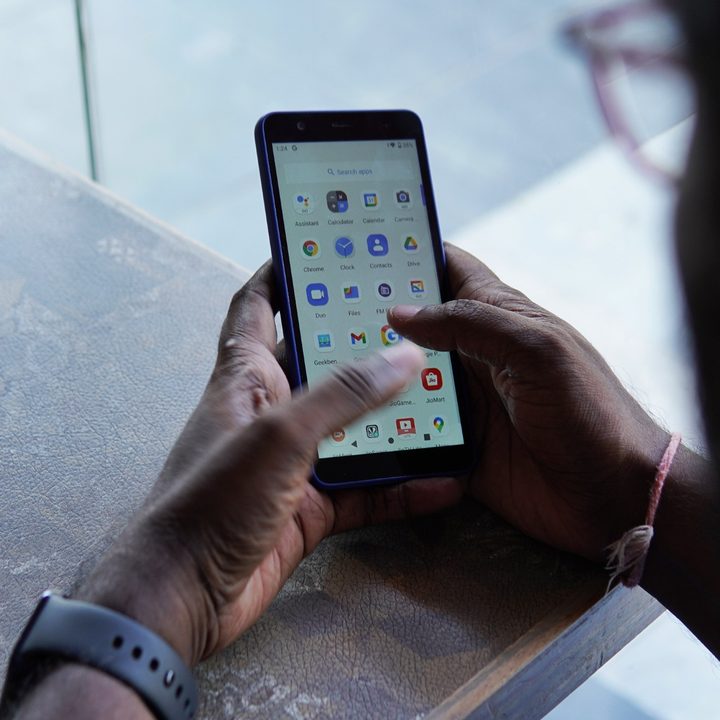
The UI is close to stock Android with several India-centric optimizations. Given that a large number of JioPhone Next users will not be comfortable with English, the phone supports several Indian languages. Google chips in here with quick translation options from English to several Indian languages, along with excellent Google Lens and Google Translate integrations within the system UI. The translation feature lets users translate any text displayed on the screen to 10 supported languages. Users also get the option to make the phone read out loud any test on the screen in their language.
Given Jio’s claim that the JioPhone Next was developed in close cooperation with Google, I expected the JioPhone Next to offer an optimized user experience — you know, devoid of UI stutter, lag, and general performance issues. After using the phone for as long as I did, it felt like I overestimated Google’s optimizations to cover for what’s lacking in the hardware.
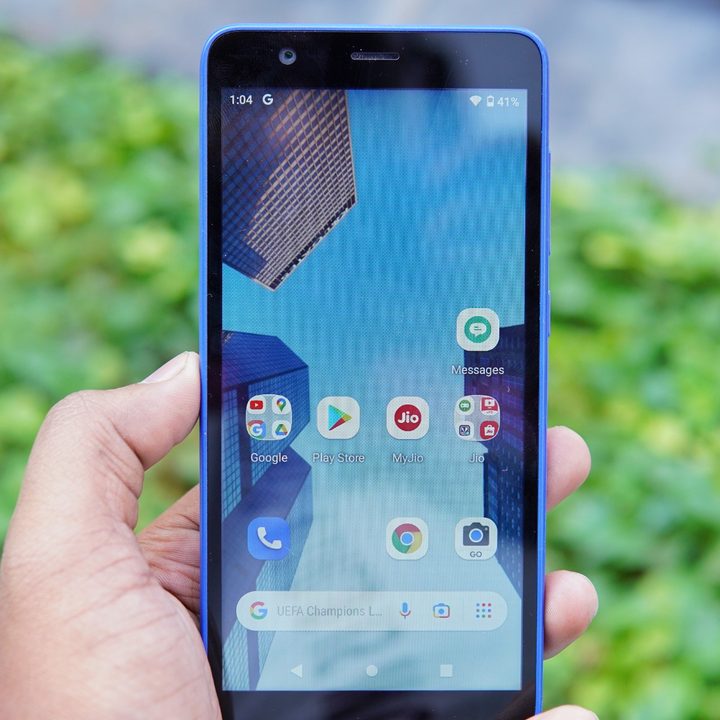
Do not get me wrong. The JioPhone Next is a very usable phone. But it is simply not designed for anyone who’s used an Android smartphone before — let alone a smartphone enthusiast like yours truly. As outlined earlier, the target audience is the 300-odd-million people in India who — unbelievable as it may seem — still use feature phones connected to 2G networks. For many of them, the JioPhone Next would be their first-ever experience with a smartphone, Android, and the internet.
Simply put, this phone is not intended to be capable of multitasking or playing games. Instead, it is designed as a capable content consumption device and an educational tool in some cases.
Camera
Google has achieved incredible things with computational photography on the Pixel series, and I really wanted some of that magic to trickle over to the JioPhone Next. Amazingly, Google and Jio have certainly managed to do a good job here, and seem to have spent a lot of time optimizing the camera. Both the front (13MP) and rear (8MP) cameras on the JioPhone Next output good, shareable images that are better than that of most other phones in its price range in India.
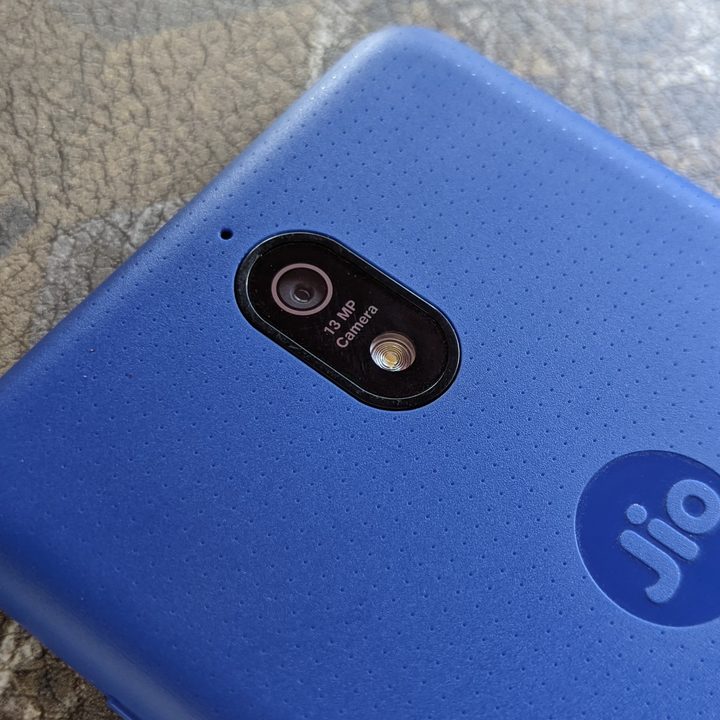
The camera app was also well-designed with easy-to-use menus and features like portrait mode, night mode, HDR, and even Snapchat integration — which seemed a bit out of place on a device that primarily targets rural India. I was not able to use the phone long enough to be able to capture lowlight shots, though.
Pricing
Jio’s strategy in India ever since its inception in 2016 has been simple: Outprice the competition, disrupt the market, and dominate. Except for this time, with the JioPhone Next, it entered a market that has already been through this disruption phase.
The prices of low-cost smartphones in India are already among the lowest in the world, and Chinese brands like Xiaomi and Realme dominate the space. Both these companies already sell excellent low-cost handsets that cost nearly the same as the JioPhone Next.
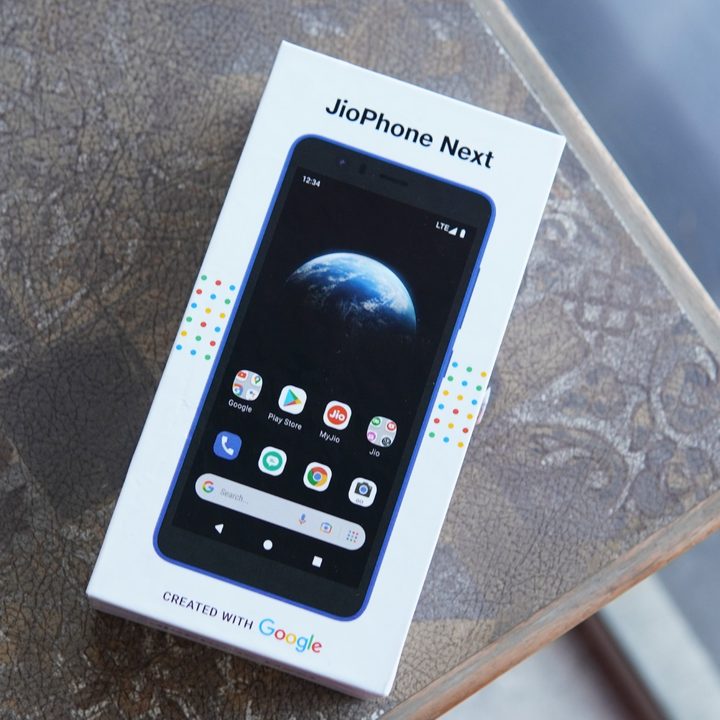
Currently, anyone can buy a JioPhone Next by paying 6,499 rupees ($86) upfront and then use any existing Jio prepaid plan they wish to. But the phone will still be locked to Jio, and they would not be able to use the second SIM card for data on other carriers. As Mehta points in his article, this goes entirely against the nature of the Indian market, where people are used to buying carrier-unlocked smartphones.
The second and supposedly more affordable option brings down the initial down payment to 2,500 rupees ($33) — which includes a processing fee of 501 rupees. Buyers then get the option to club the payment for their phone with their monthly data plan. But as many Twitter users pointed out, the total cost of ownership of the JioPhone Next appears to be simply too expensive for the demographic it targets.
Here's a quick calculation of #JioPhoneNext ownership cost along with plan benefits. #CPInsights pic.twitter.com/55jcgybNqR
— Ritesh Bendre (@GadgetFreak4U) October 29, 2021
Rough competition
Most of the devices that compete against the JioPhone Next are only marginally more expensive while also offering objectively better hardware. Take the Xiaomi Redmi 9A, for example, which at 7,299 rupees ($96) is only slightly more expensive than the JioPhone Next.
What you get for the marginally higher price includes a larger display, a much bigger battery, and a faster MediaTek Helio G25 processor. The Xiaomi Redmi 9A does not fare too badly in the camera and software department either. For those who cannot buy the phone upfront, Xiaomi also offers EMI options. The Redmi also offers users the freedom to use any carrier of their choice.
Our take
A month since its launch, the general consensus among people seems to be that the JioPhone Next should have been launched for a much lower price tag — and with less expensive monthly plans. Unfortunately, in a market where prices are already at the lowest possible levels, this seems a bit too much of an ask — even with the combined might of Jio and Google behind it.


