The LG V40 ThinQ is to the LG G7 ThinQ, as Samsung’s Galaxy Note 9 is to the Galaxy S9: Bigger, more expensive, and packing a few extra features. The V in LG’s V Series phones stands for video, but that’s not the only thing that sets these two phones apart.
If you’re shopping for a new smartphone, you like LG, and you’re wondering whether to go for the V40 or the G7, then we’re here to help. Perhaps you’re weighing up whether to upgrade from the G7 to the V40 — we can help you there, too.
Specs
| LG V40 ThinQ |
LG G7 ThinQ | |
| Size | 158.7 x 75.7 x 7.7mm (6.25 x 2.98 x 0.30 inches) | 153.2 x 71.9 x 7.9 mm (6.03 x 2.83 x 0.31 inches) |
| Weight | 169 grams (5.96 ounces) | 162 grams (5.71 ounces) |
| Screen size | 6.4-inch P-OLED | 6.1-inch IPS LCD |
| Screen resolution | 3120 x 1440 pixels (537 pixels per inch) | 3120 x 1440 pixels (564 pixels per inch) |
| Operating system | Android Oreo 8.1 | Android 8.0 Oreo |
| Storage space | 64GB | 64GB, 128GB |
| MicroSD card slot | Yes | Yes |
| Tap-to-pay services | Google Pay | Google Pay |
| Processor | Qualcomm Snapdragon 845 | Qualcomm Snapdragon 845 |
| RAM | 6GB | 4GB, 6GB |
| Camera | Triple-lens 12MP (with OIS) and 16MP wide and 12MP telephoto rear, dual 8MP and 5MP wide front camera | Dual lens 16MP (with OIS) and 16MP wide-angle rear, 8MP front camera |
| Video | 4K at 60 fps, 1080p at 240 fps | 4K at 30 fps, 1080p at 60 fps, 720p at 240 fps |
| Bluetooth version | Bluetooth 5.0 | Bluetooth 5.0 |
| Ports | USB-C 2.0 | USB-C 1.0 |
| Fingerprint sensor | Yes (back) | Yes (back) |
| Water resistance | IP68 | IP68 |
| Battery | 3,300mAh
Fast charging (Qualcomm Quick Charge 3.0) Qi wireless charging |
3,000mAh
Fast charging (Qualcomm Quick Charge 3.0) Qi wireless charging |
| App marketplace | Google Play Store | Google Play Store |
| Network support | T-Mobile, AT&T, Verizon, Sprint | T-Mobile, AT&T, Verizon, Sprint |
| Colors | Aurora Black, Moroccan Blue | Aurora Black, Platinum Gray, Raspberry Rose, and Moroccan Blue |
| Price | $900+ | $650+ |
| Buy from | LG | LG, Buy Now , Best Buy |
| Review score | 3.5 out of 5 stars | 3.5 out of 5 stars |
Performance, battery life, and charging

Both the G7 ThinQ and the V40 ThinQ rely on Qualcomm’s Snapdragon 845 processor which ensures fast and smooth performance. The V40 ThinQ backs that up with 6GB of RAM and 64GB of storage, while the G7 has 4GB of RAM in the 64GB model and 6GB of RAM in the 128GB model. You can expand the storage in both of these phones with a MicroSD card.
There’s fast charging and wireless charging out of the box with these phones, so there’s no dividing them there. The V40 has a slightly larger battery, but it also has a slightly larger screen, so we think battery life will be similar and you’ll probably need to charge your phone daily whichever one you pick.
Winner: Tie
Design and durability

We were a little disappointed when LG embraced the notch in the G7 ThinQ, and the notch in the V40 suggests that it’s here to stay. The V40 ThinQ is the taller and wider of these two phones, though it does manage to be a touch more svelte than the G7. Both have a metal frame and a curved glass back with a fingerprint sensor in the middle of it. They’re clearly part of the same family, but you can see an important difference right off the bat: The V40 ThinQ boasts three lenses in its main camera to the G7’s two.
Drop either of these phones and you’re going to run the risk of cracked glass and a scuffed metal chassis. Cases are a smart move. Water need not provoke any concerns, though, as both phones are IP68 rated, which means they can survive in water up to a meter and a half deep for 30 minutes without any signs of permanent damage.
Winner: Tie
Display

It has taken a while to hit upon a meaningful difference, but the OLED screen in the V40 is clearly superior to the LCD screen in the G7. The shape of these wide screens is very similar and they both have a 3120 x 1440-pixel resolution. That actually means the G7’s screen is a touch sharper, because it’s smaller, but we think the advantage of OLED tech far outweighs that detail. There are good reasons why all the top manufacturers are employing OLED in their phones now including the fact that it’s thinner, offers better refresh rates, and delivers higher contrast with true blacks.
Winner: LG V40 ThinQ
Camera

The headline feature for the LG V40 ThinQ is the camera. There are five lenses in the two cameras that the V40 ThinQ has and they’re packed with tricks. You’ll find a 12-megapixel main lens with larger pixels for improved low-light performance and optical image stabilization (OIS). It’s flanked by a 16-megapixel wide-angle lens and a 12-megapixel telephoto lens. That means you can still shoot wide photos when there is a lot to pack in, but it should also mean you can take better portrait shots with the bokeh effect blurring the background or zoom in on subjects that are far away. The front-facing camera pairs an 8-megapixel lens with a 5-megapixel wide-angle lens — a setup you’ll appreciate if you take a lot of group selfies.
By contrast, the LG G7 ThinQ pairs two 16-megapixel lenses, one with OIS, and the second with wide-angle support. It’s a solid performer, as we recently found out in a shootout with the S9 Plus. The G7 makes do with a single 8-megapixel lens in its front-facing camera.
Not only is the hardware in the V40 better and more versatile, but you’ll also find some neat tricks in the software, especially if you love to shoot video. One of our favorite new features is the cinemagraph support, which enables you to take video where a single spot is animated and the rest is frozen like a photograph. While there’s a gimmicky feel to some of this stuff, and it may be used once and forgotten by the average person, if you’re into shooting video, the V40 should delight you.
Winner: LG V40 ThinQ
Software and updates
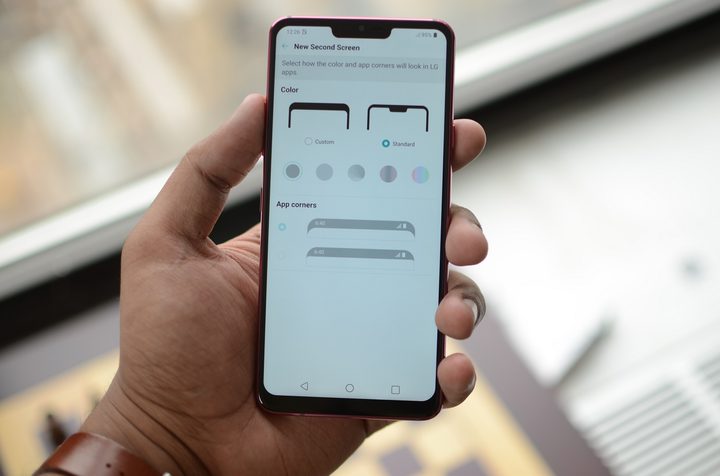
The LG G7 ThinQ shipped with Android 8.0 Oreo while the LG V40 ThinQ is shipping with Android 8.1 Oreo. They will both get upgraded to Android 9.0 Pie, but we don’t know how long that will take. With LG’s interface on top of Android, you’ll find the experience of using these phones very similar. Since they came out around the same time, we don’t expect to see much difference in terms of future updates or support longevity.
Winner: Tie
Special features

The camera and some of the video tricks and filters are what sets the LG V40 ThinQ apart. As we said in the camera section, if you love to make videos, the V40 has been designed with you in mind.
Winner: LG V40 ThinQ
Price
While you’ll need at least $900 to snag an LG V40 ThinQ, the Buy Now has recently dropped in price and can be picked up for $650 if you shop around. Both phones have wide carrier support, so you shouldn’t have any trouble using them on any network or buying one on a contract.
Overall winner: LG V40 ThinQ
The triple-lens camera and the OLED screen elevate the V40 ThinQ above the G7 ThinQ. The fact that LG is asking for a big premium to secure those advantages might give you pause, but there’s no doubt that the V40 is the better phone.