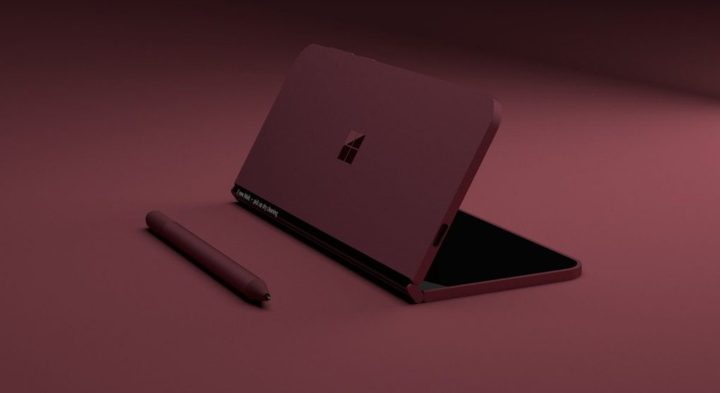
The computing world has been buzzing over Microsoft’s unannounced two-screen “Andromeda” project for ages — but multiple sources suggest the project is on hold indefinitely.
“Multiple sources have told me that Microsoft plans to overhaul the software and hardware before releasing the device. At this time, the software and hardware do not create a compelling solution that would move the needle for Microsoft and more importantly the Surface brand which is why when it came to the ‘go, no go’ decision earlier this year, it was not given the green light,” reported well known tech enthusiast Paul Thurrott on Friday. This report expands on an earlier, similar tale from ZDNet, in which Mary Jo Foley cited unnamed sources and said software components and services used by Andromeda would not be included in the next Windows 10 feature release, aka Redstone 5, slated to arrive in October.
The Andromeda components may not arrive in Redstone 6 (or whatever it’s called) either.
Sources claim Microsoft put Andromeda on ice over scheduling and quality. Given the company split up its Windows engineering team to better focus on artificial intelligence and cloud computing, the new Windows team will be building “experiences” based on those platforms. That also means retooling current software and services to take advantage of those platforms.
The problem with Andromeda is that it had no real target audience, and even if it were to hit the market, it would be sold at a price that wouldn’t be attractive to whatever market it does find. It was on a path to become a device “in search of an audience,” thus Microsoft currently sees no compelling reason to launch a dual-screen device.
Another problem with Andromeda is that it reportedly didn’t have a supporting app ecosystem. Given Andromeda would still be based on Windows Core, that means developers would need to re-tool their apps to accommodate a two-screen device or create new apps from scratch. Right now, third-party manufacturers could build a Windows-based Andromeda device, but it wouldn’t include Microsoft’s Andromeda-based software and services.
A recent prototype revealed that Andromeda included telephony components. The two-screen book-style form factor seemingly aimed to transform the smartphone market much like the original Apple phone did in 2007, but apparently, that is not the case at all. Sources said Microsoft never had any intention to enter Andromeda into the smartphone market to compete with Apple and Google.
The latest wave of “leaks” indicated that Andromeda would arrive by the end of the year sporting the Surface brand. In fact, one leaked document said the disruptive “new pocketable Surface device form factor” would provide a personal and versatile computing experience based on “innovative new hardware and software experiences.”
Even more, another leak revealed Andromeda would have five modes depending on how the screens are oriented via the 360-degree hinge: Closed, flat, convex, concave, and full. In a flat position, the two screens would come together as a tablet while convex would be similar to “tent mode” on 2-in-1s. Concave would serve as your typical laptop mode while full mode would see the two screens’ backs touching each other. To put the device to sleep, simply close it by touching the faces together.
What’s interesting about all this Andromeda talk is the sheer amount in 2018 alone. Based on all the leaked information, an official reveal looked promising at the end of 2018 along with new Surface devices and Redstone 5’s launch (likely called November 2018 Update). But given that Microsoft is putting Andromeda on hold indefinitely, someone or some group is apparently trying to save the project, generating hype. Maybe Microsoft itself is “leaking” the information just to evaluate consumer response.
Talk of Andromeda isn’t exactly new. Rumors of the device appeared in 2015 as Microsoft reportedly dumped an earlier phone project to create a “disruptive” device. It would be an entirely new design built by the Surface team and led by Microsoft hardware lead Panos Panay.
Updated on June 15: Added new Thurrott report confirming ZDNet report.